

Relying on reactive dispute resolution is the costliest way to manage an Australian enterprise. When your leadership team is managing intricate Modern Award frameworks, shifting penalty rates, and strict federal compliance thresholds, administrative uncertainty quickly drains executive focus and commercial momentum. Most corporate leaders recognise that keeping pace with constant industrial updates is demanding, particularly when unaddressed payroll classifications or procedural missteps expose the business to severe penalties. Engaging an experienced workplace relations advisory australia partner replaces that vulnerability with steady, structured governance designed for operational clarity.
Through this guide, you'll gain a clear operational framework to manage employment obligations, ensure award compliance, and maintain workplace stability across your Australian operations. We examine defensible people management frameworks that resolve workforce friction methodically, eliminate award classification ambiguity, and safeguard commercial continuity through structured advisory support. You will find the practical steps required to align daily operations with national standards and maintain lasting organisational order.
Key Takeaways
- Engaging an independent workplace relations advisory australia partner establishes structured operational alignment with National Employment Standards and statutory obligations.
- Prioritising preventative compliance governance over reactive industrial disputes preserves commercial capital and insulates executive teams from unnecessary operational disruption.
- Reviewing Modern Award classifications methodically resolves administrative ambiguity and protects your business from systemic underpayment risks.
- Implementing structured, defensible people management frameworks provides leadership with transparent procedures to defuse workplace friction objectively.
- Connecting compliance guidance with employee retention research cultivates an enduring organisational culture focused on operational continuity and workforce stability.
Understanding Workplace Relations Advisory in the Australian Regulatory Environment
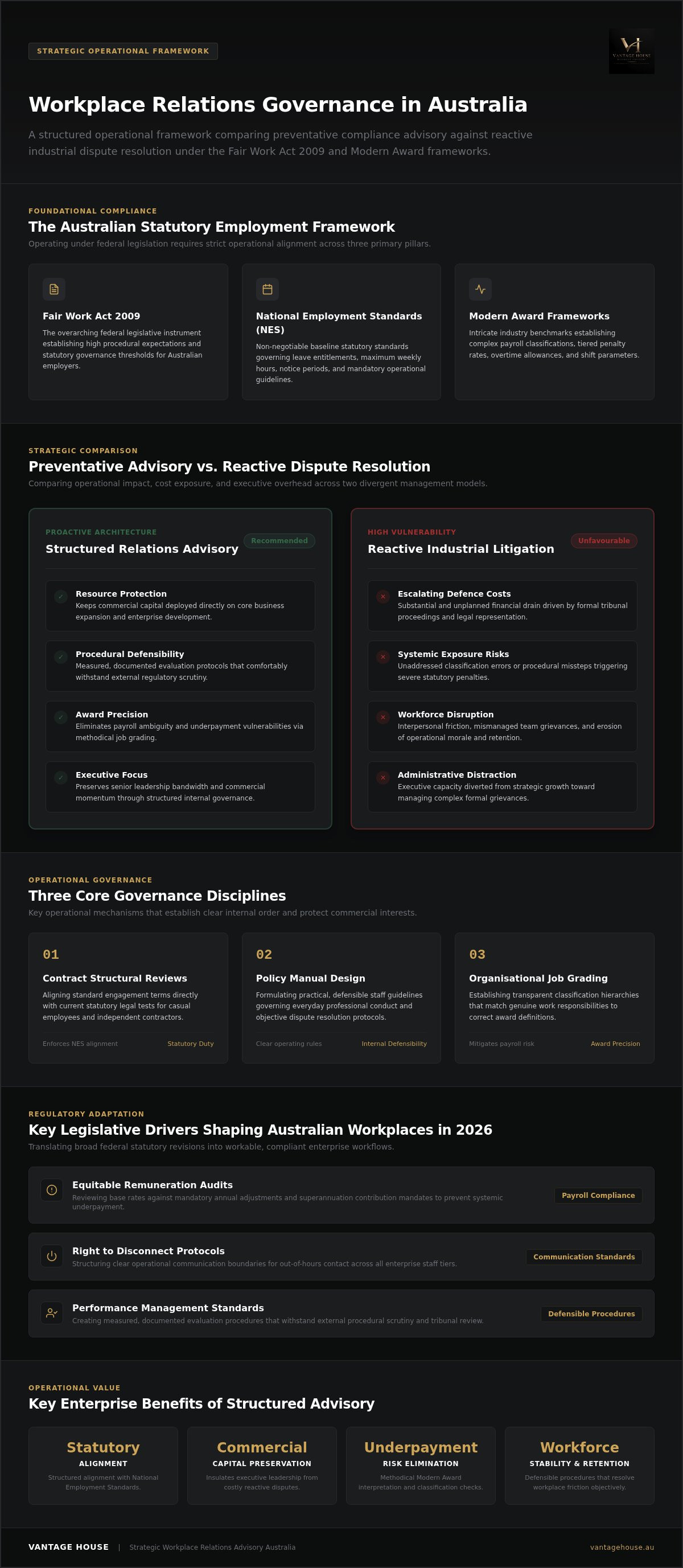
Australian employment regulation establishes high procedural expectations for employers of all sizes. Operating under the national framework established by the Fair Work Act 2009, corporate leaders must maintain strict alignment with statutory National Employment Standards (NES) while managing daily workforce dynamics. Professional workplace relations advisory delivers structured guidance across employment standards, Modern Awards, and operational governance. Independent advisory assists executive teams in meeting their legal duties without administrative strain, establishing objective protocols that protect commercial interests and workforce stability.
The Scope of Modern Workplace Relations Governance
Modern advisory extends beyond simple regulatory checks. It provides a cohesive operational architecture that connects statutory requirements directly to business operations. Key governance disciplines include:
- Employment contract structural reviews: Aligning engagement terms with current statutory tests for casuals and independent contractors.
- Policy manual design: Formulating practical, defensible staff guidelines that govern everyday conduct and dispute protocols.
- Organisational job grading: Establishing transparent classification hierarchies that match genuine work responsibilities to correct award definitions.
Clear internal governance prevents misunderstandings between departmental managers and staff. That clarity keeps operations steady.
Key Legislative Drivers Shaping Australian Workplaces in 2026
Statutory revisions implemented through successive waves of federal legislation have created a complex operating environment for Australian businesses. These parameters demand rigorous oversight of payroll rules, classification bands, and flexible working arrangements. Engaging an experienced workplace relations advisory australia partner translates these broad legislative changes into workable enterprise workflows.
Advisory frameworks address critical operational areas where legislative changes intersect with business management:
- Equitable remuneration audits: Reviewing base rates against mandatory annual adjustments and superannuation contribution mandates.
- Right to disconnect protocols: Structuring clear operational communication boundaries for out-of-hours contact across all staff tiers.
- Performance management standards: Creating measured, documented evaluation procedures that withstand external procedural scrutiny.
By translating regulatory mandates into practical operating principles, external advisors give leadership teams the clarity needed to lead with confidence.
Workplace Relations Advisory Versus Reactive Litigation: Strategic Comparison
Many corporate leaders assume workplace relations assistance is only necessary once a formal grievance lands on an executive desk. That assumption proves costly. Industrial litigation introduces significant commercial expense, executive distraction, and reputational exposure. Establishing proactive internal systems through professional workplace relations advisory australia services keeps operational matters resolved internally before they turn into tribunal disputes.
The Commercial Advantages of Preventative Advisory
Preventative advisory targets the root causes of workplace friction rather than merely reacting to procedural errors after the fact. Formal tribunal proceedings often result from unstructured performance conversations, ambiguous position descriptions, or mismanaged team grievances. Implementing methodical advisory structures delivers immediate operational advantages:
- Resource protection: Keeps commercial resources focused on core business growth rather than escalating legal defence fees.
- Cultural continuity: Resolves interpersonal conflict calmly, protecting workplace morale and staff retention.
- Procedural defensibility: Ensures internal performance and review mechanisms remain transparent, consistent, and fair.
Early intervention preserves workplace stability. It stops minor misunderstandings from escalating into formal disputes.
Differentiating Advisory Support from Formal Legal Advocacy
Business owners often conflate commercial advisory with adversarial legal advocacy. While law firms focus primarily on formal representation in court or Fair Work Commission hearings, strategic workplace advisory operates entirely upstream. It focuses on internal compliance guidance, practical HR support, and workforce alignment under the Fair Work Commission modern awards framework. Strategic consultants don't provide courtroom litigation or union advocacy. Instead, they provide the internal operational clarity that keeps employers out of adversarial venues altogether.
Engaging tailored workplace relations advisory gives leadership teams the systems and objective guidance needed to resolve workforce challenges with steady, non-adversarial confidence.
Ensuring Modern Award Interpretation and Compliance Precision
Modern Awards present one of the most intricate operational hurdles for Australian employers. Inadvertent payroll discrepancies rarely stem from deliberate underpayment. They occur when fast-moving businesses misinterpret multi-layered award definitions, blended work profiles, or shifting penalty conditions. Securing professional workplace relations advisory australia services ensures your business maintains an exact match between everyday staff tasks and statutory pay structures.
Navigating Job Classifications and Employment Duties
Statutory coverage depends on the actual work an employee performs, not the formal title stated on their employment agreement. When internal duties evolve without a formal review, historical classifications quickly turn into compliance liabilities. Objective advisory specialists analyse day-to-day work patterns against specific award criteria to verify correct grading. Routine classification audits establish transparent, defensible records that satisfy regulatory standards set out in the Fair Work Ombudsman compliance and enforcement policy.
A rigorous classification review focuses on several operational elements:
- Core duty mapping: Auditing primary tasks against the indicative duties specified within modern awards.
- Supervisory thresholds: Ensuring staff exercising managerial discretion or team supervision sit within the proper classification stream.
- Qualification validation: Matching relevant trade qualifications or degree requirements to statutory pay increments.
Managing Overtime, Allowances, and Flexible Working Agreements
Modern Award rules regarding shift spans, meal allowances, and weekend rates leave little margin for administrative error. When businesses establish Individual Flexibility Agreements (IFAs), each arrangement must satisfy the strict Better Off Overall Test (BOOT) across all relevant rosters. Clear compliance guidance gives managers complete confidence when designing rosters and adjusting operational hours.
Maintaining systematic wage-rule alignment eliminates the administrative friction that disrupts executive leadership. Experienced advisors examine your working arrangements systematically, verifying that every penalty rate, allowance, and overtime trigger functions as intended. That methodical approach preserves commercial stability while keeping your payroll processes accurate and accountable across all operational tiers.
Implementing a Proactive Workplace Relations Governance Framework
Establishing dependable workplace governance requires a structured methodology rather than ad hoc reactions. When leadership implements a systematic framework, operational compliance becomes an inherent business habit rather than an administrative burden. A mature governance roadmap follows four progressive stages: auditing foundational agreements, updating internal operational policies, formalising review workflows, and monitoring workforce sentiment continuously.
Auditing Foundational Employment Contracts and Documentation
The framework begins with an objective baseline audit of existing employment contracts, position descriptions, and Modern Award classifications. Outdated agreements often contain obsolete terms regarding working hours, termination notice, and offset provisions that fail to protect the commercial interests of the organisation. Standardising these core documents removes ambiguity regarding everyday duties, leave accruals, and statutory entitlements.
Once employment agreements reflect current national standards, internal operational policies must be updated to mirror contemporary legislative requirements. Clear, modern workplace policies provide supervisors with unambiguous guidelines, ensuring procedural fairness across every operational division.
Structured Performance Management and Dispute De-escalation
Workplace friction often intensifies when performance reviews lack objective structure. Unstructured feedback sessions create operational vulnerability and increase the risk of unfair treatment claims, turning manageable capability issues into protracted disputes. Implementing defensible, documented performance procedures equips managers to address underperformance calmly, methodically, and without emotional bias.
Early internal dispute resolution protocols neutralise interpersonal friction before procedural escalation occurs. Engaging experienced workplace relations advisory australia specialists ensures your performance management and feedback processes remain operationally sound and fully compliant with national benchmarks. To establish lasting stability, leadership teams should also maintain regular feedback mechanisms to monitor shifting workplace conditions, team morale, and staff retention.
Implement a proactive workplace relations framework to protect your commercial operations and build enduring workforce stability across your enterprise.
Partnering with Vantage House for Comprehensive Workplace Relations Advisory
Vantage House provides strategic advisory grounded in objective, practical commercial execution. Managing a workforce effectively demands more than sporadic document checks or reactive responses to workplace grievances. It requires an integrated operational strategy. By deliberately avoiding tribunal litigation and commission hearings, our consulting focuses entirely on proactive workplace prevention that protects enterprise continuity. We work alongside leadership teams across Australia to establish clarity, composure, and regulatory certainty across their entire operational structure.
Integrated People Advisory from Recruitment to Retention
Sustainable workforce stability requires tight alignment between recruitment practices and internal governance standards. When talent acquisition operates in tandem with clear compliance guidance, new personnel integrate smoothly under verified award classifications and accurate contracts.
Our comprehensive service model unites several essential disciplines:
- Compliance guidance and HR support: Streamlining day-to-day people operations and maintaining procedural alignment.
- Recruitment and staff placement: Ensuring commercial operations secure qualified talent aligned with operational needs.
- Employee review and research: Evaluating staff satisfaction objectively to pinpoint operational friction early.
Measuring workplace sentiment through structured employee research identifies cultural friction and operational risks before turnover rates rise. This connected approach equips leadership to make sensitive people decisions calmly, knowing each action supports team stability and organisational culture.
Initiating a Strategic Advisory Engagement
Every advisory partnership begins with an objective assessment of existing employment contracts, Modern Award mappings, and HR documentation. This thorough baseline evaluation identifies procedural vulnerabilities, providing executives with a clear, prioritised roadmap tailored to their commercial footprint.
Partnering with Vantage House delivers dependable workplace relations advisory australia employers trust to safeguard their commercial interests. Through structured workflows and practical business solutions, our advisors remove administrative strain so your executive team can lead with focus. Discover how our team supports sustainable business stability through workplace relations advisory.
Sustaining Workplace Stability and Commercial Certainty
Achieving regulatory certainty across Australian operations doesn't happen by chance. It stems from disciplined governance systems that translate complex Modern Award parameters and statutory obligations into practical, repeatable routines. Proactive compliance eliminates administrative confusion, insulates leadership from unexpected liabilities, and preserves executive focus for commercial growth. Prioritising prevention over reactive dispute management keeps your workplace balanced and productive.
When you align employment standards directly with talent recruitment and employee satisfaction research, your organisation builds enduring cultural resilience. Vantage House delivers the dedicated workplace relations advisory australia employers rely on to safeguard their commercial stability. By resolving workforce friction early through objective people management frameworks, our non-adversarial consulting keeps operations steady and compliant. Connect with Vantage House for strategic workplace relations advisory to establish lasting clarity and confidence across your workforce.
Frequently Asked Questions
What is the primary function of a workplace relations advisory in Australia?
The primary function is providing employers with proactive governance, compliance guidance, and practical operational frameworks to manage workforce relationships effectively. A dedicated workplace relations advisory australia provider helps businesses align employment contracts, workplace policies, and internal processes with national standards. Rather than reacting to disputes, advisors institute structured systems that preserve workplace stability, ensure statutory alignment, and prevent administrative friction before issues reach executive escalation.
How does workplace relations advisory differ from engaging an employment lawyer?
Workplace relations advisory focuses on proactive, internal operational consulting rather than formal legal advocacy. While employment law firms handle courtroom litigation and representation before the Fair Work Commission, strategic advisory firms provide practical guidance on governance, award compliance, and daily HR support. Advisors work upstream to create compliant policies and defensible performance processes, intentionally resolving matters internally to keep commercial operations out of adversarial legal venues.
Can an independent advisory firm assist with Modern Award interpretation?
Yes, an independent advisory firm evaluates actual staff duties to determine accurate Modern Award coverage and classification levels. Advisory specialists examine daily job responsibilities against specific award grading definitions to eliminate role misalignment. They also verify complex pay conditions, including overtime thresholds, weekend penalty rates, and allowances. This thorough analysis provides employers with defensible documentation, protecting the business from systemic payroll misinterpretations.
What steps should an employer take to avoid underpayment claims under Australian law?
Employers should conduct regular payroll audits, map job duties directly to current Modern Award classifications, and maintain transparent time-tracking records. Reviewing employment agreements ensures annualised salaries comfortably cover all applicable award entitlements under the Better Off Overall Test. Engaging experienced workplace relations advisory australia specialists helps identify classification drift early, ensuring shift penalties, allowances, and statutory superannuation contributions remain accurate across every roster cycle.
Does workplace relations advisory assist with employee performance management?
Yes, strategic advisory establishes defensible, structured frameworks for evaluating and addressing staff performance. Advisors help management teams design objective feedback procedures and documented review pathways that minimise procedural ambiguity. This measured approach equips supervisors to handle capability concerns calmly and consistently. Defensible documentation ensures fair treatment, protecting organisational culture while significantly reducing the risk of procedural disputes or unfair dismissal claims.
How does strategic workplace advisory integrate with recruitment and retention?
Strategic advisory links compliant hiring contracts with structured employee review and satisfaction research to create workforce stability. Establishing verified award classifications and clear employment terms during talent placement ensures smooth onboarding. Following placement with objective staff satisfaction research allows leadership to identify internal operational friction before turnover increases. This integrated model aligns talent acquisition with long-term cultural stability and commercial continuity.