

Waiting for a formal employment dispute before a statutory body is the most disruptive way to uncover an operational vulnerability. Securing structured, proactive workplace relations guidance gives leadership teams the clarity needed to identify Award classification risks and unaddressed employee grievances early, well before minor operational friction escalates into costly external proceedings. Most Australian employers don't run into difficulty through negligence; they encounter strain because keeping pace with shifting Modern Award interpretations, strict Payday Super timelines, and sensitive personnel dynamics demands constant vigilance.
You shouldn't have to manage these administrative pressures in isolation or wait for unresolved friction to compound. By establishing a preventative governance framework, your leadership team can resolve workplace concerns at the source, preserve managerial confidence, and maintain genuine workforce alignment. Below, you will find a practical employer checklist for 2026, delivering clear benchmarks for internal compliance reviews, defensible processes aligned with Fair Work standards, and actionable steps to ensure sustained stability across your operations.
Key Takeaways
- Embedding proactive workplace relations guidance enables leadership teams to identify Modern Award discrepancies and resolve workplace friction before issues escalate into operational disruption.
- Establishing structured alignment between employment contracts and the National Employment Standards creates a secure, defensible foundation across all business units.
- Prioritising early internal de-escalation rather than reactive dispute management protects organisational resources and maintains managerial confidence.
- Implementing a regular internal review checklist ensures payroll structures, job classifications, and operational policies remain fully aligned with Fair Work benchmarks.
- Integrating ongoing advisory practices into ordinary workforce rhythms equips organisations to adapt smoothly as regulatory standards and enterprise demands evolve.
Understanding Proactive Workplace Relations Guidance in Australian Business
Operating a sustainable commercial enterprise in Australia requires a structured approach to employment standards. Proactive workplace relations guidance establishes clear, documented processes before operational friction turns into administrative paralysis. Rather than treating compliance as an occasional administrative audit, preventative governance weaves legislative benchmarks directly into daily supervisory habits. This disciplined posture shields an organisation from disruption, preserves managerial focus, and ensures baseline employment practices reliably mirror Fair Work standards across every department.
Managing workforce obligations demands systematic oversight across contracts, award classifications, and operational policies. The broader Australian labour law framework sets strict statutory expectations through the National Employment Standards and industry-specific Modern Awards. Without ongoing oversight, small discrepancies in shift loadings, allowance interpretations, or job definitions compound quietly over time. Applying structured guidance early neutralises these exposures, replacing ad-hoc guesswork with methodical operational routines.
The Distinction Between Preventative Advisory and Reactive Intervention
Reactive intervention begins only after an employee lodges a formal grievance, an audit notice arrives, or workplace morale deteriorates. This scramble forces leadership into defensive positions, draining commercial resources and distracting key managers from core business objectives. Preventative advisory reverses that dynamic entirely:
- It audits job classifications against actual operational duties before pay misalignments occur.
- It identifies subtle policy gaps before supervisory decisions lead to formal employee friction.
- It reinforces leadership capability, preserving executive credibility and fostering workplace stability.
Clear, practical advisory bridges the gap between complex legal interpretations and real-world commercial management.
The Strategic Imperative for Modern Australian Employers
Statutory oversight by bodies like the Fair Work Ombudsman continues to expand nationwide, leaving little tolerance for administrative oversight. Growing enterprises feel this pressure most acutely. As headcount expands, supervisory layers multiply, increasing the risk that inconsistent personnel practices take root on the operational floor.
Executive leadership cannot rely on assumptions when managing workforce liabilities. Implementing proactive workplace relations guidance equips decision-makers with clear, defensible frameworks to manage commercial exposure safely. By treating workforce governance as a preventative business discipline rather than an emergency response, companies protect their ongoing stability, retain key talent, and maintain steady momentum in an increasingly regulated commercial environment.
The Core Pillars of a Resilient Workplace Relations Framework
A durable employment relations model relies on three interdependent pillars: structural compliance, documented policy benchmarks, and frontline procedural capability. When these elements operate together, organisations prevent minor misunderstandings from compounding into significant liabilities. Engaging proactive workplace relations guidance gives leadership teams the clarity needed to audit these components methodically, replacing subjective management styles with reliable, repeatable operational systems.
Modern Award Alignment and Classification Reviews
Award misclassification remains one of the most persistent financial risks for employers. Job responsibilities evolve naturally as businesses expand, meaning an employee's original position description rarely matches their day-to-day duties three years later. Establishing a scheduled, twice-yearly classification audit ensures base wage rates, overtime structures, and allowances match actual operational reality. Consulting the Fair Work Ombudsman best practice guides offers a helpful baseline, but enterprise stability requires rigorous internal verification across every tier of your payroll structure.
Clear Workplace Policies and Communication Channels
Documented policies establish unambiguous standards for acceptable performance, code of conduct, and grievance resolution. When personnel expectations remain unwritten, supervisory decisions appear arbitrary, which quickly erodes employee trust. Robust policies provide two distinct safeguards:
- They supply frontline supervisors with clear, objective benchmarks for conducting fair performance appraisals.
- They give staff accessible, confidential escalation pathways to raise concerns internally before seeking external intervention.
Consistency across these channels protects operational continuity while reassuring teams that internal resolutions are impartial and transparent.
Frontline Manager Education and Procedural Capability
Supervisors represent the primary touchpoint for detecting emerging friction on the floor. Even the most comprehensive policies fail if team leaders lack basic training in procedural fairness. Equipping frontline managers to document discussions accurately, maintain objectivity during difficult conversations, and listen actively prevents constructive dismissal risks and defuses grievances early. Establishing regular training ensures managerial habits remain consistent across all operational units.
Structuring these pillars into your everyday business rhythms requires deliberate effort. Seeking tailored workplace relations advisory helps organisations review their baseline frameworks, ensuring leadership operates with complete procedural clarity and lasting workforce stability.
Comparing Strategic Advisory Support with Adversarial Dispute Management
Adversarial workplace conflict represents an operational breakdown in communication. When routine employment misunderstandings escalate into statutory claims, enterprise progress stalls while executive focus shifts entirely to damage control. Seeking proactive workplace relations guidance prioritises early, practical de-escalation within internal operational boundaries. By introducing measured, objective advice before personal frustration hardens into formal opposition, leadership teams can address grievances at the source without triggering defensive posturing.
The True Organizational Cost of Escalated Disputes
Formal workplace conflict extracts a heavy organisational toll that extends well beyond direct legal fees. Executive hours diverted into compiling evidentiary records, drafting chronology statements, and attending statutory conferences directly undermine core operational targets. Internally, persistent departmental tension damages overall staff morale, frequently sparking unwanted voluntary turnover among key performers who simply choose not to work in a strained environment.
A contentious dispute can also compromise an organisation's public reputation, complicating future recruitment and client relationships. A review of formal Fair Work Commission dispute resolution processes demonstrates that once a matter reaches a statutory registry, operational friction is already entrenched. Preventing that escalation through prompt internal mediation remains the most commercially sound path for business continuity.
The Scope of Non-Litigious Workplace Relations Advisory
Strategic advisory functions on a fundamentally different premise than formal courtroom advocacy or tribunal litigation. Rather than preparing defensive arguments after an employment relationship collapses, independent workplace relations advisory works proactively to strengthen everyday workforce governance. Specialists audit employment contracts, verify Modern Award coverage, and help management conduct structured, defensible performance discussions well before conflict sparks formal friction.
This distinct, non-adversarial focus intentionally keeps disputes out of external courtrooms. By resolving procedural misalignments early and equipping managers with calm, objective guidance, organisations build resilient internal systems that defuse tension, safeguard operational continuity, and maintain workforce confidence across every stage of business growth.
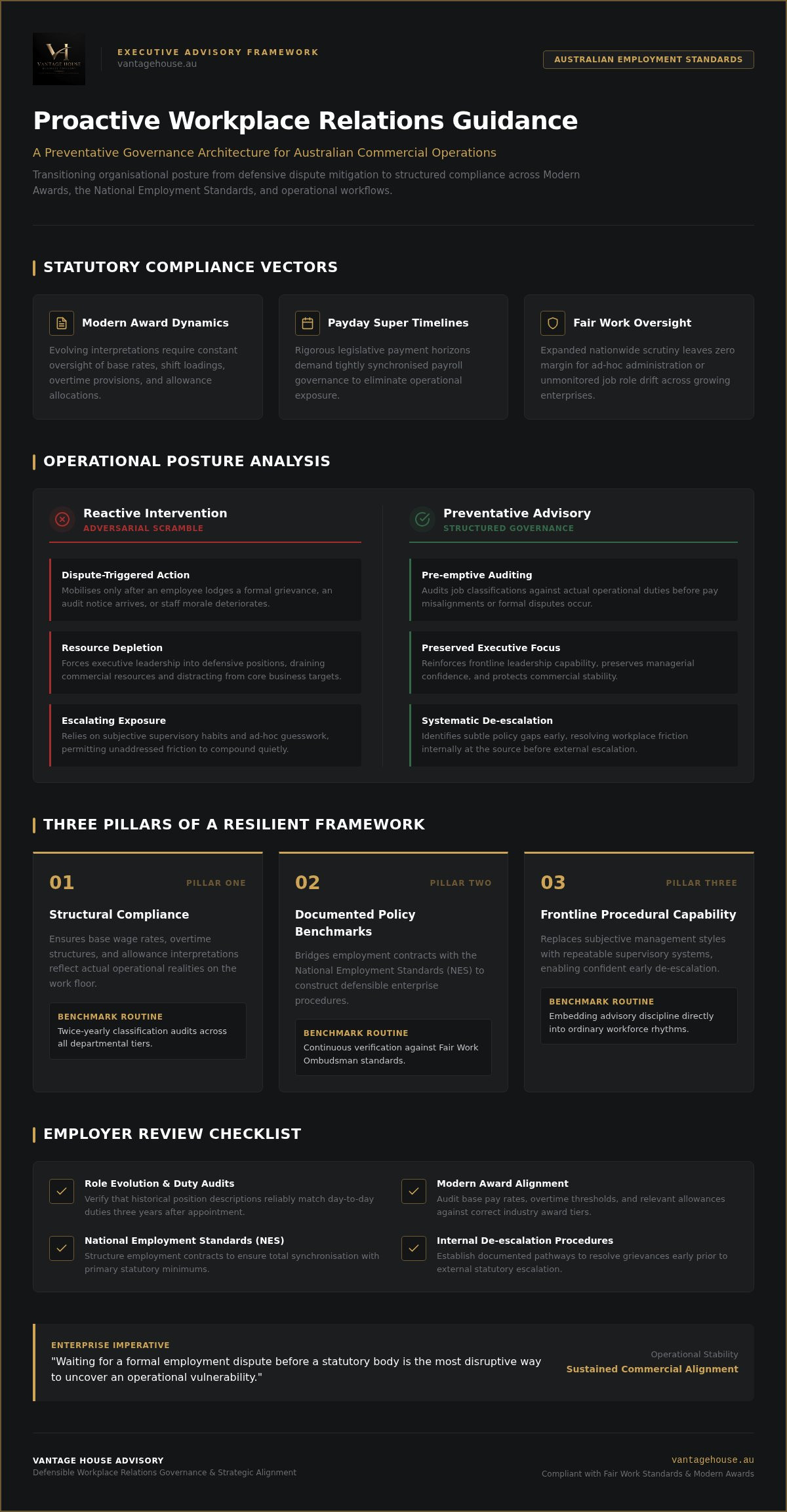
The Proactive Workplace Relations Checklist for Australian Employers
Sustaining regulatory alignment across an expanding enterprise requires regular, structured evaluations. Rather than assuming legacy contracts and informal supervisory habits remain adequate, commercial leaders need an objective method to assess operational vulnerability. Seeking proactive workplace relations guidance transforms scattered administrative tasks into a reliable audit schedule, safeguarding the organisation against unnoticed compliance gaps.
Contractual and Statutory Compliance Audits
Every defensive employment framework begins with current documentation. Outdated terms or invalid offset clauses leave organisations vulnerable to historic underpayment claims, even when total remuneration exceeds base Award minimums.
- National Employment Standards audit: Confirm all standard contracts reflect current statutory entitlements, leave provisions, and maximum weekly hour requirements.
- Casual conversion reviews: Track casual employment milestones systematically to ensure eligible team members receive required assessment notices in writing.
- Record-keeping systems: Verify that payroll records, single touch payroll data, and time-tracking systems accurately capture overtime, allowances, and penalty rates.
Procedural Fairness and Dispute De-Escalation Protocols
Internal conflict turns into statutory liability when procedural steps are rushed or bypassed. Standardising management workflows ensures supervisory discussions remain balanced, defensible, and calm.
- Award classification mapping: Review job descriptions annually against Modern Award classification definitions to prevent bracket creep as staff absorb broader operational duties.
- Investigation standards: Formalise internal inquiry processes, ensuring staff receive reasonable advance notice of performance concerns, access to an independent support person, and genuine opportunity to respond.
- Contemporaneous record-keeping: Mandate that supervisors document discussions immediately using objective, factual language rather than personal impressions.
Monitoring Cultural Health and Early Retention Indicators
Statutory disputes rarely emerge without warning; they are usually preceded by measurable operational symptoms. Analysing internal data points, such as sudden spikes in unplanned personal leave, elevated turnover within specific teams, or repeated informal complaints, highlights managerial friction before it hardens into formal opposition.
Deploying structured employee review and research tools gives leadership an objective assessment of workforce sentiment. To benchmark your internal documentation and address emerging personnel risks before they escalate, access expert compliance guidance to secure your operational foundation.
Integrating Continuous Advisory into Long-Term Workforce Strategy
Workplace relations governance cannot remain static while an enterprise evolves. When organisations scale into new markets, introduce specialised service lines, or restructure operational reporting tiers, informal management habits quickly break down. Embedding proactive workplace relations guidance directly into long-term commercial planning ensures compliance mechanisms keep pace with headcount growth. By treating regulatory alignment as an ongoing operational rhythm rather than an annual panic, executive teams protect company culture and preserve enterprise value.
Aligning People Management with Organizational Milestones
Enterprise growth creates structural inflection points that alter baseline employment obligations. Adding operational divisions, integrating acquisitions, or introducing supervisory tiers demands a methodical review of how work is organised and compensated across the business.
- Operational expansion: Review Award coverage and remuneration structures whenever introducing new job functions, preventing legacy pay arrangements from contaminating new teams.
- Structured onboarding: Calibrate induction workflows so incoming personnel immediately understand documented communication channels, performance benchmarks, and grievance procedures.
- Strategic talent placement: Align recruitment and staff placement pipelines directly with established operational job classifications to prevent structural misalignment from day one.
Integrating these operational checkpoints preserves managerial consistency as team sizes multiply.
Partnering with Independent Workplace Relations Specialists
Internal leaders often find it difficult to evaluate operational friction objectively, particularly when dealing with longstanding managers or sensitive personnel histories. Working alongside dedicated workplace advisors introduces an impartial external perspective, identifying procedural vulnerabilities before they generate commercial friction.
An ongoing advisory partnership gives frontline managers immediate access to measured, external support the moment complex staffing issues surface. Rather than improvising difficult conversations or leaving supervisory tension unresolved, decision-makers receive structured, calm direction grounded in current Australian standards. Discover how strategic HR and workplace advisory can safeguard your leadership focus, maintain organizational balance, and support your long-term commercial strategy with complete procedural clarity.
Securing Long-Term Workforce Stability for 2026 and Beyond
Workplace compliance shouldn't be an exercise in crisis management. Establishing regular internal audits, aligning employment agreements with current Modern Awards, and equipping supervisors with structured procedural fairness protocols transforms employment governance into a commercial strength. Securing proactive workplace relations guidance gives your leadership team the preventative clarity required to resolve emerging friction early, well before it threatens operational momentum or organizational culture.
Sustainable enterprise growth relies on dependable, non-litigious systems built specifically around Australian employment standards. Backed by a proven national track record of delivering objective workplace governance, our advisory frameworks help business leaders replace compliance anxiety with predictable operational order. Take control of your compliance obligations and partner with Vantage House for practical workplace relations guidance to ensure your workforce remains resilient, defensible, and aligned throughout 2026 and beyond.
Frequently Asked Questions
What is proactive workplace relations guidance?
Proactive workplace relations guidance is a preventative advisory framework designed to align an organisation's employment contracts, operational policies, and managerial practices with Australian statutory standards before friction arises. Rather than responding to formal grievances after disruption occurs, this structured approach continuously audits Modern Award classifications and supervisory workflows. It establishes clear operational boundaries that defuse workplace conflict early and protect long-term business stability.
How does proactive workplace relations reduce regulatory risk under Fair Work?
Proactive workplace relations reduces regulatory risk by establishing verifiable compliance checks across daily business operations. Regular reviews of overtime rates, classification tiers, and leave records catch administrative discrepancies before they turn into underpayment liabilities or Fair Work Ombudsman inquiries. Documenting fair, transparent internal procedures also ensures that any performance management or disciplinary actions remain fully defensible against adverse action or unfair dismissal scrutiny.
Does proactive workplace relations guidance involve legal representation?
No, proactive workplace relations guidance focuses strictly on early-stage advisory, compliance systems, and internal dispute de-escalation rather than legal representation. Advisors don't represent employers in court litigation or formal Fair Work Commission tribunal hearings. Instead, the service equips leadership teams with practical governance structures, defensible documentation, and objective mediation strategies to resolve personnel friction internally, intentionally keeping the organisation out of statutory proceedings.
How frequently should an Australian business audit its Modern Award compliance?
Australian employers should audit Modern Award compliance at least twice each year. Mid-year reviews align payroll systems with annual statutory minimum wage and allowance increases, which take effect on 1 July. A secondary mid-cycle audit evaluates whether expanding staff responsibilities have triggered Award classification bracket creep. Conducting regular, scheduled payroll and contract checks prevents historical underpayment claims and ensures job descriptions remain accurate as operational demands evolve.
What is the role of frontline managers in workplace relations compliance?
Frontline managers act as the primary operational safeguard for workplace relations compliance. Because supervisors oversee daily rostering, task delegation, and direct team discussions, their adherence to procedural fairness directly dictates organisational risk. Training managers to document performance meetings objectively, listen to staff concerns without bias, and apply company policies consistently prevents minor operational friction from developing into costly, formal employment disputes.
Can proactive workplace relations improve staff retention and workplace culture?
Yes, structured workplace relations governance directly improves retention by eliminating arbitrary decision-making and fostering transparent communication. When employees know pay rates are accurate, job expectations are well documented, and internal grievance channels are impartial, trust across the enterprise deepens. Combining objective employee review tools with preventative compliance protocols allows leadership to address managerial friction early, reducing unnecessary staff turnover and supporting overall workforce morale.
What is the difference between internal HR support and strategic workplace relations advisory?
Internal HR support focuses primarily on operational administration, talent placement, onboarding, and day-to-day staff queries. Strategic workplace relations advisory delivers higher-level structural governance, auditing regulatory risk, interpreting Modern Awards, and guiding sensitive performance matters. Accessing proactive workplace relations guidance supplements internal HR teams with objective, external counsel, ensuring executive decisions balance commercial objectives with strict Australian employment benchmarks without overwhelming internal administrative capacity.
