

Australian people managers spend between 30% and 50% of their working hours handling interpersonal friction and internal grievances. When unaddressed tension festers, it quickly disrupts team productivity and exposes organisations to significant operational drag, psychosocial safety hazards, and compliance risks under Australian workplace laws. Most leaders already recognise that managing employee disputes proactively delivers far greater stability than reacting after a formal application lands at the Fair Work Commission.
Resolving friction shouldn't require contentious legal proceedings or disruptive adversarial battles that permanently damage working relationships. In this guide, you'll learn how to resolve workplace conflicts early through structured internal processes that protect operational culture and avoid tribunal escalation. We outline clear procedural fairness requirements, practical conflict triage frameworks, and measured steps to restore stability across your teams before minor grievances turn into costly claims.
Key Takeaways
- Establishing structured internal intervention models ensures that managing employee disputes proactively protects team culture and avoids contentious tribunal filings.
- Systemic workplace friction often stems from underlying ambiguity surrounding Modern Award classifications, performance benchmarks, and operational expectations.
- A structured five-stage resolution framework separates emotional reactions from objective facts, ensuring procedural fairness while maintaining psychological safety across teams.
- Early, advisory-led dispute triage preserves critical working relationships and prevents the heavy executive drain associated with formal external litigation.
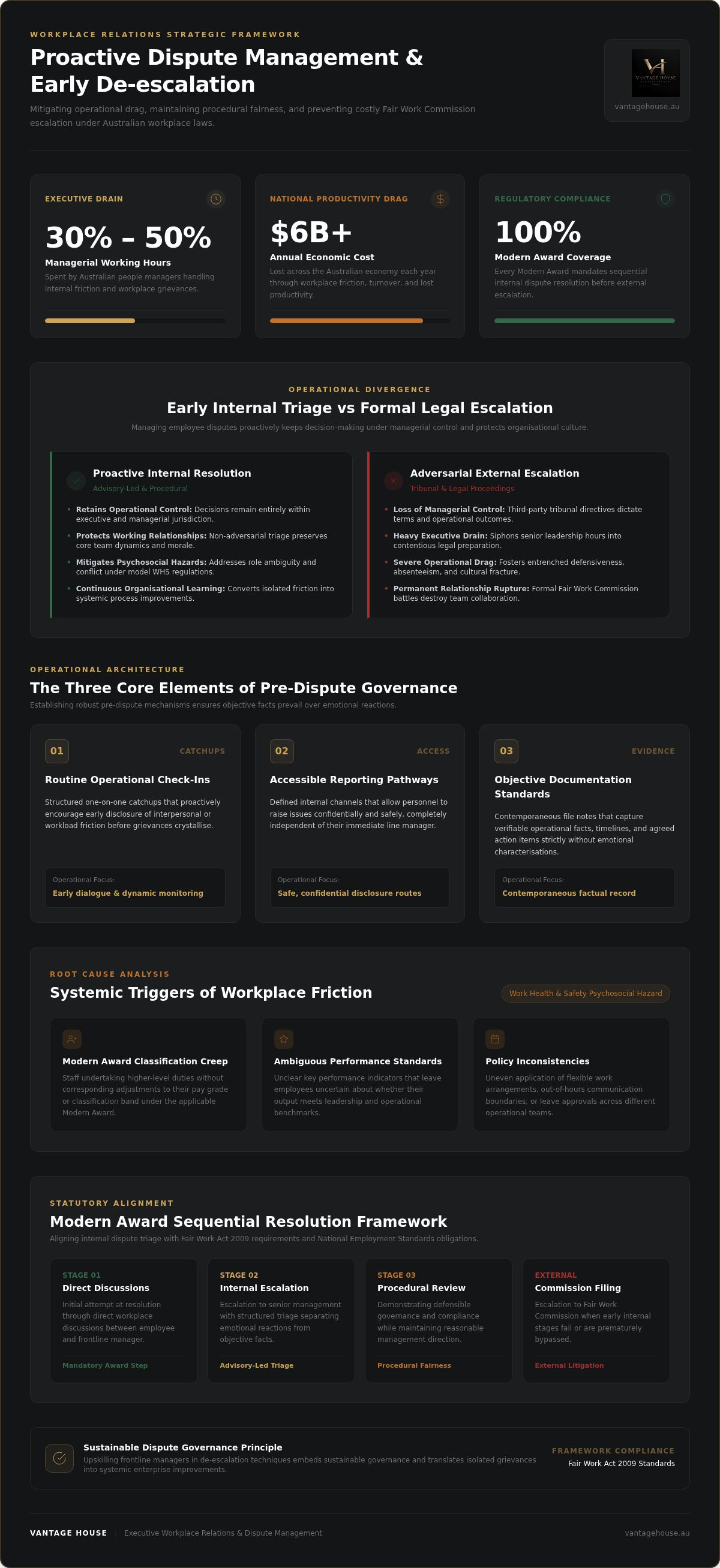
- Upskilling frontline managers in practical de-escalation techniques embeds sustainable governance and translates isolated grievances into broader organisational improvements.
Understanding Proactive Workplace Relations and Dispute Management
Proactive dispute management isn't an emergency intervention; it's an ongoing operational discipline. Within Australian enterprises, managing employee disputes proactively means establishing structured mechanisms that surface and address friction before grievances crystallise into formal claims. While adversarial proceedings before the Fair Work Commission demand substantial external resources and drain executive focus, early internal resolution keeps decision-making under managerial control. Workplace friction costs the Australian economy upwards of $6 billion annually in lost productivity and turnover. Addressing conflict early protects operational momentum and maintains a constructive workplace culture.
The Core Elements of Pre-Dispute Workplace Governance
Sound workplace relations rest on clear pre-dispute governance. Operational leaders serve as the first line of defence, identifying subtle shifts in team dynamics, absenteeism, and communication breakdowns before issues escalate. Establishing open dialogue requires practical protocols across three distinct areas:
- Routine operational check-ins: Structured one-on-one catchups that encourage early disclosure of interpersonal or workload friction.
- Accessible reporting pathways: Defined internal channels that allow personnel to raise issues confidentially, independent of their immediate line manager.
- Objective documentation standards: Contemporaneous file notes that capture verifiable operational facts, timelines, and agreed action items without emotional characterisations.
Capturing facts early ensures that any subsequent inquiry remains grounded in measurable events rather than personal animosity.
Statutory Alignment Under the Fair Work Framework
Every Modern Award contains a mandatory dispute resolution clause outlining sequential stages for resolving grievances. Typically, these provisions require parties to attempt resolution through direct workplace discussions before escalating issues to senior management or external bodies. Employers often overlook this preliminary phase, inadvertently fast-tracking manageable interpersonal friction toward external dispute channels.
Understanding formal dispute resolution processes enables employers to structure these initial discussions strictly within statutory boundaries. By aligning early triage meetings with National Employment Standards obligations and procedural fairness rules, leadership preserves its right to issue reasonable management directions while demonstrating transparent, defensible governance.
Identifying Common Triggers of Workplace Friction Early
Workplace conflict rarely erupts overnight. Instead, it accumulates through subtle operational misalignments, structural ambiguities, and unmonitored team friction. While personality differences are frequently blamed for team discord, the underlying catalyst is almost always structural. When duties lack definition or Modern Award classifications become blurred, everyday interactions turn defensive. Managing employee disputes proactively requires leaders to recognise these operational fractures before they solidify into formal grievances or claims under the Fair Work Act 2009.
Operational and Structural Friction Points
Organisational changes often outpace formal role documentation. When duties shift without formal realignment, employees face conflicting priorities and uncertain expectations. This lack of role clarity is recognised under model Work Health and Safety regulations as an actionable psychosocial hazard. Systemic friction points typically include:
- Award classification creep: Staff taking on higher-level duties without corresponding adjustments to their pay grade or classification band under the applicable Modern Award.
- Ambiguous performance standards: Unclear key performance indicators that leave employees uncertain about whether their output meets leadership expectations.
- Policy inconsistencies: Uneven application of flexible work arrangements, out-of-hours communication boundaries, or leave approvals across different teams.
Conducting regular position audits and modern award reviews removes these points of contention before informal dissatisfaction leads to wage compliance disputes.
Interpersonal Dynamics and Cultural Indicators
Before an employee lodges a formal grievance, team behaviour changes. Staff may withdraw from voluntary collaboration, exhibit uncharacteristic absenteeism, or display passive resistance during routine operational handovers. Safe Work Australia data indicates that harassment, bullying, and interpersonal friction account for roughly one-third of all accepted mental health compensation claims. Leaving interpersonal hostility unmanaged creates significant regulatory exposure for employers under statutory psychosocial risk duties.
Implementing structured employee feedback channels allows organisations to identify cultural strain early. As outlined in the Fair Work Ombudsman's effective dispute resolution guide, establishing transparent, multi-channel reporting mechanisms enables businesses to surface friction while it remains fully workable. Engaging third-party workplace relations advisory can help benchmark team sentiment and identify latent compliance risks across your organisation. Managing employee disputes proactively through systematic employee review processes ensures leadership detects cultural strain early, protecting team cohesion and reducing operational disruption.
Early Informal Resolution Versus Formal Legal Escalation
Workplace grievances generally follow one of two paths: early internal dialogue or formal legal escalation. The first prioritises commercial pragmatism and mutual alignment; the second introduces procedural rigidity and adversarial posturing. Annual lodgments before the Fair Work Commission recently exceeded 50,000 cases, driven by sharp increases in unfair dismissal and general protections claims. This volume highlights how frequently minor misunderstandings metastasise into external proceedings when internal containment fails. Choosing early intervention over external advocacy protects leadership bandwidth and operational stability.
The Commercial Reality of Formal Tribunal Proceedings
External tribunal disputes impose heavy commercial burdens on employers. Preparing statements, collating electronic records, and briefing representatives demands dozens of executive hours. The cultural fallout can be even more severe. Formal proceedings entrench opposition, polarise colleagues who may be called as witnesses, and publicly signal cultural dysfunction. While roughly 78% to 80% of unfair dismissal applications settle during Commission-assisted staff conciliation, reaching that threshold still consumes weeks of administrative energy and distracts senior leadership from core commercial objectives.
The Strategic Advantages of Internal Resolution
Internal resolution models avoid the binary "win-lose" outcome of tribunal proceedings. By managing employee disputes proactively through collaborative, staged discussions, organisations retain control over outcomes rather than delegating decisions to external arbiters. This approach delivers distinct operational advantages:
- Commercial confidentiality: Matters remain entirely internal, preventing sensitive operational practices or personnel matters from entering the public record.
- Relationship continuity: Facilitated problem-solving addresses root causes while preserving working relationships between employees and their immediate managers.
- Defensible procedural fairness: Documenting reasonable internal steps neutralises subsequent claims that an employer acted arbitrarily or harshly.
Following a structured internal approach mirrors the intent of the standard Fair Work Commission dispute resolution procedure, which expects parties to genuinely attempt informal workplace-level resolution before lodging applications. Committing to managing employee disputes proactively keeps operational authority where it belongs: within your business.
Step-by-Step Internal Framework for De-escalating Disputes
De-escalating workplace friction requires a methodical structure rather than ad-hoc conversations. When managing employee disputes proactively, establishing an objective five-stage framework provides clarity for operational leaders and reassurance for participating staff. This staged approach separates subjective emotions from operational facts, ensuring that any resolution reached aligns with Modern Award obligations and statutory procedural fairness standards.
Stage 1 to 3: Preliminary Assessment and Direct Engagement
The initial phase focuses on early containment and factual discovery. Rushing into formal disciplinary pathways without establishing baseline facts often inflames interpersonal tension. Instead, leadership should navigate three preliminary steps:
- Stage 1: Scope assessment. Conduct a confidential initial inquiry to determine whether the issue involves interpersonal friction, role ambiguity, or potential statutory breaches.
- Stage 2: Structured exploratory dialogue. Convene a non-adversarial meeting using clear ground rules. Focus discussions on observable workplace behaviours and verifiable events rather than subjective impressions.
- Stage 3: Evidentiary review and procedural fairness. Collate relevant rosters, communications, or position descriptions. Give the employee a genuine opportunity to respond to any concerns raised before reaching preliminary findings.
Adhering to these early steps guarantees that reasonable management action remains justifiable and defensible under Australian workplace standards.
Stage 4 to 5: Agreed Solutions and Monitoring Mechanisms
Once the factual core of the issue is clear, leadership must transition from inquiry to sustainable resolution. Agreements made informally often unravel if they lack operational accountability. The final two stages cement long-term stability:
- Stage 4: Co-designed action planning. Formulate a practical resolution plan outlining measurable behavioural benchmarks, workflow adjustments, or updated communication boundaries. Both parties must receive written confirmation of these agreed expectations.
- Stage 5: Staged post-resolution reviews. Schedule formal checkpoints at 30-day and 60-day intervals to verify that commitments are maintained and to confirm that underlying interpersonal friction hasn't resurfaced.
Structuring these stages systematically ensures that managing employee disputes proactively becomes a repeatable operational process rather than an administrative crisis. For organisations seeking objective support in structuring internal grievance frameworks or reviewing award coverage, partner with Vantage House for tailored workplace relations advisory. Engaging experienced external guidance reinforces procedural compliance while keeping dispute resolution firmly inside your business.
Embedding Sustainable Dispute Governance Across the Organisation
Resolving an isolated dispute offers immediate relief, but embedding long-term governance prevents recurring conflict. True operational stability requires organisations to treat every internal grievance as diagnostic feedback. When businesses review the systemic causes behind interpersonal friction, they can update outdated procedures, clarify reporting lines, and strengthen overall compliance. Managing employee disputes proactively means establishing organisational architecture that resolves friction continuously, rather than relying on reactive troubleshooting whenever friction peaks.
Leadership Capability and Operational Policy Design
Clear governance begins with accessible operational policies. Outdated employee handbooks and vague grievance procedures leave supervisors uncertain about how to intervene early. Developing consistent leadership capability requires organisations to target three operational areas:
- Transparent policy drafting: Incorporating clear, staged dispute resolution steps into employment agreements, employee handbooks, and standard operating procedures.
- Frontline supervisor training: Equipping team managers with practical de-escalation skills and coaching them to spot early signs of withdrawal or friction.
- Standardised incident records: Supplying uniform templates for contemporaneous notes across all operating units to maintain defensible administrative consistency.
When frontline leaders understand their procedural duties, minor operational disputes are addressed immediately rather than lingering unmanaged.
Strategic Advisory for Proactive Workplace Harmony
Employers often mistake compliance for a static document review. Sustainable workplace relations demand ongoing assessment of underlying cultural indicators and award alignment. While formal legal advocates focus primarily on defending claims after a dismissal has occurred, independent workplace relations advisory focuses on pre-dispute health and risk mitigation. This non-adversarial guidance identifies structural misalignments before they harden into legal claims.
Integrating structured employee review and research frameworks provides leadership with objective data on staff satisfaction and operational morale. Combining targeted workforce analytics with regular modern award interpretation audits allows employers to address pay discrepancies, clarify ambiguous job descriptions, and remove operational friction early. Managing employee disputes proactively through dedicated HR support and compliance guidance creates a fair workplace environment, reduces turnover, and safeguards the organisation against avoidable external dispute risks.
Securing Operational Stability Through Structured Conflict Resolution
Workplace friction doesn't have to culminate in tribunal applications or fractured team cultures. When organisations establish clear staged frameworks, address Modern Award ambiguities early, and upskill frontline supervisors in objective communication, leadership retains full control over commercial outcomes. Managing employee disputes proactively transforms emerging workplace tension into constructive operational alignment rather than an escalating crisis.
Long-term workplace stability relies on disciplined internal governance paired with objective advisory support. Implementing defensible documentation practices and structured review cycles safeguards your business against unnecessary disruption and protects vital working relationships. Strengthen your workplace relations with strategic advisory from Vantage House to audit your grievance procedures, maintain strict compliance, and build a resilient operational culture across your organisation.
Frequently Asked Questions
What constitutes proactive dispute management under Australian employment standards?
Proactive dispute management involves establishing early, transparent communication mechanisms and staged grievance procedures to address operational conflict before it escalates into formal legal filings. Under the Fair Work framework, it focuses on resolving issues directly at the workplace level through structured discussions, clear role definitions, and rigorous adherence to procedural fairness. This approach ensures management decisions remain reasonable, defensible, and supportive of long-term employee retention.
How does early internal resolution differ from Fair Work Commission proceedings?
Early internal resolution maintains dispute handling within the organisation, allowing leadership to resolve grievances collaboratively while preserving commercial confidentiality and working relationships. External proceedings before the Fair Work Commission, by contrast, involve rigid statutory processes, public lodgments, and significant administrative strain. Managing employee disputes proactively inside the enterprise allows parties to reach workable compromises without delegating operational decisions to external tribunal members.
Can an employer mandate informal mediation before a formal grievance is lodged?
An employer can issue reasonable and lawful directions requiring employees to participate in preliminary, non-disciplinary discussions to address operational friction. However, voluntary engagement generally produces more sustainable outcomes than forced participation. The process must remain procedurally fair, giving employees an opportunity to articulate their perspective without fear of reprisal, while maintaining safe, respectful meeting environments.
What records should businesses maintain during early informal dispute discussions?
Businesses should record factual, contemporaneous file notes that document meeting dates, attendees, specific operational topics raised, and agreed action items. Avoid recording subjective impressions or emotional interpretations. Accurate documentation demonstrates that management acted reasonably and provided procedural fairness, which proves vital if an employee subsequently raises statutory general protections or unfair dismissal claims.
How do Modern Award dispute resolution clauses affect internal company procedures?
Modern Award dispute clauses mandate staged escalation processes that require parties to attempt resolution through direct discussions before taking external legal steps. Company grievance procedures must reflect these mandatory stages, establishing direct dialogue as the default preliminary phase. Aligning internal HR workflows with Modern Award clauses ensures statutory compliance and demonstrates to industrial bodies that the enterprise genuinely exhausted workplace-level solutions first.
When should an Australian business seek external workplace relations advisory support?
Organisations should engage independent advisory support when recurring grievances suggest systemic operational friction, award classification ambiguities, or leadership communication gaps. While formal legal representation handles court or tribunal litigation after an escalation, workplace relations advisors provide non-adversarial governance, award compliance reviews, and structured employee research frameworks. This proactive support helps employers stabilise team dynamics and resolve underlying disputes before formal claims emerge.

