

An effective hr compliance checklist for employers is a repeatable management process, not a document to file away. Australian employers may know they need to meet workplace obligations, but it can be less clear which requirements apply to their business and whether payroll, policies and records still align.
That uncertainty is understandable. Award conditions and employment requirements can change, and updates such as Payday Super, effective from 1 July 2026, can affect established processes. A structured review turns these moving parts into manageable actions, with clear owners and current evidence.
This guide provides a practical, prioritised checklist for reviewing core Australian employment obligations in 2026. It covers pay and entitlements, employment records, workplace policies, health and safety, and respectful workplace practices. It also explains how to assign responsibility, schedule regular checks and identify gaps that may need specialist guidance.
Key Takeaways
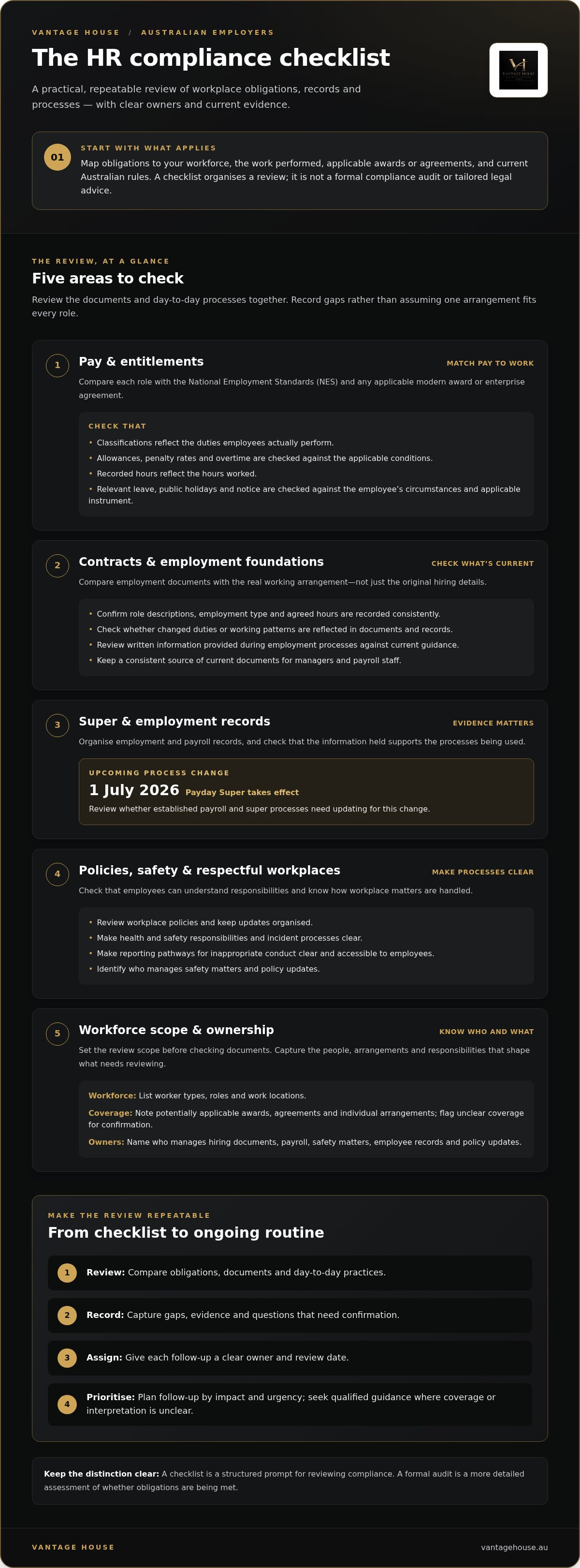
- Use an hr compliance checklist for employers to map obligations to your workforce, applicable instruments and current Australian rules.
- Compare employment documents with each worker’s role, the National Employment Standards and any applicable modern award or enterprise agreement.
- Check that classifications, allowances, penalty rates, overtime and recorded hours reflect the work employees actually perform.
- Make safety responsibilities, incident processes and reporting pathways for inappropriate conduct clear and accessible to employees.
- Turn review findings into a repeatable process: record gaps, assign owners, set review dates and prioritise follow-up by impact and urgency.
HR compliance checklist for Australian employers: define what applies
An hr compliance checklist for employers is a working review of obligations, records and processes across the employment lifecycle, from hiring and pay through to workplace safety and the end of employment. It helps you organise what to check and who is responsible. It is not a formal compliance audit or a substitute for advice tailored to your circumstances.
The requirements that apply depend on your workforce, the work being performed, applicable awards or agreements, and current Australian rules. Some checks are common across businesses, such as keeping employment documents organised. Others need closer verification, including worker classification, award coverage and requirements that may vary by role or work location. The Australian labour law framework provides a broad overview, but confirm specific obligations against current official guidance.
Set the scope before reviewing documents. List your worker types, roles, work locations and existing employment documents. Then note which arrangements or requirements need checking. This gives you a practical starting point and helps identify areas that need closer attention. For a wider business-level overview, see this Australian small business workplace compliance guide.
Who and what should the HR compliance review cover?
Include employees, managers and relevant employment arrangements. Check that each person’s classification reflects the actual working relationship and duties, rather than relying on a job title or contract label alone. For each role, record any potentially applicable modern award or enterprise agreement, along with individual arrangements that may affect employment terms. If coverage or interpretation is unclear, flag it for confirmation instead of assuming one arrangement applies to everyone.
Map responsibility for key compliance records and processes. Identify who manages hiring documents, payroll, safety matters, employee records and policy updates. In a small business, one person may own several areas, but naming an owner for each makes follow-up more reliable.
How to use this checklist without treating it as legal advice
Use the checklist to organise a review, capture evidence and identify questions. It can help you see where documents or processes may need attention, but it does not determine legal coverage or resolve complex interpretations. Confirm uncertain points through current official Australian guidance or an appropriately qualified adviser, especially if worker status, award coverage or jurisdiction-specific requirements are unclear.
A checklist is a structured prompt for reviewing compliance; a formal audit is a more detailed assessment of whether obligations are being met. This distinction keeps the process useful without overstating what a checklist can establish.
Check employment foundations, contracts and National Employment Standards
Employment documents should reflect the working arrangement in practice. As part of an hr compliance checklist for employers, compare each worker’s role, employment type, agreed hours and leave arrangements with the information in contracts, records and payroll systems. If someone’s duties or working pattern have changed, check whether their documents still describe the arrangement accurately.
Review contracts, written information and role details
Review employment documents against current workplace practices, not just the original hiring details. Confirm that each role has a clear description and that employment type and agreed hours are recorded consistently. Check that written information required during the employment process has been provided at the appropriate point. Requirements depend on the circumstances, so use current Fair Work Ombudsman guidance to confirm what applies and when.
Look for differences between templates and day-to-day arrangements. A role description may no longer match an employee’s duties, for example, or recorded hours may not reflect the agreed pattern. Note each discrepancy, identify who will review it and update records through an appropriate process. Keep a consistent source of current documents so managers and payroll staff are not relying on different versions.
Check National Employment Standards and award coverage
Review the National Employment Standards (NES) alongside any applicable modern award or enterprise agreement. Check relevant minimum conditions, including leave, public holidays and notice, against the employee’s circumstances and applicable instrument. Do not assume that one set of conditions applies across every role in the business.
Assess award coverage and classification against the work performed, rather than relying on job titles alone. A title may not describe the duties or responsibilities that inform coverage. Record the basis for your assessment and flag any uncertainty, including possible interactions between an award, agreement and individual arrangements, for qualified review.
- Employment type: Record the arrangement and check it matches the work performed.
- Role and hours: Compare documented duties and agreed hours with current practice.
- Applicable conditions: Note the NES and any award or agreement requiring review.
- Follow-up: Assign an owner to resolve inconsistencies or confirm unclear coverage.
Keep the scope clear across employment topics. Workplace safety requirements involve separate checks, and Safe Work Australia resources can help employers locate relevant WHS information. For support reviewing employment standards, award interpretation or workplace processes, workplace relations advisory may be useful.
Audit pay, modern award conditions, super and employment records
Payroll checks should compare what employees are paid with the work they perform and the conditions that apply to their roles. In your hr compliance checklist for employers, review rates and entitlements against the current award, enterprise agreement or other applicable arrangement. Check classifications against actual duties, then compare recorded hours with rosters, timesheets and approved changes.
Are pay rates and modern award conditions being applied correctly?
Review ordinary hours, overtime, allowances and penalty rates in both payroll settings and pay outcomes. For example, check whether a shift that attracts a penalty has been recorded and paid according to the relevant instrument. Avoid relying on old rate tables or assumptions based on job titles. Use current Fair Work Ombudsman tools and the applicable award or agreement to verify conditions. Its Fair Work Act best practice guide is a useful starting point.
Are payroll, super and employee records complete?
Check that payslips, time records, payroll reports and superannuation records are complete, consistent and accessible to the people responsible for review. For 2026-27, the superannuation guarantee rate is 12%. Payday Super also took effect on 1 July 2026: contributions are payable on payday and must reach the employee’s super fund within seven business days. Confirm current processes and applicable requirements against Australian Taxation Office guidance.
Reliable records help employers show what was paid, which information informed the calculation and how payroll processes were followed. Employment records must be kept for seven years. Confirm current retention requirements and record categories through official guidance.
A simple tracking table can make follow-up clear:
| Compliance item | Evidence to inspect | Owner | Review frequency |
|---|---|---|---|
| Pay and award conditions | Applicable instrument, classifications and payroll outputs | Payroll or HR lead | At changes and scheduled reviews |
| Hours and entitlements | Timesheets, rosters and leave records | Manager or payroll lead | Each pay cycle |
| Super and record keeping | Contribution records, payslips and employee files | Payroll or records owner | Each pay cycle and scheduled review |
Record exceptions, assign an owner and note the next review date. For a deeper process, use this workplace compliance audit guide. Where award interpretation or recurring payroll gaps need closer review, workplace relations advisory may be a useful source of support.
Review workplace safety, respectful conduct and employee processes
Workplace compliance also depends on how safety concerns and employee matters are handled in practice. Include these processes in your hr compliance checklist for employers, then check that written procedures match the work people actually do. Requirements can differ between states and territories, so confirm the applicable regulator guidance for each work location rather than assuming one national process covers every detail.
Are work health and safety responsibilities clear?
Review how the business identifies hazards, consults workers, provides relevant training and responds to incidents. This includes psychosocial hazards such as excessive workloads, bullying and poor management support. Australian WHS requirements address psychosocial risks, but check the applicable rules and guidance with the regulator for each jurisdiction where your employees work.
Make the steps practical and clear. Employees and managers should know how to raise a concern, who receives the report, who decides what action is needed and where the resulting records are kept. Check that the process reflects current work activities, including changes to equipment, work locations or systems. Keep incident records and follow-up actions together so the business can track whether identified issues were addressed.
Do conduct and employee processes support fair, consistent practice?
Review policies and reporting pathways for discrimination, harassment, bullying and other inappropriate conduct. Employees should be able to find out how to raise a concern, while managers should understand how to receive it and when to escalate a sensitive or complex matter. Employers also have a positive duty to take proactive steps to prevent workplace sexual harassment and related conduct. Check current official guidance when reviewing the scope of that duty and how it applies to your workplace.
Apply complaint, performance and leave processes consistently. Set out the key steps, identify the person responsible and keep appropriate records of decisions and follow-up. Limit access to sensitive information to people who need it for their role, and handle records in line with applicable privacy requirements. Clear procedures support fair handling without promising the same outcome in every case.
- Safety: Confirm hazard reporting, consultation, incident response and record keeping are understood.
- Conduct: Check that policies cover inappropriate behaviour and explain how concerns are raised and managed.
- People processes: Review complaint, performance and leave steps for consistency, confidentiality and clear ownership.
- Jurisdiction: Verify local WHS requirements and relevant regulator guidance for each work location.
This checklist is a starting point for reviewing procedures, not a detailed guide to managing a specific performance matter. If your review identifies complex or recurring workplace process gaps, seek HR support and compliance guidance to help clarify the next steps.
Turn the HR compliance checklist into an ongoing employer routine
A checklist is most useful when it leads to tracked action and regular review. Treat your hr compliance checklist for employers as a living record: workforce changes, revised duties, new policies or changes to applicable requirements can all prompt a fresh check. Set review dates that suit your operations, and consult current Fair Work Ombudsman, Australian Taxation Office and relevant work health and safety regulator guidance when confirming obligations.
Use a consistent process to move from review to follow-up:
- Identify obligations. Confirm which employment requirements apply to the roles, work locations and arrangements in scope.
- Inspect evidence. Check the relevant documents, records and processes, and note what supports your assessment.
- Record gaps. Describe what needs attention, where the issue was found and what further confirmation may be needed.
- Assign owners. Name an accountable person and set a due date for each action.
- Review progress. Track completion, retain evidence of follow-up and schedule another check where needed.
How should employers assign and track compliance actions?
For every finding, record the supporting evidence, accountable owner, due date and completion status. Separate corrections that need prompt attention from longer-term improvements to policies, training or systems. Prioritise follow-up by the potential impact and urgency of the issue, based on your business circumstances rather than an assumed universal risk ranking. Keep an evidence trail showing when actions were reviewed and completed.
Revisit the register when workers join or leave, roles change, work locations shift, or awards, policies and official requirements are updated. A strategic workplace relations guide can provide broader context for maintaining a considered approach as workplace arrangements evolve.
When should an employer seek external HR support?
Consider tailored support if award interpretation, worker status or overlapping requirements remain unclear after checking current official guidance. Recurring payroll, documentation or process gaps that your internal team cannot resolve may also warrant further review. Vantage House provides workplace relations advisory, HR support and compliance guidance for Australian employers. This is advisory support, not legal representation in formal proceedings.
What are the next steps for an employer?
Start with one checklist area and assign an accountable reviewer. Ask them to confirm the applicable guidance, inspect the evidence and report any gaps with a proposed owner and next step. This creates a manageable first action without requiring the whole review to be completed at once.
For support reviewing your priorities, discuss your HR compliance priorities with Vantage House.
Make compliance part of your regular routine
A useful hr compliance checklist for employers starts by identifying which obligations apply to your workforce, roles and work locations. Then review employment documents, pay practices, safety and employee processes against current guidance, and keep evidence of what you checked.
The lasting value comes from follow-through. Record gaps, assign an owner and review progress, then revisit the checklist when roles, arrangements or requirements change. This turns compliance from a one-off task into a manageable business routine.
Where award interpretation or recurring process gaps need further attention, Vantage House offers workplace relations advisory, compliance guidance and practical HR support, including employee review services. Discuss your HR compliance priorities with Vantage House to consider what support may suit your business.
Start with one area, set a clear next step and build from there. A steady, well-organised review can make employment obligations easier to manage over time.
Frequently Asked Questions
What should an HR compliance checklist include for Australian employers?
An HR compliance checklist for employers should cover employment documents, the National Employment Standards (NES), applicable awards or agreements, pay and employee records, superannuation, workplace safety, conduct policies and key people processes. The exact checks depend on your workforce and business arrangements. Use the checklist as a starting point, record the evidence reviewed and who owns each action, then confirm detailed requirements against current official guidance.
Do small businesses in Australia need to comply with the National Employment Standards?
Small business size alone does not mean an employer is exempt from the NES. These standards establish minimum employment conditions within the Fair Work system, and how they apply should be considered alongside the employer’s circumstances and any relevant award or agreement. Check current requirements with the Fair Work Ombudsman or an appropriately qualified adviser, particularly if you are unsure which system or instrument applies to your workforce.
How often should employers review their HR compliance checklist?
Set a regular review cycle that suits your business, and bring reviews forward when roles, workforce arrangements, applicable instruments or official requirements change. Each checklist item should have an owner, evidence to inspect and a review date. Record what has been checked and what remains unresolved. This creates a practical follow-up process rather than relying on an annual reminder that may not reflect changes during the year.
How can an employer check which modern award applies?
Start by reviewing your business activities, the employee’s actual duties and the coverage and classifications in potentially relevant awards. A job title alone may not determine coverage. Use current Fair Work Ombudsman tools and read the applicable award text, then seek tailored advice if the answer remains unclear. Keep a note of the basis for your decision so it can be reviewed if duties or business operations change.
What HR records should Australian employers keep?
Identify the employment, time, pay and other records required for your circumstances, then check that they are accurate, complete and securely managed. Limit access to people who need the information for their role, and establish a clear process for correcting errors. Retention requirements can vary by record type, so verify current rules through official sources before setting a retention schedule and deciding how records will be stored and disposed of.
Can an HR compliance checklist replace professional advice?
No. A checklist helps organise routine reviews and identify questions, but it cannot determine every obligation for a particular workforce or resolve complex award, employment or safety issues. Use it to gather relevant documents and define the matter, then check current official guidance or seek appropriate professional advice. Vantage House provides HR and workplace relations advisory and compliance guidance, but does not provide legal representation in court or Fair Work Commission proceedings.
What should an employer do after finding an HR compliance gap?
Record the issue, the evidence reviewed, the affected process and the person responsible for follow-up. Decide what needs attention first, verify the current requirement and agree on a practical correction and timeframe. If the matter involves unclear award coverage, pay or another complex obligation, seek tailored advice before changing practice. Track the action to completion, retain relevant evidence and review whether the change has addressed the gap.
Discuss your HR compliance priorities with Vantage House for workplace relations advisory, HR support or compliance guidance.


