

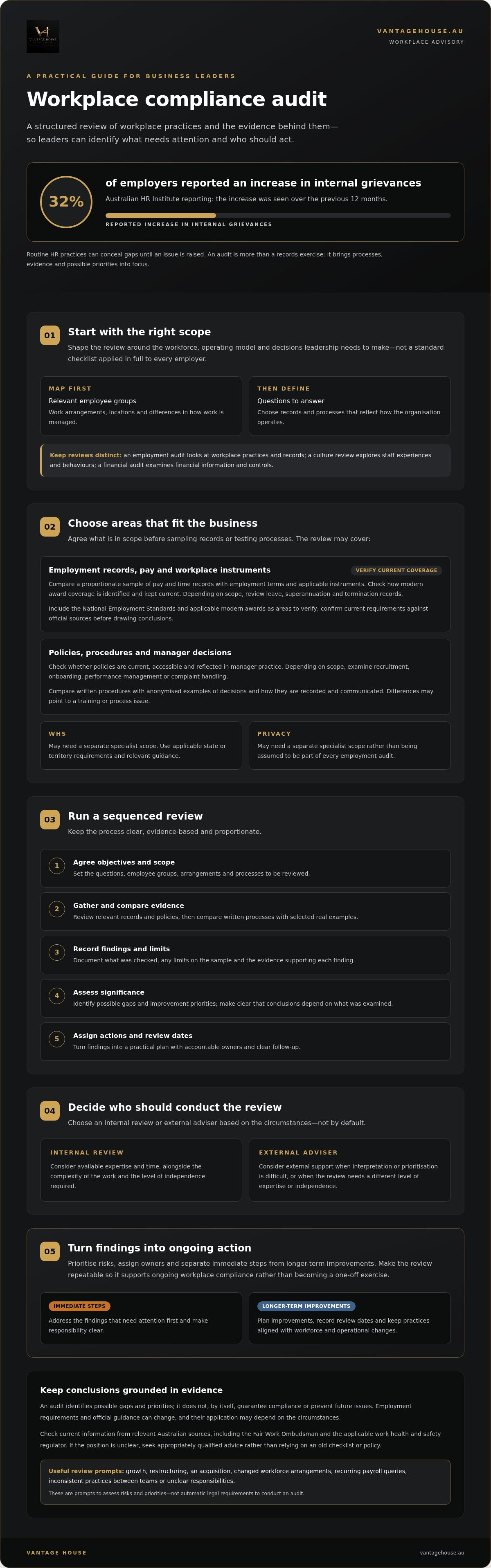
In September 2026, the Australian HR Institute reported that 32% of employers had seen internal grievances increase over the previous 12 months. A workplace compliance audit for business leaders is therefore more than a records exercise: routine HR practices can conceal gaps until an issue is raised.
It’s understandable to be unsure which employment records, processes and obligations deserve attention, particularly when internal time or expertise is limited. A practical audit brings those moving parts into focus. It helps you check whether current practices reflect your workforce and operations, and identify issues that need a closer look.
This guide explains how to scope, conduct and follow up a workplace compliance audit. You’ll learn how to select relevant records and processes, assess findings by significance, and assign clear owners to corrective actions. It also explains how to make the review repeatable, so the results support ongoing workplace compliance rather than becoming a one-off exercise. When interpretation or prioritisation is difficult, workplace relations advisory, HR support and compliance guidance can help employers plan practical next steps.
Key Takeaways
- Set an audit scope around your workforce, operating model and the decisions leadership needs to make.
- A workplace compliance audit for business should map relevant employee groups and work arrangements before records or processes are sampled.
- Use a sequenced review to agree objectives, gather evidence and record findings. Make clear that conclusions depend on what was examined.
- Choose an internal review or external adviser based on available expertise, time, complexity and the level of independence required.
- Turn findings into a practical plan by prioritising risks, assigning owners and separating immediate steps from longer-term improvements.
Why a workplace compliance audit matters for an Australian business
A workplace compliance audit is a structured review of workplace practices and the evidence that supports them. For business leaders, its purpose is to understand how employment obligations are managed in practice, not simply to collect policies and records.
The right scope depends on the organisation’s workforce arrangements, operating model and the questions leaders need answered. A business with employees working under different arrangements may need to examine different processes from a business with one consistent operating model. An employment audit can focus on workplace practices and records, while a culture review explores staff experiences and workplace behaviours. A financial audit examines financial information and controls. These reviews may inform each other, but they answer different questions.
An audit identifies possible gaps and improvement priorities. It doesn’t, by itself, guarantee compliance or prevent future issues. Its value is in giving leaders evidence to decide what needs attention and who should act. This makes the review a practical part of Governance, risk, and compliance (GRC), where compliance considerations connect with broader oversight and risk management.
Employment requirements and official guidance can change, and their application may depend on the circumstances. Before drawing conclusions, check current information from relevant Australian sources, such as the Fair Work Ombudsman and the applicable work health and safety regulator. If the position is unclear, seek appropriately qualified advice rather than relying on an old checklist or policy.
What a workplace compliance audit can tell business leaders
A review can show whether written policies match day-to-day practice. For example, it can test how managers record decisions or handle recurring employee requests. Comparing documents with selected real records may reveal incomplete files, inconsistent processes or missing decision trails. These findings give leaders a basis for setting actions, assigning accountable owners and recording review dates.
When an employer may benefit from a review
A review can be useful after growth, restructuring, an acquisition or a change to workforce arrangements, when existing processes may no longer fit how the organisation operates. Recurring payroll queries, inconsistent practices between teams or unclear responsibilities can also signal that a closer look would help. These events are prompts to assess risks and priorities, not automatic legal requirements to conduct an audit.
Which workplace compliance areas should a business audit?
A useful scope is proportionate to the business, rather than a standard checklist applied in full to every employer. Before choosing records or processes to test, map the workforce: identify relevant employee groups, work arrangements, locations and differences in how work is managed. This helps ensure the review reflects how the organisation operates and highlights where practices may vary.
For business leaders, the agreed scope might cover employment documents, pay processes, leave records and people-management procedures. Include the National Employment Standards and applicable modern awards as areas to verify, but confirm current coverage and requirements against official sources before reaching conclusions. Work health and safety (WHS) and privacy may need separate specialist scopes rather than being assumed inclusions in every employment audit.
Employment records, pay and workplace instruments
Compare a proportionate sample of pay and time records with employment terms and the instruments that apply to the relevant roles. Check how the organisation identifies modern award coverage and keeps that assessment current. Depending on the scope, review leave, superannuation and termination records against current official requirements. Record the evidence checked and any limits on the sample, so findings are clear and appropriately qualified.
Policies, procedures and manager decisions
Assess whether policies are current, accessible to employees and reflected in manager practice. Within the agreed scope, this may include recruitment, onboarding, performance management or complaint handling. Compare written procedures with anonymised examples of how decisions are made, recorded and communicated. Differences may point to a training or process issue, even when the policy itself appears complete.
For a WHS review, use the applicable state or territory requirements and relevant guidance. Safe Work Australia’s Code of Practice for managing WHS risks outlines a risk-management approach, but regulators and requirements can differ by jurisdiction. Scope privacy deliberately too, including what employee information is handled and which rules apply. Neither area needs to be folded into an employment review without a clear reason.
Set out what is in scope, what is excluded and why before evidence collection begins. If interpreting employment standards or award requirements is difficult, workplace relations advisory and compliance guidance may help clarify findings and practical next steps.
How to conduct a workplace compliance audit step by step
A structured process makes the review easier to manage and its results easier to act on. The sequence should connect agreed objectives to evidence, findings and follow-up, while making clear what the review did and didn’t test.
Set the scope and collect relevant evidence
Start by agreeing the review’s objectives, workforce groups, time period, systems and decision-makers. Confirm who can provide records, who will assess them and who will approve actions. Then gather only material relevant to the scope, which may include policies, employment records, payroll information and process documents.
Plan access carefully. Limit employee information to people who need it for the review, and use appropriate internal controls for storing, sharing and retaining records. If a full review would be disproportionate, select a sample that reflects relevant roles, arrangements or processes. State how the sample was chosen, and don’t treat it as proof about records or practices that weren’t reviewed.
Test evidence, record findings and assign actions
Compare selected records and observed practices with current requirements and the organisation’s own procedures. Verify applicable requirements through current official guidance before relying on them. An audit finding is a documented gap between an expected process and the evidence reviewed. Describe its practical impact and any limits on what was checked.
Use a simple evidence matrix to make the reasoning traceable. Each entry can record:
- Obligation: The requirement or internal procedure being checked.
- Source: The current reference, policy or record used.
- Test: The comparison or sample reviewed.
- Finding: The evidence, gap, practical impact and any limitation.
- Owner: The person accountable for the action and follow-up.
For example, a review of a pay process could record the relevant employment terms as the source, the selected records as the test, and any inconsistency found as the result. The finding should distinguish a confirmed issue from a question that needs further verification. This keeps conclusions proportionate to the evidence rather than implying that every employee record has been examined.
For each confirmed action, record a proportionate response, accountable owner, target date and follow-up evidence needed to show completion. Recheck the evidence after changes are made, and escalate uncertainty for further review. An audit is a practical management tool, not a substitute for current official guidance or legal advice when the application of an obligation is unclear.
Internal review or external adviser: how should a business choose?
The choice depends on the review’s complexity, the capability available internally and the level of independence leaders need. A familiar process with clear records may suit an internal check. Questions involving complex award interpretation, inconsistent practices across teams or a need for an independent perspective may warrant external support.
An audit doesn’t have to disrupt normal work. A staged, risk-informed scope can focus first on priority processes, use relevant samples and schedule evidence requests with the people responsible. This keeps the review manageable and gives leaders a basis for deciding whether further examination is needed. For broader context on Australian employer obligations, see the Australian workplace compliance guide.
When an internal audit may be a practical fit
An internal review can work well when responsibilities are clear, records are accessible and the reviewer has enough time and relevant expertise. Internal knowledge can help explain how a process operates in practice. If the reviewer owns the process being examined, consider safeguards such as independent sign-off or a second reviewer to reduce the risk of overlooking gaps.
Internal familiarity shouldn’t be mistaken for certainty. If a question requires specialist interpretation, such as whether a particular modern award applies, verify it through current official guidance or seek appropriate advice before concluding that a process is sound.
What to assess when considering external support
Before engaging an adviser, clarify how they propose to define the scope, handle employee information and present findings. Ask whether the work includes recommendations, implementation guidance or follow-up, and confirm what evidence or internal time the business will need to provide. These details help set realistic expectations and ensure the support matches the review’s purpose.
The adviser should explain findings in practical terms, including what needs attention and where interpretation remains uncertain. Vantage House provides employer-side workplace relations advisory, HR support and compliance guidance. Its consulting does not include representation in court or Fair Work Commission hearings.
If your team needs help interpreting workplace obligations or prioritising review findings, explore workplace relations advisory and compliance guidance from Vantage House.
Turn workplace audit findings into a practical compliance plan
Audit findings become useful when they lead to clear, proportionate action. Prioritise them using criteria agreed in advance, such as the potential significance of the issue, likelihood of recurrence, number or type of employees affected and urgency. Record the reasons for each priority so leaders can understand how decisions were made and apply the same approach consistently.
Separate the response into three timeframes. Immediate containment addresses an urgent risk while the underlying issue is assessed. Process correction fixes the specific gap, such as clarifying a record-keeping step or correcting an inconsistent approval process. Longer-term capability improvements, such as updating guidance or building manager understanding, can reduce the likelihood of the issue recurring.
Create a remediation register leaders can use
Keep findings and actions in a central register that relevant leaders can review. For each item, include a plain-English description, supporting evidence, accountable business owner, agreed action, priority, due date, dependencies and any approval requirements. Add a planned recheck and specify what evidence will demonstrate that the change has been completed and works in practice.
A finding is not closed until completion evidence has been checked against the agreed action and the change has been verified in practice. This prevents an update marked “complete” from being mistaken for proof that the underlying process has improved. If the evidence is incomplete or the issue remains, keep the action open and record the next step.
Maintain oversight after the initial review
Set a review cadence that reflects the organisation’s operations and the significance of its findings. Revisit actions when workforce arrangements, systems or processes change, and use regular management reviews to surface overdue work, recurring issues and new questions. The aim is a repeatable oversight process, not a fixed schedule that ignores changes in the business.
A workplace compliance audit for business leaders should result in a plan with named owners, realistic due dates and evidence-based closure, rather than a list of concerns without follow-through. If internal teams need help interpreting employment standards or award requirements, Vantage House’s workplace relations advisory and compliance guidance may provide employer-side support. For broader context on ongoing advisory considerations, read the strategic workplace relations guidance.
Make your audit a repeatable part of good workplace practice
A useful workplace compliance audit for business leaders is defined by the actions it enables, not the volume of documents collected. Set a scope that reflects your workforce and operations, then compare relevant practices and records with current requirements and your own procedures.
Keep findings proportionate to the evidence reviewed. Prioritise issues using clear criteria, assign an accountable owner and due date, and check completion evidence before closing an action. A central register and scheduled rechecks can help turn a one-off review into ongoing oversight as your workforce or processes change.
If your team needs support interpreting employment standards or award requirements, Vantage House provides workplace relations advisory, compliance guidance and practical HR support for Australian employers. Discuss practical workplace relations and compliance support with Vantage House.
With a clear scope and steady follow-through, your audit can give leaders a more practical view of workplace obligations and a manageable path to improvement.
Frequently Asked Questions
Is a workplace compliance audit mandatory for every Australian business?
There isn’t a universal requirement for every Australian business to conduct a formal workplace compliance audit. However, employers still need to meet the obligations that apply to their workforce, and some requirements may involve keeping records or following specific processes. Check current official guidance for your circumstances, industry and jurisdiction. An audit is a practical way to check how obligations are managed, but it doesn’t replace the obligations themselves.
What should a workplace compliance audit include?
The scope should reflect the business’s workforce, operating model and review objectives. It may cover employment documents, pay and time records, leave, applicable modern awards, the National Employment Standards and relevant HR procedures. A workplace compliance audit for business leaders may also consider how managers apply policies and record decisions. Work health and safety or privacy can require separate specialist consideration, so don’t assume they’re included in every employment review.
How often should a business conduct a workplace compliance audit?
There’s no single review interval that suits every business. Set a proportionate cadence based on the workforce, the complexity of employment arrangements and findings from earlier reviews. Reassess the scope after material changes, such as restructuring, growth or changes to work arrangements. Recurring payroll queries, inconsistent processes or overdue corrective actions can also prompt a targeted review. Check current official requirements for any specific review or record-keeping obligations that apply.
Can a small business conduct its own workplace compliance audit?
Yes, a small business can conduct an internal review when it has enough time, access to relevant records and appropriate knowledge to assess the agreed scope. Keep the review focused, document what was checked and note any limitations. If the reviewer manages the process under examination, arrange an independent check where practical. Questions involving award coverage or complex interpretation should be verified through current official guidance or appropriate specialist advice.
What happens if a workplace compliance audit identifies a gap?
Document the evidence and practical impact, then assess the finding using clear criteria such as significance, likelihood, urgency and employees affected. Decide whether immediate containment is needed, identify the process correction and assign an accountable owner and due date. Record what evidence will show the action is complete, then recheck whether the change works in practice. If the finding’s interpretation is uncertain, seek appropriate advice before deciding on a response.
Should a business use an external workplace compliance adviser?
External support may be useful when internal expertise or capacity is limited, the scope is complex or an independent perspective is important. Ask how the adviser will define the review, handle evidence and explain findings, and confirm whether recommendations, implementation guidance or follow-up are included. Vantage House provides employer-focused workplace relations advisory and compliance guidance, not representation in court or Fair Work Commission hearings.
What evidence should an employer gather for a compliance audit?
Gather evidence that matches the agreed scope. This may include employment agreements, relevant policies and procedures, payroll and time records, leave information, award coverage assessments and records of manager decisions. Process documents can show how work is meant to be handled, while selected examples can show how it operates in practice. Limit access to personal information to those who need it, and record the evidence reviewed and any sampling limitations.


