

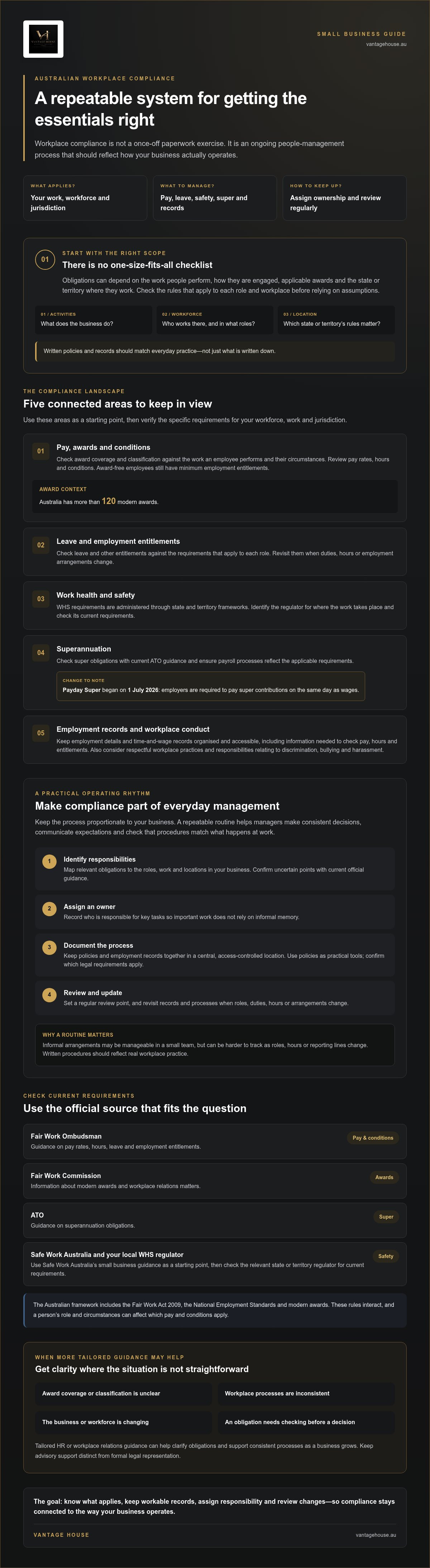
Workplace compliance is not a once-off paperwork exercise. It’s a repeatable people-management system. For Australian owners searching “small business workplace compliance australia”, the challenge is knowing which obligations apply and keeping everyday practices aligned as the business changes.
That uncertainty is understandable. Responsibilities can depend on the work people perform, applicable awards and the state or territory where they work. Policies and records also need to reflect how the business operates in practice, not just what’s written down.
This 2026 guide covers the main workplace compliance areas Australian small businesses need to manage, including pay and conditions, leave, work health and safety, superannuation and employment records. It sets out a practical review process and explains how to check current requirements through official sources, including changes such as Payday Super, which began on 1 July 2026. You’ll also learn when tailored HR or workplace relations guidance may help clarify obligations and support consistent processes as your business grows.
Key Takeaways
- Small business workplace compliance in Australia depends on your activities, workforce arrangements and the rules that apply. Don’t assume every small business has the same obligations.
- Check how pay, conditions and award coverage apply to each role, then align workplace practices with the requirements that affect your team.
- Set up a manageable routine to identify responsibilities, assign an owner, document processes and review relevant changes.
- Keep policies and employment records together in a central, access-controlled location so they’re easier to maintain and review.
- Consider tailored HR or workplace relations guidance when award coverage is unclear or processes are inconsistent. Keep advisory support distinct from formal legal representation.
Small business workplace compliance in Australia: what it covers and why it matters
Workplace compliance means meeting the employment, safety, record-keeping and related requirements that apply to your business and its workers. It isn’t a single checklist: obligations depend on what the business does, how people are engaged and the legal framework that applies. Start by identifying those factors, then check current official guidance before making decisions.
Australian employers may need to consider national workplace relations rules alongside state or territory requirements, particularly for work health and safety. The Australian labour law framework includes the Fair Work Act 2009, the National Employment Standards and modern awards. These rules interact, and an employee’s role and circumstances can affect which pay and conditions apply. For current requirements, check sources such as the Fair Work Ombudsman and the relevant work health and safety regulator for your jurisdiction.
What does workplace compliance mean for a small employer?
Some responsibilities are legal obligations, while internal policies and sound management practices help put those obligations into effect. For example, a policy can explain how staff raise a workplace concern, but the policy itself may not be legally required in every circumstance. Responsibilities can arise when hiring, throughout employment and when a working relationship ends. The details vary, so use policies as practical tools and confirm which legal requirements apply to your situation.
Why a repeatable compliance process matters
A repeatable process helps managers make consistent decisions, keep accurate records and communicate expectations clearly. It also makes it easier to check whether written procedures match what happens at work. Informal arrangements may be manageable in a small team, but can be harder to track when roles, hours or reporting lines change.
Keep the process proportionate. Identify the obligations relevant to your workforce, record who is responsible for key tasks and set a regular review point. When an obligation is unclear, check current official guidance or seek tailored workplace relations advice before relying on an assumption. This makes compliance part of day-to-day management, rather than paperwork completed once and forgotten.
The main Australian workplace compliance areas small businesses need to understand
Workplace obligations usually span several connected areas. A useful starting point is to identify which rules affect each role and workplace, rather than relying on a general checklist. Verify obligations against your workforce, work and jurisdiction, because the right answer can depend on all three.
Pay and conditions are role-specific. Australia has more than 120 modern awards, and coverage and classification depend on the work an employee performs and the circumstances of their employment. Award-free employees still have minimum employment entitlements. Check classifications, pay rates, hours and leave against current Fair Work Ombudsman guidance, and use the Fair Work Commission for information about awards and workplace relations matters.
Pay, awards, employment records and superannuation
Keep employment details and time-and-wage records organised and accessible, including the information needed to check pay, hours and entitlements. Review them when duties, hours or employment arrangements change. The ATO provides guidance on superannuation obligations. From 1 July 2026, Payday Super requires employers to pay super contributions on the same day as wages. Confirm current requirements and make sure payroll processes reflect them.
Work health and safety, fair treatment and workplace conduct
Work health and safety requirements are administered through state and territory frameworks, so identify the regulator relevant to where work takes place. Safe Work Australia’s guidance on Small business WHS duties is a useful starting point, but check the applicable local regulator for current requirements. Employers should also consider respectful workplace practices and responsibilities relating to discrimination, bullying and harassment. Requirements can depend on the circumstances and the laws that apply, so consult the relevant regulator or a qualified adviser if you’re unsure.
Consider these areas together. A change in a role may affect its award classification, pay arrangements, records and safety processes. Reviewing them as a group helps keep workplace practices aligned as the business evolves.
- Fair Work Ombudsman: practical information on pay, awards and employment conditions.
- Fair Work Commission: information about modern awards and workplace relations matters.
- ATO: guidance on superannuation and related employer obligations.
- State or territory safety regulator: local work health and safety requirements.
If award interpretation or workplace processes remain unclear, tailored workplace relations advisory can help employers assess obligations and improve consistency.
Common small business compliance assumptions that need checking
A small team can make workplace processes feel straightforward, but team size alone doesn’t determine which obligations apply. Some rules include size-based provisions, while other responsibilities depend on the work performed, employment arrangements or the workplace itself. Check each obligation on its own terms rather than assuming one “small business” rule applies across the board.
For example, an employer might qualify for a particular provision under workplace relations law but still need to meet separate work health and safety requirements. The relevant definition of a small business, how workers are counted and any conditions attached can differ between rules. Before relying on an exemption or special process, check current guidance from the responsible regulator and confirm that it applies to your circumstances.
Does being a small business change which rules apply?
Sometimes, but the effect is specific to the rule. Don’t transfer an employee threshold or exemption from one area of workplace law to another. Check the official guidance for the obligation in question, including how it defines a small business and counts its workforce. If the wording or application is unclear, seek tailored advice before changing a workplace process or making an employment decision.
Why documents alone don’t establish compliance
A policy can be current on paper yet poorly understood or applied inconsistently. Templates may also fall out of step with changes to roles, reporting lines or everyday practices. Check whether managers know the current procedure, follow it consistently and keep appropriate records of actions taken. General information can help identify issues, but it isn’t a substitute for legal advice tailored to a particular situation.
For example, a written procedure for handling staff concerns is only useful if employees know how to raise an issue and managers understand how to respond. A regular review can reveal gaps between the documented process and what happens in practice. Check whether the policy remains suitable and whether the people responsible for applying it have the information and support they need.
Workplace relations guidance can help employers interpret obligations and improve internal processes. Formal legal advice may be needed for questions that require an assessment of specific legal rights or risks. For more context on how workplace relations strategy can support consistent employer decisions, read this strategic workplace relations guide.
How to organise a manageable workplace compliance routine
A workable compliance routine turns obligations into regular business tasks instead of leaving them until a concern arises. The aim is to make responsibilities visible, keep supporting information in order and review the process when the business changes.
Map what applies, assign an owner, keep evidence, check for changes and record how gaps are resolved. Scale the routine to suit the size and structure of your business. A new role, change in duties, different award coverage or operational change can all prompt a review of relevant arrangements.
Build a practical compliance register and document routine
A simple register helps managers see what needs attention without creating a complex system. For each obligation, record the responsible person, the evidence or document that supports it, the next review date and the official source used to confirm the requirement. Where practical, link each entry to the relevant policy or employment record.
Keep policies and employment documents in a central, access-controlled location. Check for missing or outdated items, and confirm that current procedures are actually used. Personnel files can contain sensitive information, so limit access to people who need it for their work and use appropriate security settings. The register should point to records, not make them accessible to everyone.
Review changes and respond to identified gaps
Set a regular review date and add a separate check when a material change occurs. Monitor updates from the Fair Work Ombudsman, the ATO and the relevant state or territory safety regulator. If an update may affect the business, verify its scope and effective date through current official guidance before changing payroll, policies or workplace processes. This is particularly useful in 2026, when employers need to keep procedures aligned with applicable changes.
When a review identifies a gap, record what needs to change, who will address it and the target completion date. Prioritise the work based on its relevance to current operations and any applicable deadlines. Then record the decision and confirm when the action is complete. A clear record makes follow-up easier and helps prevent the same issue from being overlooked.
Where the right process or interpretation is unclear, specialist support can help turn a review into practical next steps. Explore workplace compliance guidance to discuss support for interpreting obligations and improving internal processes.
When small businesses may benefit from workplace compliance support
Not every small business needs ongoing external support. However, repeated uncertainty about employment conditions or gaps between written procedures and day-to-day practice can be a good reason to seek guidance. The aim is to clarify what applies and decide on a practical way forward, rather than add unnecessary process.
Recognising when internal capacity may not be enough
Consider getting support if you’re unsure which modern award covers a role, how a classification applies or whether employment processes remain suitable as the team changes. Growth, new or changing duties, and unresolved gaps in HR procedures are also useful prompts for a review. These are reasons to assess your needs, not signs that every small employer requires an ongoing adviser.
Before seeking help, identify the question you need answered and gather relevant information, such as position descriptions, employment documents, pay records and current policies. A clear starting point can keep the discussion focused on the issue and the practical decisions involved.
What an employer can expect from advisory support
Official sources can help employers understand general requirements. Tailored workplace relations or HR advisory support can help interpret how obligations may apply to a business’s roles, arrangements and internal processes. The type of support needed depends on the issue. Questions about legal rights, exposure or a specific dispute may require advice from a suitably qualified legal practitioner.
Vantage House provides employer-focused workplace relations advisory, HR support and compliance guidance. Its workplace relations advice includes employment standards and modern award interpretation, while practical HR assistance can help employers review processes and support consistent practices as the business changes. The appropriate scope of support depends on the employer’s circumstances.
Advisory support is distinct from formal legal representation. Vantage House does not provide representation in court or Fair Work Commission hearings. If a matter requires representation or formal legal advice, employers should seek an appropriately qualified legal provider.
A practical next step is to define the issue, gather the relevant records and discuss what type of guidance would suit your circumstances. Discuss workplace compliance support with Vantage House.
Make workplace compliance a steady part of running your business
Effective workplace compliance starts with understanding which obligations apply to your roles and operations, then keeping practices and records aligned as circumstances change. Regular reviews help identify outdated documents, unclear responsibilities and processes that need attention. They also give you a practical way to check current requirements rather than rely on assumptions.
When award coverage or employment standards are difficult to interpret, tailored guidance can help clarify the next steps. Vantage House provides employer-focused workplace relations advice, including employment standards and award interpretation, alongside practical HR support and compliance guidance for Australian employers.
To discuss the issue affecting your business and the support that may suit your circumstances, Discuss practical workplace compliance support with Vantage House.
Clear responsibilities and a manageable review routine can help you approach workplace compliance with greater confidence as your business evolves.
Frequently Asked Questions
What workplace compliance requirements apply to small businesses in Australia?
Requirements depend on your business activities, workforce arrangements and the laws that apply. They may cover pay and conditions under the National Employment Standards and any relevant modern award, employment records, superannuation, work health and safety, and fair treatment at work. Start by checking which obligations apply to each role and workplace, then confirm current details with the relevant official sources.
Do small businesses have different workplace obligations from larger employers?
Some workplace rules include provisions based on business size, but that doesn’t mean small employers are exempt from workplace obligations. For example, the Fair Work Act defines a small business as having fewer than 15 employees for particular workplace relations provisions, including aspects of unfair dismissal and casual conversion. Other laws use different rules or thresholds. Check the current guidance for each obligation rather than applying one definition across your business.
How can a small business check whether it is complying with workplace laws?
Start by listing your roles, employment arrangements and the requirements that may apply to each. Check pay, award coverage and employment conditions using current Fair Work Ombudsman and Fair Work Commission information, and consult the ATO about superannuation. For work health and safety, refer to the regulator for the relevant state or territory. Compare official guidance with your actual practices and records, and seek tailored advice if an obligation remains unclear.
What records should a small business keep for workplace compliance?
Keep employment and time-and-wage records that help verify each person’s role, hours, pay and entitlements, along with relevant employment documents and records of workplace processes. The records needed depend on the obligation, so check current Fair Work Ombudsman and ATO guidance for applicable requirements and retention periods. Store documents securely, restrict access to people who need them for their work, and keep records organised enough to review when arrangements change.
Can a small business use online HR templates to meet its compliance responsibilities?
Online templates can provide a starting point, but using one doesn’t by itself establish compliance. A template may not reflect your award coverage, workforce arrangements, state or territory requirements, or current rules. Check that it suits your business and update it when relevant obligations or workplace practices change. Managers should also understand and follow the procedure consistently. If you’re unsure whether a document fits your circumstances, seek qualified workplace relations or HR guidance.
How often should a small business review workplace compliance?
Set a regular review schedule and revisit relevant requirements when something changes, such as a new role, altered duties, workforce growth or a change in operations. Monitor official updates from the Fair Work Ombudsman, the ATO and the applicable safety regulator, then confirm whether they affect your business. Record the review date, any identified gaps, the person responsible and actions taken. This makes reviews easier to follow up without assuming a single schedule suits every obligation.
When should a small business seek workplace relations or HR advice?
Seek guidance if award coverage or employment conditions are unclear, HR processes are inconsistent, or changes in roles and operations leave gaps you can’t resolve internally. Vantage House provides employer-focused workplace relations advice, including employment standards and award interpretation, alongside practical HR support and compliance guidance. Advisory support is distinct from legal advice and representation. Vantage House does not represent employers in court or Fair Work Commission hearings, so seek an appropriate legal provider if representation is required. Discuss your workplace compliance needs with Vantage House.


