

The obvious choice isn’t always the fairest one. An internal investigation may be practical, but existing relationships can affect how impartial the process appears. For Australian employers searching for guidance on “managing workplace misconduct australia”, the right response depends on the allegations, workplace context and need for independence.
Employers also need clear boundaries around who gathers information, what will be treated confidentially, and how evidence and decisions will be recorded. Inconsistent steps can increase workplace tension and weaken confidence in the outcome, even when a concern is handled with good intentions.
This article offers a practical framework for assessing a misconduct concern, comparing internal and external investigation options, and deciding when independent support may be appropriate. It explains what to clarify before engaging an external investigator, including scope, impartiality, confidentiality and documentation. The aim is a fair, well-documented process that gives relevant people an opportunity to respond and helps the employer decide on a proportionate next step.
Key Takeaways
- Record the concern, assess any immediate needs and define the specific questions the process must answer.
- When managing workplace misconduct australia, compare internal and external options against impartiality, capability, conflicts and clear reporting.
- Keep interviews evidence-focused, treat participants consistently and provide a genuine opportunity to respond.
- Separate fact-finding from the employer’s decision, then consider findings in context before deciding on any action.
- Close out the matter with appropriate communication and organised records to support a clear, practical next step.
Managing workplace misconduct in Australia: establish the issue before choosing a response
A conduct concern can affect people, working relationships and day-to-day operations. For employers managing workplace misconduct australia, start by clarifying what has been reported, what is known and whether anyone needs immediate support. A measured response helps preserve relevant information and avoids treating an allegation as a conclusion.
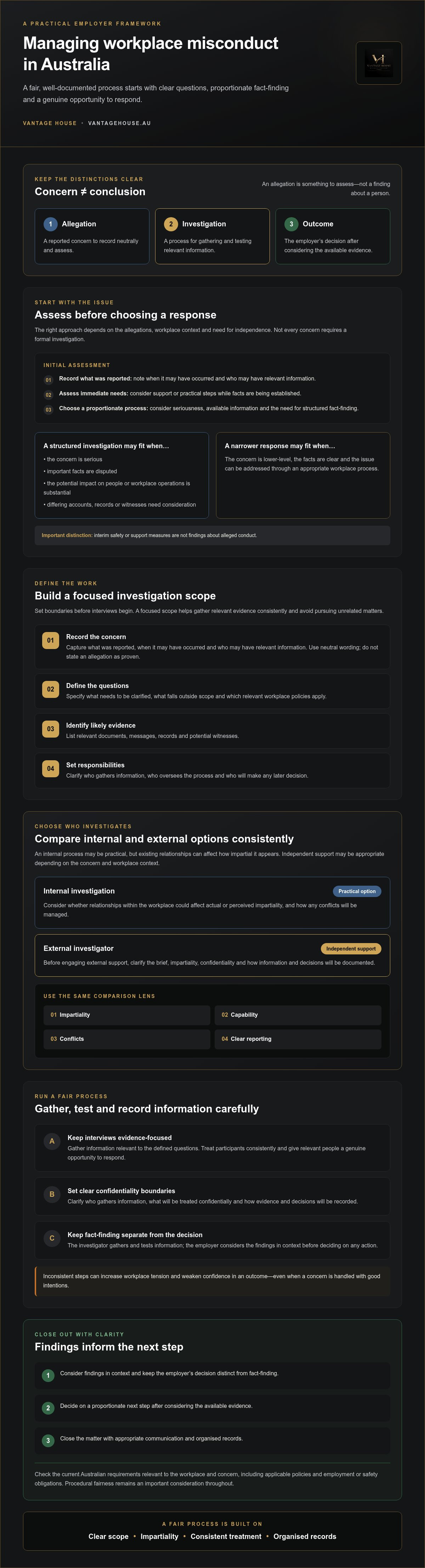
An allegation is a concern to assess, an investigation is a process for gathering and testing information, and an outcome is the employer’s decision after considering the available evidence. Not every concern requires a formal investigation. Choose a response proportionate to the seriousness of the issue, the information available and the need for structured fact-finding.
What counts as a workplace misconduct concern?
A concern might involve alleged bullying, harassment, dishonesty or a breach of workplace rules. These examples are illustrative, not legal definitions or findings about a particular person. The same reported behaviour may call for different responses depending on its context, the available evidence and the employer’s policies.
Begin by recording what was reported, when it may have occurred, who may have relevant information and what material could help clarify events. Use neutral wording. For example, record that a person reported repeated unreasonable comments, rather than stating that bullying occurred. This distinction supports a fair process and helps define what needs to be established.
For broader employer context, see the strategic workplace relations guide. It can help place a misconduct concern within the wider work of managing workplace relationships and responsibilities.
When might an employer consider an investigation?
A structured investigation may be appropriate when the concern is serious, important facts are disputed, or the potential impact on people or workplace operations is substantial. It can also help where accounts differ and relevant records or witnesses need to be identified and considered. A narrower, informal response may suit a lower-level concern when the facts are clear and the issue can be addressed through an appropriate workplace process.
Keep immediate safety or support measures separate from conclusions about alleged conduct. An employer may need to consider practical steps to reduce contact or provide support while facts are being assessed. Those steps should not be treated as a finding against any person.
Before choosing a process, check the current Australian requirements that apply to the workplace and concern, including relevant policies and employment or safety obligations. Procedural fairness is an important consideration throughout. This plain-language overview of the principles of natural justice describes ideas such as providing a fair opportunity to be heard and avoiding bias. The next step is to define the questions the process needs to answer.
Scope a workplace misconduct investigation around clear questions and evidence
A practical approach to managing workplace misconduct australia starts with a defined process, not an open-ended search for fault. Once a concern is recorded, set the investigation’s boundaries before interviews begin. A focused scope helps the investigator gather relevant evidence consistently and reduces the risk of overlooking key issues or pursuing unrelated matters.
- Record the concern: Capture what has been reported, when it may have occurred and who may have relevant information.
- Assess immediate needs: Consider whether interim support or practical steps are needed while facts are being established.
- Define the questions: Identify what the investigation needs to clarify without assuming an allegation is proven.
- Identify evidence: List likely documents, messages, records and potential witnesses.
- Set responsibilities: Confirm who gathers information, who oversees the process and who will make any later decision.
What should the investigation brief include?
A written brief should describe the allegations neutrally, identify relevant workplace policies and set out the questions to be examined. It should also specify what falls outside scope, who is responsible for fact-finding, who makes decisions and how actual or perceived conflicts will be managed.
Set expectations for updates, evidence handling and review points. Use a realistic timetable that allows for participant availability and the complexity of the matter, rather than promising a fixed completion date. If credible new information emerges, assess whether the scope needs to change. Record what changed, why it matters and who approved the adjustment, then communicate necessary updates to affected participants.
How should evidence and confidentiality be managed?
Identify likely evidence early, including relevant emails, messages, work records and potential witnesses. Preserve material in its original form where practicable, record what has been collected and store it securely. Limit access to people with a legitimate role in the process, and avoid circulating allegations more widely than necessary.
Handle confidentiality carefully, but don’t promise absolute secrecy. Information may need to be shared so people have a fair opportunity to respond or the employer can manage the matter appropriately. Explain that information will be treated discreetly and shared only where needed. Check applicable legal and workplace requirements before deciding on access or disclosure arrangements. The Fair Work Ombudsman’s Workplace investigations process provides further Australian guidance on conducting investigations and considering evidence.
Clear responsibilities and careful records help keep the process organised. Employers seeking broader workplace relations or HR support can discuss their requirements with Vantage House.
Choose an internal or external workplace investigator using a consistent comparison
There’s no automatic advantage to choosing an external investigator. An internal process may be appropriate when the people involved can act impartially and have the capability and time to do the work. External support may help when seniority, workplace relationships or perceived bias could undermine confidence in an internal process. The aim in managing workplace misconduct australia is to choose an approach that fits the matter, not to assume one option is always better.
Compare both options against the same practical criteria:
| Factor | Internal option | External option |
|---|---|---|
| Independence | Can the person investigate without pressure or divided loyalties? | Can they demonstrate objectivity and distance from the workplace? |
| Capability | Do they have relevant experience and enough time? | Can they explain their approach and relevant experience? |
| Conflicts | Could reporting lines, relationships or interests affect confidence? | Have actual or potential conflicts been disclosed and addressed? |
| Availability | Can the person give the matter appropriate attention? | Can the provider meet the organisation’s reasonable timing needs? |
| Reporting | Can findings be recorded clearly and neutrally? | Are the format and deliverables agreed in writing? |
| Communication | Can updates be handled consistently and discreetly? | Are responsibilities for updates and contact clearly assigned? |
For broader employer-side workplace relations support, you can discuss workplace relations support with Vantage House.
When can an external workplace investigator be appropriate?
Consider external support if a senior leader is involved, decision-makers have close relationships with the people concerned, or internal reporting lines could affect perceived impartiality. Complexity, sensitivity, scale and in-house capability also matter. Record why the selected approach is proportionate to the allegations and workplace context. Appointing an external investigator alone doesn’t guarantee independence; conflicts and methods still need to be checked.
What should employers check before engaging an investigator?
Ask about relevant experience, investigation methodology, conflict checks and insurance arrangements, and verify any requirements that apply. Agree in writing on the scope, deliverables, reporting format, evidence security, communication responsibilities and a realistic timetable. Request references and clarify the fee basis before engagement. The employer retains responsibility for decisions after fact-finding, so confirm who will assess the findings and determine next steps.
Manage interviews, fairness and records throughout the investigation
Consistent interviews and reliable records help an employer assess evidence without letting assumptions shape the result. In managing workplace misconduct australia, fairness is practical: ask relevant questions, give people a genuine chance to respond to material information, and document how the process was carried out.
How should an employer prepare for investigation interviews?
Plan neutral, open questions linked to the defined allegations and evidence. Questions such as “What happened next?” invite an account. Questions that assume a person’s conduct was improper can lead or unfairly frame the response. Use a consistent core set of questions where appropriate, while allowing relevant follow-up questions to clarify different accounts.
At the outset, explain the interview’s purpose, the investigator’s role, how notes will be taken and what happens next. Keep the discussion respectful and allow the person to explain their account. If information may be relied on when assessing a concern, consider how the affected person can respond through an appropriate process. The steps required can depend on the circumstances, workplace policies and current law, so check relevant requirements and obtain appropriate advice where needed.
What records should be retained?
Maintain an organised file that allows a later reviewer to understand what happened and why. Useful records may include:
- a dated chronology and the investigation brief;
- an evidence register identifying material received and its source;
- interview notes, including any corrections or confirmation process; and
- key communications and records of decisions about scope, interim arrangements and next steps.
Record reasons for material changes as they occur, rather than relying on memory at the end. Keep notes factual and distinguish direct observations from a participant’s account or the investigator’s assessment. Limit access to people with a legitimate role, store records securely and follow the organisation’s privacy and retention processes. Check current requirements before deciding how long records should be kept or how personal information should be handled.
The investigator’s role is to gather and assess information against the questions in scope. The employer, or an authorised decision-maker, should separately consider the findings and determine any response under applicable workplace processes. Keeping those roles distinct supports clearer accountability and avoids treating an investigator’s findings as an automatic disciplinary decision.
For support with workplace relations processes, discuss your workplace relations requirements with Vantage House.
Use investigation findings to decide next steps and improve workplace practice
Closing a workplace investigation involves more than receiving a report. The employer should review the findings, consider the relevant context and decide what practical next steps are appropriate. In managing workplace misconduct australia, a finding informs the employer’s decision but doesn’t automatically determine disciplinary action.
How should employers assess investigation findings?
Review each allegation against the evidence gathered and the agreed scope. Consider whether the information supports the allegation, does not support it, or leaves it unresolved. Check that relevant responses and contextual information have been considered, and make the reasoning clear in the final record.
The employer’s decision-maker should then consider relevant workplace policies, any applicable process and the circumstances before deciding what action, if any, is appropriate. Base the response on the findings rather than assumptions, and take account of the impact on people and the workplace. Where potential consequences or legal risks are significant, seek advice from a suitably qualified adviser and confirm that the advice fits the issue.
How can employers close the process constructively?
Communicate the outcome to relevant people in measured terms. Explain what can appropriately be shared while protecting personal information and avoiding unnecessary disclosure about other participants. Record the outcome, any actions to be taken, who is responsible and when those actions will be reviewed.
Use the review to identify whether the issue points to a broader workplace concern. For example, the employer may need to clarify a policy, provide relevant training or review how managers address similar concerns. These steps can help reduce the risk of repeat problems without treating one investigation as proof of a wider pattern.
Retain the investigation brief, relevant evidence, findings, decision rationale and close-out communications under the organisation’s record-keeping and privacy processes. A clear file helps explain how the matter was handled and supports consistent follow-up.
For broader workplace relations guidance or HR support, employers can contact Vantage House to discuss their requirements. Vantage House provides employer advisory and HR support, rather than investigations or investigator services.
Move forward with a fair, well-documented response
A practical approach to managing workplace misconduct australia starts by separating the concern from any finding. Define the questions, choose an internal or external process suited to the workplace context, and assess information consistently. Clear records and a genuine opportunity for relevant people to respond help the employer reach a considered outcome.
Findings are not automatic disciplinary decisions. Consider the evidence, responses, relevant policies and context before deciding what happens next. Then communicate appropriate outcomes, record responsibilities and follow-up actions, and address any wider workplace issues the matter has highlighted.
Workplace misconduct can create uncertainty, but a structured response gives employers a clear way to make decisions and support workplace confidence. Vantage House provides Australian employers with workplace relations advisory, HR support and compliance guidance. To discuss your broader workplace relations requirements, contact Vantage House.
Frequently Asked Questions
When should an Australian employer use an external workplace investigator?
An external investigator may be worth considering when seniority, personal relationships or reporting lines could affect confidence in an internal process. External support may also suit matters that are sensitive, complex or beyond the organisation’s available capability. It isn’t automatically necessary or inherently more impartial, so assess the circumstances and document why the chosen approach is proportionate. Check the investigator’s experience, methodology and conflicts before engagement.
Can an employer investigate workplace misconduct internally?
Yes. An employer can manage fact-finding internally if the person responsible can act impartially and has the capability, time and authority to follow a clear process. Identify any relationships or reporting lines that could affect perceived fairness, and consider who will make decisions separately from the investigator. For managing workplace misconduct australia, the approach should suit the allegations and workplace context, with relevant policies and current requirements checked before proceeding.
What should an external workplace investigator’s terms of engagement include?
Set out the scope, allegations and questions to be examined, along with the investigator’s responsibilities and the employer’s decision-making role. Confirm the proposed methodology, deliverables, report format, evidence security and communication responsibilities. Also clarify conflict checks, relevant experience, insurance arrangements, expected timing and the fee basis. Agree how any scope changes will be approved and recorded. Check applicable requirements and obtain appropriate advice if the matter carries significant risk.
How long does a workplace misconduct investigation take in Australia?
There’s no single timeframe that suits every investigation. Duration can depend on the number and complexity of the issues, the availability of participants, the volume of evidence and whether new information changes the scope. Set a realistic review timetable rather than promising a fixed completion date. Keep relevant people updated about progress and any delays while managing information carefully. If the process needs more time, record the reason and adjust expectations.
What happens if an employee disputes the investigation findings?
Consider the employee’s concerns carefully and check whether they identify relevant evidence, an overlooked response or a process issue. Review the material against the investigation’s scope and record the reasons for any further steps. A disagreement doesn’t automatically invalidate findings or require the investigation to be repeated. Before deciding how to respond, check applicable workplace processes and seek appropriately qualified advice where the consequences or risks are significant.
Is workplace investigation information confidential?
Investigation information should be handled discreetly and shared only with people who have a legitimate role, but absolute confidentiality shouldn’t be promised. Information may need to be shared so a person can respond to relevant concerns or the employer can manage the process. Explain how information is expected to be handled, store records securely and follow organisational privacy and retention processes. Check current requirements before deciding what can be disclosed and to whom.
How should an employer choose between an internal and external investigator?
Compare the options using consistent criteria: independence, relevant capability, conflicts, availability, reporting and communication. An internal investigator may be suitable if they can act objectively and manage the work properly. An external investigator may be preferable if relationships, seniority or the matter’s complexity could undermine confidence in internal handling. Ask any external provider for a written scope, deliverables and fee basis, then record why the selected approach fits the matter.


