

Workplace Investigation Guide for Employers 2026
A concern reaches HR on Monday morning, but the next steps aren’t clear. Who should lead the response, what needs to be preserved, and how can the people involved be treated fairly? A sound workplace investigation process for employers starts with a measured response, not a conclusion reached before the facts are known.
Workplace concerns need timely attention, but uncertainty about roles, communication and record-keeping can weaken confidence in the outcome. A structured process separates fact-finding from decision-making and makes fairness visible at each stage.
This guide sets out a practical sequence for managing a concern from initial intake to outcome. It covers assessing immediate risks, defining the scope, selecting an impartial investigator, gathering and documenting relevant information, and giving people a meaningful opportunity to respond. It also explains how to communicate findings discreetly and determine proportionate next steps, while checking the obligations that apply to your organisation and workforce in Australia.
Key Takeaways
- Use a structured fact-finding process to assess concerns such as alleged misconduct, bullying or policy breaches before deciding on a response.
- Follow a clear workplace investigation process for employers, from defining the scope and appointing an appropriate investigator to gathering evidence and reporting findings.
- Give the person responding enough information to address the allegations, and manage confidentiality on a need-to-know basis rather than promising complete secrecy.
- Choose an internal or external investigator based on the circumstances, including the need for impartiality, relevant capability and stakeholder confidence.
- Keep investigation findings separate from the employer’s decision, then communicate outcomes appropriately while protecting sensitive information.
When should an employer begin a workplace investigation?
A workplace investigation is a structured way to gather and assess relevant information about a concern. It is not a disciplinary outcome, and an allegation should not be treated as proven simply because it has been raised. Reports of alleged misconduct, bullying, discrimination, safety concerns or significant policy breaches may warrant formal fact-finding. Concerns can come through a manager, HR, employee complaints or whistleblowing.
Not every issue needs a formal investigation. A minor misunderstanding may be addressed through an informal conversation, while ongoing capability concerns may be better managed through performance processes. Immediate steps to reduce a safety or contact risk are safeguards, not findings. Choose a process that reflects the seriousness and circumstances of the concern, the information available and the obligations that apply.
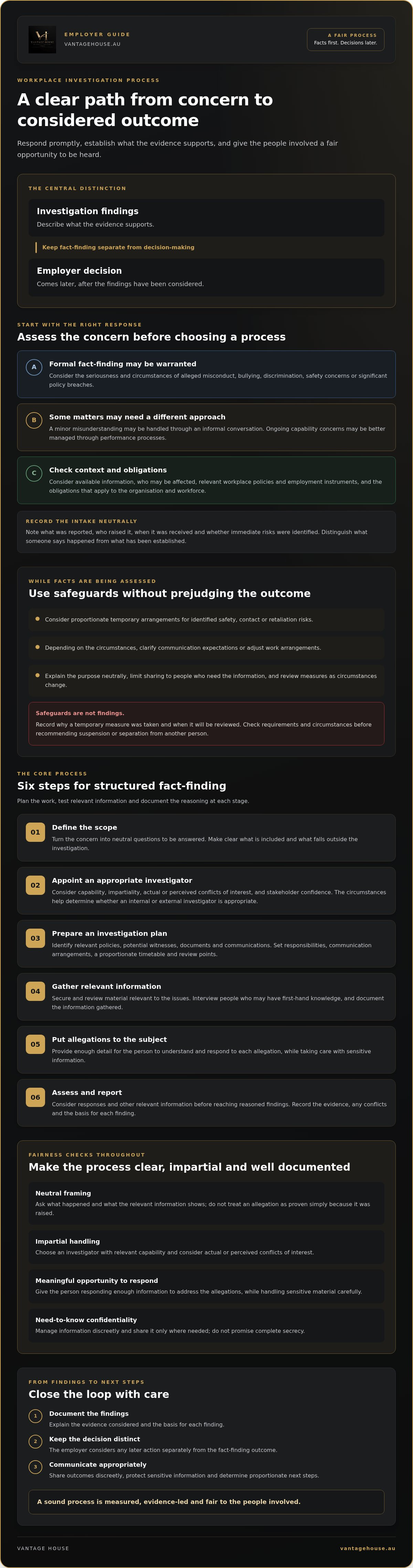
Investigation findings describe what the evidence supports; the employer makes any later decision about action. Keeping these stages distinct helps prevent premature conclusions and supports a considered response.
Assess the concern before choosing a response
Start by recording what was reported, who raised it, when it was received and whether any immediate risks have been identified. Use neutral language that distinguishes what a person says happened from what has been established. Consider the seriousness of the alleged conduct, whether similar concerns have arisen before, what evidence may be available and who could be affected.
Check relevant workplace policies, employment instruments and applicable obligations before settling on a response. Requirements can depend on the employer’s jurisdiction and workforce, so verify uncertain points rather than assuming one approach applies in every Australian workplace.
Set immediate safeguards without prejudging the outcome
While facts are being assessed, consider proportionate temporary arrangements to manage identified safety, contact or retaliation risks. Depending on the circumstances, this could mean clarifying communication expectations or adjusting work arrangements. Explain the purpose neutrally, share information only with people who need it, and review the measures as circumstances change.
Safeguards must not be presented as proof of wrongdoing. Suspension or separation from another person may have significant consequences, so check the relevant requirements and circumstances before recommending either. Record why a temporary measure was taken and when it will be reviewed.
How to conduct a fair workplace investigation: the core process
A fair process is planned, even when a concern needs prompt attention. Make clear what is being examined, who is responsible for each step and how the evidence will inform findings. A practical sequence is:
- Define the scope. Turn the concern into neutral questions to be answered, and identify what falls outside the investigation.
- Appoint an appropriate investigator. Consider the person’s capability, impartiality and any actual or perceived conflicts of interest.
- Prepare an investigation plan. Identify relevant policies, potential witnesses, documents and communications. Set responsibilities, communication arrangements, a proportionate timetable and review points.
- Gather relevant information. Secure and review material relevant to the issues, and interview people who may have first-hand knowledge.
- Put allegations to the subject. Provide enough detail for the person to understand and respond to each allegation, while taking care with sensitive information.
- Assess and report. Consider responses and other relevant information before reaching reasoned findings. Record the evidence, any conflicts and the basis for each finding.
In short, define the issues, appoint an impartial investigator, gather and test evidence, provide a meaningful opportunity to respond, then document findings separately from any later employment decision.
Define the scope and prepare an investigation plan
Frame each issue as a question, not a conclusion to confirm. For example, ask what occurred during a particular interaction and whether the conduct was consistent with the relevant policy, rather than assuming a breach took place. Identify potential witnesses and records, such as relevant messages or meeting notes, and check for conflicts that could affect the investigator’s neutrality.
Set a timetable that supports prompt progress, with review points in case new information changes the scope. Avoid promising a fixed completion date before the complexity and availability of evidence are clear.
Gather evidence, interview fairly and assess findings
Explain the process to interviewees and use consistent, open questions that invite detail without suggesting an answer. Keep accurate records of what was said, distinguish direct evidence from assumptions, and give people a reasonable chance to correct errors in interview notes or summaries.
The subject of an allegation must have a genuine opportunity to address the material issues. Consider their response and other relevant information before making findings. If accounts conflict, record the difference and explain how the available evidence was weighed. A prompt investigation matters, but speed shouldn’t replace a fair opportunity to participate.
Where the process or applicable workplace obligations are unclear, workplace relations advisory may help an employer clarify relevant considerations and next steps.
What makes a workplace investigation fair, impartial and well documented?
Fairness is demonstrated through the steps taken, not simply stated in a final report. The investigator should approach the evidence impartially, explain the allegations clearly, give relevant people a meaningful opportunity to respond and reach findings supported by the information gathered. These safeguards help make the process transparent and consistent.
Confidentiality should be managed carefully, but it shouldn’t be promised absolutely. Information may need to be shared with people involved in responding to the allegations or making decisions. Restrict access to those who need the information for their role, and explain these limits at the outset. This protects sensitive details without creating an expectation of secrecy the employer may not be able to maintain.
Protect impartiality and give people a genuine opportunity to respond
Before appointing an investigator, consider whether their relationships, prior involvement or reporting lines could create an actual or perceived conflict. Assess independence in context rather than assuming it from a job title. If a concern arises during the investigation, review whether it affects confidence in the process and decide whether responsibilities need to change.
Give the person responding enough information to understand the substance of each allegation and address it meaningfully. Sensitive details can be handled with care, but the explanation still needs to be adequate for a response. Consider that response, along with any relevant new evidence, before finalising findings.
Create records that explain how conclusions were reached
Good records allow an employer to trace the steps from the initial concern to the findings. Keep dated notes of key decisions and communications, source documents, interview records and an evidence register. Record what information was considered and why particular steps were taken, including any changes to the scope or timetable.
In the report, distinguish observed facts from disputed accounts, inferences and conclusions. For example, identify whether a detail comes from a document, a person’s direct recollection or an interpretation of events. Where accounts differ, explain how the evidence was assessed and why a finding was reached, without presenting an unsupported assumption as fact.
Investigation findings are not the same as a decision about disciplinary action or another employment outcome. The investigator reports what the evidence supports; the employer considers any response separately, taking the findings and relevant circumstances into account.
Limit access to investigation material and check the privacy, workplace surveillance and record-retention requirements that apply to the employer’s jurisdiction and circumstances. Don’t assume one storage or retention approach suits every case. Confirm the relevant obligations before setting practices for handling or disposing of records.
Should an employer use an internal or external investigator?
The choice depends on the nature of the concern and the organisation’s capacity to manage a fair process. An internal investigator may be suitable if they have the right skills and enough distance from the matter. External support can be useful when the issue is complex, sensitive or involves senior decision-makers. The process should be credible to the people involved, not just convenient to arrange.
Appointing someone external doesn’t automatically ensure independence. Consider their relationships, prior involvement, expertise and how participants will understand their role. The comparison below can help guide the decision.
| Consideration | Internal investigator | External investigator |
|---|---|---|
| Impartiality | Can be appropriate if the person has no relevant conflict and sufficient distance from the matter. | May provide greater separation, but independence still depends on relationships, instructions and prior involvement. |
| Capability | May understand workplace policies and context, provided they have the skills and time to investigate fairly. | May bring relevant experience or specialist knowledge that isn’t available internally. |
| Complexity | May suit a contained matter within the organisation’s capability and authority. | May be helpful for serious, sensitive or complex concerns, including allegations involving senior leaders. |
| Stakeholder confidence | Confidence can be supported by a clear scope, transparent process and suitable oversight. | External appointment may increase confidence in some circumstances, but doesn’t replace a sound process. |
When an internal investigator may be appropriate
Assess whether the proposed investigator has suitable skills, enough time and authority to obtain relevant information, and sufficient distance from the people and events involved. In a smaller organisation, the available options may be limited. Check reporting lines, prior involvement and personal relationships for risks to actual or perceived impartiality.
Where an internal appointment is reasonable, define the scope, provide appropriate support and set review arrangements. If new information reveals a conflict or capability gap, reconsider the appointment rather than allowing the process to continue by default.
When external or specialist support may help
External or specialist input may be appropriate for serious or sensitive allegations, matters involving senior decision-makers, or issues requiring expertise in workplace relations or safety. It may also help where the organisation lacks a suitable internal investigator. Not every complaint requires an external investigator or legal adviser; match the support to the risks and skills needed.
Clarify responsibilities before engaging support. Workplace relations or HR advice can help employers consider process and next steps, while legal representation is a separate service. For practical support with workplace relations considerations, Vantage House provides workplace relations advisory.
How should employers communicate findings and manage next steps?
Once fact-finding is complete, keep the investigator’s findings separate from the employer’s decision about what to do next. The investigator should report what the evidence supports, including any limitations or unresolved conflicts. The employer or authorised decision-maker then reviews that report alongside relevant policies and circumstances before deciding on an employment response or other action.
This distinction is central to a sound workplace investigation process for employers. A finding that an allegation is supported does not, by itself, determine a particular disciplinary outcome. Consider any response in light of the evidence, applicable policies and relevant workplace requirements. Verify legal and procedural obligations for the organisation, workforce and jurisdiction before taking action.
Make a reasoned decision after the investigation
The decision-maker should review the report and underlying evidence, rather than relying on a summary alone. Check that each finding follows from the information gathered and consider whether the relevant policy or employment instrument applies. If an employment response is being considered, confirm whether the affected employee should have an opportunity to respond to the proposed action before a final decision is made.
Document who made the decision, the reasons for it and the factors considered. Record any further advice obtained and how it informed the outcome. This creates a clear account of the decision-making stage without changing or overstating the investigator’s findings.
Communicate outcomes and address underlying workplace issues
Tell relevant participants privately that the process has concluded, with information suited to each person’s role. The complainant can be told that the concern was considered and that appropriate steps have been taken, without disclosing confidential details of another employee’s disciplinary outcome. The subject should receive clear information about findings and any decision that directly affects them. Avoid wider team updates unless there is a practical need, and keep any communication appropriately general.
Consider what the findings indicate about ongoing workplace risks. Depending on the circumstances, next steps may include support for affected staff, training, clarifying a policy or reviewing existing controls. Assign responsibility for any follow-up and check whether the steps address the identified issue. A completed investigation is not the end of the employer’s responsibility to consider workplace conditions.
For broader governance context, see this guide to strategic workplace relations. Where the appropriate response or applicable obligations remain unclear, workplace relations advisory can help employers consider process and next steps.
Build a fair and consistent response to workplace concerns
A sound workplace investigation process for employers gives concerns a clear path from initial assessment through evidence gathering, findings and appropriate next steps. Keep fact-finding separate from decisions about employment outcomes, and demonstrate fairness through impartiality, a genuine opportunity to respond and records that explain how conclusions were reached.
The right approach depends on the circumstances, including the nature of the allegations, available evidence and applicable obligations. Clear communication and proportionate follow-up can help address immediate concerns while identifying workplace issues that may need broader attention.
Vantage House provides Australian employers with workplace relations advisory and practical HR support, including guidance on employment standards, award interpretation and compliance frameworks. Explore workplace relations support for employers when you need to clarify a process or consider next steps.
With a structured approach, your organisation can respond to concerns thoughtfully and support a fairer workplace for everyone involved.
Frequently Asked Questions
What are the steps in a workplace investigation process for employers?
Start by assessing the concern and any immediate risks, then define the scope and appoint an impartial investigator. Plan how to gather relevant documents and interview people with relevant information. Explain allegations to the person responding in enough detail for a meaningful response, then consider the evidence and document reasoned findings. The employer should review those findings separately before deciding on any response, and communicate outcomes appropriately while protecting sensitive information.
Does an employer have to investigate every workplace complaint?
Not every complaint requires a formal investigation, but every concern should be assessed and responded to appropriately. A minor misunderstanding may be suitable for informal resolution, while alleged bullying, serious misconduct, safety concerns or significant policy breaches may call for structured fact-finding. Consider the seriousness, available information, workplace context and possible risks. Applicable obligations can depend on the employer’s circumstances and jurisdiction, so verify requirements before deciding not to investigate.
How long should a workplace investigation take in Australia?
There is no single timeframe that suits every Australian workplace investigation. Employers should progress matters promptly while allowing enough time to gather relevant information, interview participants and consider responses. The scope, complexity, availability of evidence and participants, and any applicable workplace requirements can affect timing. Set a proportionate timetable, keep participants informed about delays where appropriate, and review progress rather than rushing to meet an arbitrary deadline.
Can an employer use an internal investigator?
Yes, an employer can use an internal investigator if the person has suitable capability, authority and sufficient distance from the matter. Check for prior involvement, reporting relationships or personal connections that could undermine actual or perceived impartiality. A clear scope, appropriate support and review arrangements can help manage risks. External support may be more appropriate for complex or sensitive allegations, or where no suitable internal person is available, but it does not guarantee independence.
Does an employee have to be told who made a complaint?
Not automatically in every case, but the person responding must generally receive enough information about the substance of the allegations to answer them meaningfully. Whether the complainant’s identity needs to be disclosed depends on the circumstances, including the evidence, fairness and applicable obligations. Avoid promising absolute confidentiality to a complainant, as information may need to be shared to assess the concern or provide a fair opportunity to respond. Check relevant privacy requirements before disclosing details.
What should an employer include in a workplace investigation report?
A report should set out the scope, allegations considered, steps taken and evidence reviewed. It should distinguish documented or directly observed information from disputed accounts, assumptions and inferences. For each allegation, state the finding and explain the reasoning, including how relevant responses and conflicting evidence were considered. Note any limitations or unresolved issues. Keep recommendations or decisions about disciplinary action separate from findings, and handle the report in line with applicable privacy and record-management requirements.
Can an employer discipline an employee based on investigation findings?
An employer may consider disciplinary action where findings support it, but findings do not automatically determine the outcome. Review the evidence, relevant policies, employment arrangements and applicable requirements, then assess what response is appropriate in the circumstances. Where required, give the affected employee an opportunity to respond to proposed action before making a final decision. Document who made the decision, the reasons and relevant factors, and communicate the outcome privately and appropriately.


