

What if a workplace policy looks complete on paper but leaves managers unsure what to do when an issue arises? Effective hr policy and procedure development starts with how work is actually managed, then turns relevant Australian obligations into clear expectations and practical steps. This gives employees and managers a dependable reference and helps reduce inconsistent decisions.
Existing documents can become outdated, generic or difficult to apply as a workplace changes. Policies and procedures are related, but they serve different purposes: a policy sets out the organisation’s position and expectations, while a procedure explains how to act on them.
This guide sets out a practical process for developing both. You’ll learn how to identify workplace needs, check relevant obligations such as those under the Fair Work Act and applicable modern awards, and write documents people can use. It also covers approval, communication and review, so policies remain part of consistent people management rather than files that are stored and forgotten.
Key Takeaways
- Use hr policy and procedure development to turn workplace expectations into clear, usable guidance for managers and employees.
- Set out each document’s purpose, scope, responsibilities and related processes so people can apply it consistently.
- Check relevant legislation, National Employment Standards and applicable modern awards, then verify current requirements before publication.
- Follow a repeatable process that includes scoping, consultation, drafting, approval and communication.
- Assign an owner and review documents when workplace needs, requirements or feedback change. External HR support can help assess relevance and implementation.
HR policy and procedure development: what employers need to establish first
Useful HR documents clarify how an organisation intends to manage workplace matters and how people should act in practice. A policy states the organisation’s position, principles and boundaries. A procedure sets out the steps for applying that position, including who is responsible for decisions and what information they need.
This distinction matters because a policy is not an employment contract, position description or informal manager guidance. A contract sets out agreed employment terms, while a position description outlines a role’s responsibilities. A manager may give direction in a particular situation, but that advice isn’t a substitute for consistent, approved guidance. Within the wider practice of Human resource management, policies and procedures help translate people-management expectations into workable processes.
Clear documents give employees a shared reference point and help managers handle similar matters consistently. They also support accountability by making responsibilities and decision pathways visible. The aim of hr policy and procedure development isn’t to produce paperwork for its own sake. It’s to address a real workplace need with guidance people can understand and use.
When does a business need to develop or update an HR policy?
Recurring employee questions, inconsistent decisions or uncertainty about who should act are practical signals to review existing guidance. Changes to roles, systems, workforce arrangements or relevant obligations may also make a policy outdated. Start by identifying the issue and checking whether current documents already address it. A policy used by another business may not suit your workforce, operations or responsibilities, so don’t create one simply because it exists elsewhere.
How do policies and procedures work together?
A policy establishes the principles, boundaries and decision-making responsibilities. Its related procedure turns those into repeatable actions. For example, a workplace flexible-work policy might explain the organisation’s approach and who considers requests. The procedure could describe how an employee submits a request, who reviews it, what factors are considered and how the decision is communicated. The details should reflect the workplace rather than follow a universal template.
Before drafting, define the document’s purpose and intended users. Consider what people need to know, who owns decisions and where the process should leave room for judgement. This groundwork keeps guidance focused and practical, while reducing the risk of a document that promises more than managers can consistently deliver.
Build HR policies and procedures around clear responsibilities and usable guidance
A policy and its related procedure should work as a pair, but they serve different readers and purposes. The policy sets the organisation’s position and decision-making boundaries. The procedure gives managers and employees the practical steps to follow. During hr policy and procedure development, make that distinction visible so readers can quickly find either the expectation or the action required.
- Policy: explains purpose, scope, principles, responsibilities and where to seek clarification.
- Procedure: sets out the sequence of actions, decision points, records and communications needed to apply the policy.
Both documents need a named owner, an approval authority and a review date. The owner keeps the content relevant and coordinates updates. The approval authority confirms the organisation is ready to adopt it. A review date prompts a check of whether the guidance still reflects current workplace practice and requirements.
What should an effective HR policy include?
Use a consistent structure written in plain language: purpose, scope, principles, responsibilities, boundaries and related documents. Specify who the policy covers and who makes or approves decisions. Explain where employees and managers can raise questions. If the topic touches on Australian workplace obligations, check the Fair Work Ombudsman’s best practice guides as part of your research, then assess how the guidance applies to your workplace.
Refer to related procedures, forms or other policies where they help readers take the next step. Avoid repeating detailed instructions in the policy. Duplicate wording can drift out of alignment when one document is updated.
What makes a procedure practical for managers and employees?
Write actions in the order they occur, and name the role responsible at each stage. For a performance concern, for example, a procedure might guide a manager to record the concern, discuss it with the employee, agree on next steps and document follow-up. The precise process should suit the organisation and circumstances, not rely on a universal template.
Identify what needs to be recorded or communicated at each step, and show where a decision or handover occurs. Separate routine actions from situations that need further advice or escalation. Test the draft with the people expected to use it. Templates can provide a starting structure, but review them in context before adoption because roles, systems and workplace arrangements differ.
Where internal capacity is limited, external HR support for policy review can help assess whether documents are relevant and workable in practice.
Align HR policies with Australian workplace obligations without making them generic
Compliance is a starting point, not a complete policy. A document can refer to the right workplace requirements and still fail if its steps don’t match how the organisation operates. Effective hr policy and procedure development connects both: check the rules that may apply, then translate them into guidance employees and managers can follow.
Begin by mapping each policy topic to the workforce and work involved. The Fair Work Act 2009 and National Employment Standards provide a foundation for many Australian employees, while modern awards and enterprise agreements may set additional or different conditions. Don’t assume one award or agreement covers every role. Check the arrangements that apply to each employee group and verify current information through sources such as the Fair Work Ombudsman before approving a document.
- Employment arrangements: identify which employees the policy covers and what instruments or conditions may be relevant.
- Workplace risks: consider whether work health and safety requirements affect the policy, checking the rules relevant to the jurisdiction.
- Information handling: consider what personal information the process collects or stores, and check any privacy obligations that apply to the organisation.
This mapping focuses review on the areas that matter, rather than adding broad legal language that managers may not know how to apply. If the interpretation of a requirement is uncertain, seek appropriate professional advice before relying on the policy.
How should employers check policies against workplace requirements?
For each topic, record the employee groups affected, relevant employment arrangements and operational risks. Check applicable awards or agreements rather than assuming a single instrument applies across the workforce. Verify requirements against authoritative, current sources before publication. Where the answer depends on legal interpretation or complex circumstances, obtain appropriate professional advice instead of using a template as a substitute.
How can employers avoid policies that are difficult to follow?
Compare the draft with actual practice. Ask whether managers can complete each step, make the stated decisions and keep the required records. Remove promises the organisation cannot reliably deliver, and test the wording with relevant managers and employees. Their feedback can reveal unclear roles, impractical timeframes or gaps between written guidance and day-to-day work.
A template may help organise a first draft, but it can’t determine whether the content suits your workforce, systems or responsibilities. Adapt it to the organisation, and confirm that the policy and procedure reflect the same expectations. This practical check helps make documents relevant, consistent and more likely to be used.
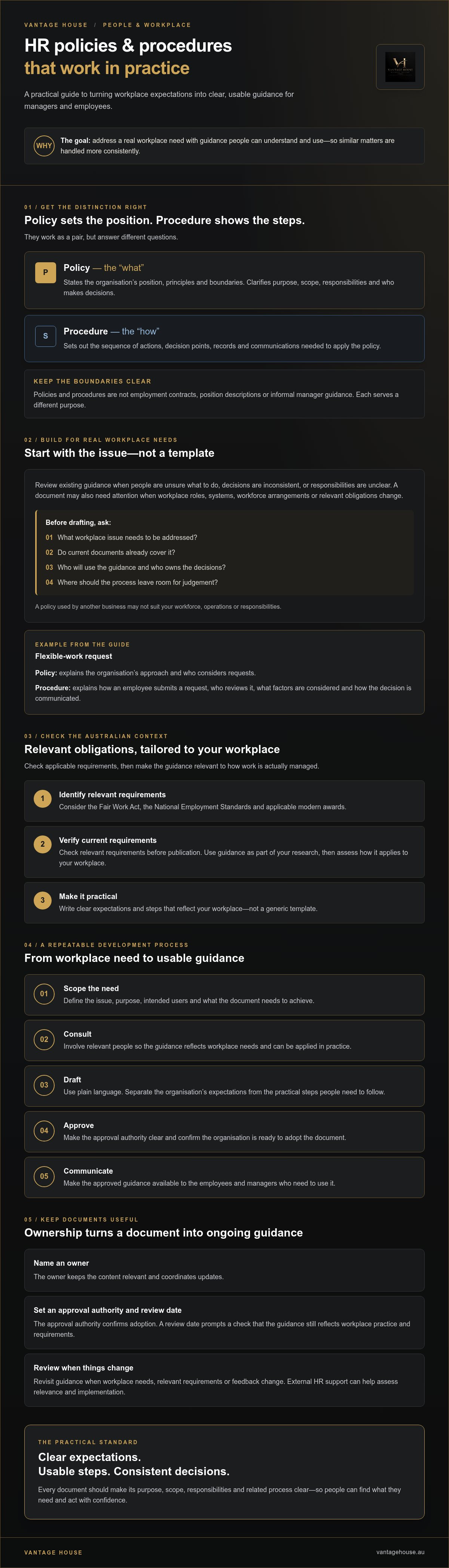
Develop HR policies and procedures through a structured, repeatable process
A consistent workflow helps employers move from an identified workplace need to guidance that’s ready to use. It also creates a clear record of why a document was developed, who contributed and who approved it. This makes hr policy and procedure development easier to manage as the organisation and its practices change.
Use a repeatable sequence, adapting the depth of review to the subject and its risks:
- 1. Identify the need. Define the issue the policy or procedure should address. Recurring questions, unclear responsibilities or changing work practices can signal a need.
- 2. Scope the document. Identify who it covers, what decisions it will guide and how it relates to existing documents.
- 3. Check obligations. Review relevant workplace requirements and confirm details against current, authoritative sources.
- 4. Consult. Invite input from relevant leaders, managers who will apply the process and employees affected by it.
- 5. Draft. Use plain language and make responsibilities, decision points and actions clear.
- 6. Approve. Resolve feedback, confirm the accountable approver and record the decision.
- 7. Communicate. Explain what has changed, when it takes effect and where employees can find the current document.
Keep consultation focused. Set a defined period for review and explain what feedback is needed. If views conflict, weigh them against operational needs and verified obligations rather than adopting every suggestion. Record key decisions, the final version, approval and the person responsible for implementation. A simple version history helps managers distinguish current guidance from superseded drafts.
How should employers consult and approve a policy?
Give affected employees and managers a practical way to comment on whether the proposed process is clear and workable. The accountable approver should consider the feedback, confirm any unresolved issues and authorise the final version. Keep the approved copy somewhere employees can access, and retain a record of its version, approval and effective date.
How can employers introduce a new procedure consistently?
Before launch, brief managers on their responsibilities, decision points and escalation pathways. Tell employees where to find the procedure, when it applies and who can answer questions. Provide a clear contact point, then record implementation issues so they can inform future improvements. Policies work best as part of broader people management. Practical HR support for business owners offers related context.
For help reviewing workplace processes and their practical application, explore workplace relations and HR support.
Maintain HR policies over time and know when to seek workplace relations support
An approved policy still needs an owner and a review plan. Assign responsibility to someone who can monitor whether the document remains relevant, gather feedback and coordinate changes. Set review dates according to the topic’s risk and likelihood of change, rather than relying on someone to remember. Ongoing review is part of hr policy and procedure development because even clear guidance can lose its usefulness as workplace arrangements evolve.
Keep a simple record of the current version, its owner, approval date and next review date. Track employee questions, requests for exceptions and differences in how managers apply the process. These patterns can reveal unclear instructions, shifted responsibilities or a process that no longer matches actual practice.
What should trigger a policy review?
Review a document when relevant legislation, awards, agreements or business processes change. Recurring confusion, complaints or inconsistent manager decisions may also warrant a review. Check the requirements that apply before revising the wording, then record the review outcome, even if no change is needed. Version control helps employees and managers locate approved guidance and reduces the risk of outdated copies remaining in circulation.
Don’t wait for a scheduled date if a material change or repeated problem arises. A review schedule provides routine oversight, while feedback and operational changes can highlight issues that need attention sooner.
When can external HR guidance help?
External workplace relations advice or HR support may help when award coverage, policy scope or practical application is unclear. An adviser can help employers assess whether a process fits their workplace and identify questions that need further professional attention. This is support for people-management decisions, not legal representation in court or Fair Work Commission hearings. For broader context on employer responsibilities, see this strategic workplace relations guidance.
Review needs can also vary with the organisation’s capacity and workforce arrangements. A guide to ongoing HR support for small business can help employers consider continued support. Used well, external input can complement internal ownership, keeping policies grounded in day-to-day practice rather than treating them as documents to update only when a deadline appears.
Put clear, practical HR guidance into action
Effective hr policy and procedure development is more than drafting documents. Policies set clear expectations, while procedures help managers and employees apply them consistently. Both need to reflect the workplace, align with relevant Australian obligations and remain current as roles, processes and requirements change.
A structured approach makes this work manageable: identify the need, check the relevant requirements, consult the people affected, then approve and communicate clear guidance. Assigning an owner and review date helps keep each document useful rather than allowing it to become outdated or disconnected from day-to-day practice.
Vantage House provides workplace relations advisory, compliance guidance and ongoing HR support for Australian employers. Clear ownership and regular attention help make policies a dependable part of how your workplace operates.
Frequently Asked Questions
What is the difference between an HR policy and a procedure?
An HR policy states an organisation’s position, principles and expectations on a workplace topic. A procedure explains the practical steps people follow to apply that policy consistently. For example, a leave policy may set out the organisation’s approach, while its procedure explains how an employee makes a request and who reviews it. Keep the documents connected and clear, and check that they align with the obligations relevant to the employees they cover.
Does a small business need written HR policies and procedures?
Written guidance can help a small business set consistent expectations and repeatable processes for employees and managers. The appropriate documents depend on the workforce, work and business context, so a small employer needn’t replicate a large organisation’s handbook. Identify relevant workplace obligations and the topics where clear guidance would help. Then make sure each policy and procedure reflects how the business operates and can be applied in practice.
How do I make sure an HR policy complies with Australian workplace requirements?
Check the requirements relevant to the employees and arrangements covered by the policy. This may include applicable legislation, the National Employment Standards, modern awards or agreements, and work health and safety requirements where relevant. Verify current information with authoritative sources such as the Fair Work Ombudsman. If it’s unclear how a requirement applies or should be interpreted, seek suitable professional advice before approving the policy.
Can I use a policy template for my business?
A template can provide a useful starting structure, but review it before adopting it. Check that its wording, responsibilities and process suit your workforce, operations and applicable obligations. Remove commitments the business can’t reliably meet, and make clear who does what. Ask relevant managers to test whether the procedure is workable. Obtain appropriate review before approval, then communicate the final version and where employees can access it.
How often should HR policies and procedures be reviewed?
Set review dates that reflect each document’s importance and how quickly the workplace may change. Review sooner if relevant requirements, awards, agreements, work arrangements or internal processes change. Employee questions, repeated exceptions and inconsistent decisions can also signal that guidance needs attention. As part of hr policy and procedure development, record the policy owner, review date and version so managers and employees can identify the current document.
Who should be involved in developing workplace policies?
Involve the leaders responsible for approval, managers who will apply the process and employees affected by it. Include appropriate HR or workplace relations expertise when the subject calls for it. Consultation can reveal practical issues before a document is finalised, while clear approval responsibilities help avoid uncertainty about who makes the decision. Record material feedback and how it was considered, then communicate the approved version to the people who need to use it.
When should an employer seek external HR advice on a policy?
Consider external HR advice when you’re unsure which obligations apply, how a policy should work in practice or how to address inconsistent existing documents. Advice can help employers review workplace processes and support their implementation. Seek guidance before uncertainty leads to inconsistent decisions. HR advisory support is distinct from legal representation in court or Fair Work Commission hearings, which Vantage House doesn’t provide.
Need help reviewing workplace processes or developing practical HR guidance? Discuss HR support for your workplace with Vantage House.


