
If you’re searching for “ongoing hr support small business”, the key question is how to manage recurring people matters consistently without adding unnecessary complexity or giving up control of decisions. The most comprehensive HR arrangement isn’t necessarily the most practical one for an Australian business.
People tasks keep returning, but not every business has someone with dedicated capacity to manage them. Internal support keeps knowledge close, while ad hoc advice can help with isolated issues. When recruitment, performance concerns or workplace relations questions recur, a more consistent approach may make processes and decisions easier to manage.
This article compares internal, ad hoc and ongoing external support against your workload, people needs and available capacity. It also explains what to agree upfront about tasks, access and decision-making, and offers practical criteria for assessing whether a provider is a good fit. The aim is a workable model that brings continuity to people matters while keeping leadership in control.
Key Takeaways
- Match your support model to how often people matters arise and the HR capacity already available in your business.
- Compare ongoing HR support options by considering continuity, internal workload, access to expertise and control over decisions.
- Clarify which day-to-day HR, workplace relations and compliance needs are in scope. Discuss recruitment or employee research separately if relevant.
- Assess a provider’s relevant experience, scope, communication arrangements, decision boundaries and approach to reviewing the arrangement.
- Prepare a brief overview of your workforce, recurring matters and current processes to help determine whether Vantage House’s employer-focused services fit your needs.
When does ongoing HR support make sense for a small business?
In a small business, people matters are often managed alongside customer work, finances and daily operations. An owner or manager may answer employee questions, update records or address performance concerns without dedicated HR capacity. The right support depends less on headcount than on how often these tasks arise, how complex they are and who has the time and capability to manage them.
An isolated question may call for ad hoc advice. If similar matters keep returning, ongoing support can help establish consistent processes and give managers a clearer point of reference. The aim isn’t to outsource every decision. It’s to make recurring work easier to manage in a practical, considered way.
Signs that people management needs have become recurring
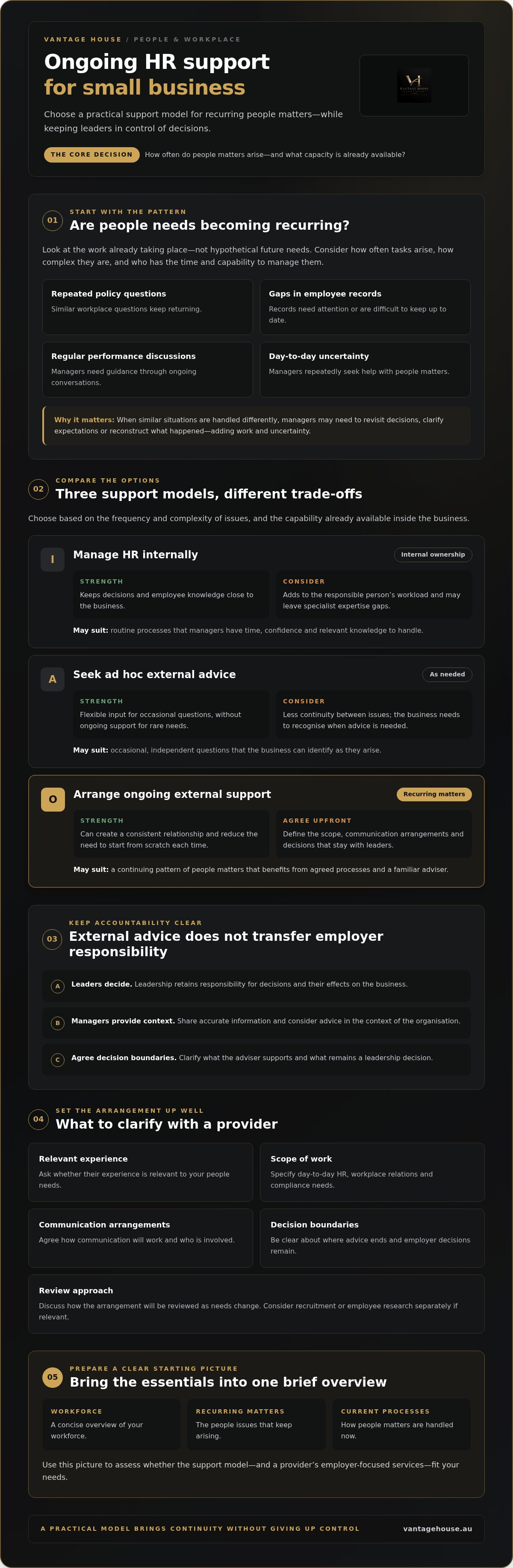
Review the work already taking place rather than planning around hypothetical future needs. Recurring signs may include repeated questions about workplace policies, gaps in employee records, regular performance discussions or managers seeking guidance on day-to-day people matters.
When similar situations are handled differently, managers may need to revisit decisions, clarify expectations or reconstruct what happened. That can create extra work and uncertainty. Reviewing recent people tasks can help show whether the business needs a consistent source of support or only occasional input.
Ongoing support compared with ad hoc HR advice
Each approach has trade-offs. The best fit depends on how often issues arise, their complexity and the capability available internally.
- Manage HR internally: Keeps decisions and employee knowledge close to the business, but adds to the workload of whoever takes responsibility and may leave gaps in specialist expertise.
- Seek ad hoc external advice: Offers flexibility for occasional questions, without arranging ongoing support for needs that rarely arise. The trade-off is less continuity between issues, and the business needs to recognise when to seek advice.
- Arrange ongoing external support: Can provide a more consistent relationship for recurring matters and reduce the need to start from scratch each time. The business still needs to define the scope, communication arrangements and decisions that remain with its leaders.
Before choosing, list the people matters that have actually come up, who currently handles them and where uncertainty or delays occur. Then consider whether the pattern calls for internal ownership, advice as needed or ongoing external input. Human resource management covers functions such as recruitment and performance appraisal, illustrating why people needs can extend beyond one-off questions. For a practical overview of common considerations, read the practical HR support guide for business owners.
Which HR support model suits a small business best?
The right model depends on the work to be done and the capability already available. Some businesses can manage routine people processes internally, while others benefit from outside advice on specific issues or a continuing advisory relationship. Choose a model that adds capacity without obscuring who makes decisions.
Internal HR capacity versus external support
Internal responsibility may suit a business where managers have the time, confidence and relevant knowledge to handle routine people processes. That doesn’t mean every small business needs a dedicated HR employee. External advice can offer another perspective when a matter is unfamiliar or more complex, while leadership retains responsibility for decisions and their effects on the business.
External support doesn’t transfer employer accountability. Managers still need to provide accurate information, consider advice in context and make decisions for their organisation. For a broader overview of the trade-offs, see HR options for small businesses.
Ad hoc advice versus an ongoing relationship
Ad hoc advice offers flexibility when questions are occasional and the business can identify when help is needed. An ongoing relationship may suit recurring matters that benefit from agreed processes and an adviser who becomes familiar with the organisation. Consider whether issues tend to arise independently or form a continuing pattern. For related Australian workplace relations context, read the strategic workplace relations employer guide.
| Model | Continuity | Internal workload | Access to expertise | Control over decisions |
|---|---|---|---|---|
| Internal HR responsibility | Can be consistent if processes and records are maintained. | Falls to an owner or manager alongside other duties. | Depends on the skills available internally. | Leadership manages the work and makes decisions directly. |
| Ad hoc external advice | May be limited between separate requests. | Leaders still identify issues and coordinate each request. | Available for the specific matter being raised. | Advice informs decisions, which remain with the business. |
| Ongoing external support | Can build familiarity across recurring matters. | May reduce the need to manage every issue without support. | Available within the agreed scope and arrangements. | Leadership retains decision-making responsibility. |
In practical terms: internal management may fit when the workload is manageable and capability is available. Ad hoc advice may suit occasional, defined questions. Ongoing support may suit repeated needs where continuity would help. These are guides, not rules based on business size. Clarify the scope and communication arrangements before choosing. If you’re weighing external support, review Vantage House’s HR support as one option.
What does “ongoing hr support small business” look like in practice?
A clear scope turns ongoing HR support into a practical working arrangement. Start with the recurring work, then confirm what the provider will advise on, what assistance they may provide with implementation and what remains the employer’s responsibility. The scope should reflect current workforce needs, not an assumed standard package.
Set out scope, access and communication expectations
Use a checklist to clarify what support covers. Depending on the provider and agreed scope, it may include:
- Day-to-day HR assistance: Guidance on routine people-management matters and employee records.
- Workplace relations advice: Support with workplace issues and manager decision-making.
- Compliance guidance: Help understanding relevant employment standards and modern award considerations, where applicable.
- Additional workforce needs: Recruitment and staff placement, employee reviews or staff satisfaction research. These may be separate requirements to discuss.
Also agree who can contact the adviser, which communication channels are suitable, how requests are prioritised and how next steps will be communicated. Confirm any response-time commitments rather than assuming them. Identify how urgent or complex matters should be escalated, and what information managers need to provide for advice to be useful.
Clarify compliance guidance and professional boundaries
In Australia, the relevant employment standards and modern award considerations depend on the circumstances of the business and its employees. Confirm whether the provider’s compliance guidance includes helping you understand which requirements may apply, and how that guidance is kept current. The Fair Work Ombudsman is an official source of employer information. A broader overview of small-business HR considerations is available in this guide to HR for small businesses.
Advice and practical implementation assistance are not the same as formal legal representation. Confirm any exclusions in writing. If a matter develops into a complex legal dispute, seek appropriately qualified legal advice or representation. Vantage House provides employer-focused HR support, workplace relations advice and compliance guidance, but does not provide legal representation in court or Fair Work Commission hearings.
Before agreeing to an arrangement, record the included work, exclusions, access arrangements, communication process and escalation pathway. This gives managers a shared understanding of what to expect and keeps accountability for decisions clear.
How can a small business evaluate an ongoing HR provider?
Compare providers against the work your business needs handled, not a broad service description. A structured assessment can show whether the proposed support is relevant, clearly defined and workable in practice.
Use a four-step assessment
- Define your needs: List recurring matters, current gaps and the internal time available to manage them.
- Check the scope: Confirm which services and deliverables are included, what is excluded and how fees are set out.
- Assess the working fit: Discuss who will provide advice, what information they need and how recommendations will support your decision-making.
- Agree review measures: Decide how you’ll review the arrangement, such as checking whether recurring issues are being addressed and whether the scope still matches your needs.
Compare providers using consistent criteria
Use the same matrix for each provider. Ask for clear answers and note any details that still need confirmation.
- Relevant experience: Which employer matters does the adviser handle, and how does that experience relate to your workforce and operating context?
- Clarity: Are advice, deliverables, fees and exclusions explained in plain terms?
- Access: Who is your contact, how is continuity managed and which communication channels are available? Confirm any response-time commitments rather than assuming them.
- Boundaries: Which decisions remain yours, and what sits outside the provider’s scope, including court or Fair Work Commission representation?
- Reporting and review: How will you discuss outcomes and recurring issues? Agree an approach rather than assuming a particular reporting feature is included.
Ask what information the adviser needs to give relevant guidance and how they’ll communicate recommended next steps. Advice should be practical and understandable, while management remains responsible for decisions. A provider’s description matters less than whether the proposed approach fits the work your business actually needs done.
Assess value against the workload being addressed, the internal time involved and the friction caused by inconsistent processes. Don’t assume the arrangement will create savings. This comparison can help you judge whether the proposed support is proportionate to your needs.
Before engagement, get the scope, deliverables, fees, exclusions, access arrangements and review process in writing. You can also review Vantage House’s employer-focused HR support and workplace relations advice against your requirements.
How to start an ongoing HR support arrangement with Vantage House
Start with a clear picture of the people-management work your business needs help with. Vantage House provides Australian employers with HR support, workplace relations advice and compliance guidance. Recruitment and staff placement, employee reviews and staff satisfaction research are also available where they match a business’s needs. Confirm the relevant scope and engagement options directly rather than assuming they fit a standard package.
Prepare for an initial discussion
A concise overview helps connect the conversation to your workforce and internal capacity. Include:
- Workforce and structure: Approximate team size, roles and who currently manages people matters.
- Recurring questions: HR or workplace relations issues that keep coming up, and where managers need practical assistance.
- Current processes: Relevant policies, records and steps already used to manage employee matters.
- Separate requirements: Immediate concerns alongside longer-term recruitment, staff placement or employee research needs.
You don’t need to prepare a lengthy report. A short, accurate summary can help identify what needs attention now, what is already handled internally and where extra support may be useful. Avoid sharing more sensitive employee information than is needed for the initial discussion.
Set clear expectations and review the fit
Before work begins, confirm the proposed scope in writing. Agree on the work covered, points of contact, communication arrangements, fees, exclusions and how requests will be managed. Clarify any response-time commitments directly, as these should not be assumed. It’s also useful to agree on a suitable point to review whether the arrangement still reflects the business’s workload and priorities.
Keep decision-making responsibilities clear. External HR support can provide advice and practical assistance, but business leaders remain responsible for decisions in their workplace. Vantage House’s consulting is employer-focused and does not include legal representation in court or Fair Work Commission hearings. If a matter requires formal legal advice or representation, arrange that separately with an appropriately qualified legal professional.
A considered scope gives both sides a shared reference point. As workforce needs change, review what is being used, where recurring issues remain and whether the agreed support still fits. This helps keep the arrangement practical and proportionate, without building expectations around unconfirmed services or terms.
To discuss your workforce needs and possible support scope, discuss ongoing HR support with Vantage House.
Choose a support model that fits your business
The right approach depends on the people matters that recur, the capability available internally and the decisions leaders want to retain. Compare internal, ad hoc and ongoing external support against your actual workload, then confirm the scope, communication arrangements, fees and boundaries in writing.
Vantage House provides employer-focused HR and workplace relations advisory nationally across Australia, including day-to-day HR assistance, compliance guidance and staff placement. Outline your workforce, recurring questions and existing processes, then confirm directly which services and engagement arrangements may fit your needs.
Discuss ongoing HR support with Vantage House to explore a practical approach to recurring people matters while keeping your business’s decision-making clear.
Frequently Asked Questions
What does ongoing HR support for a small business include?
Depending on the agreed scope, ongoing HR support can include day-to-day HR assistance, workplace relations advice and compliance guidance. Recruitment and staff placement, employee reviews and staff satisfaction research may be relevant as separate needs. Confirm which services are included, what deliverables to expect and what sits outside scope. Advice and practical assistance aren’t the same as legal representation, which should be arranged separately where needed.
Is outsourced HR support suitable for a small business?
It can suit a small business that needs external expertise but doesn’t have the internal time or capability to manage every people matter. It isn’t necessary for every small business, and no single size threshold determines the right model. Assess the recurring workload, available internal skills and complexity of issues. Leaders retain responsibility for decisions, even when an external adviser provides support.
How much does ongoing HR support cost for a small business?
There isn’t enough information here to state a price for ongoing HR support. Fees depend on the provider’s confirmed engagement terms and the work included, so ask for a written proposal based on your actual needs. Check what the fee covers, how additional work is treated and whether recruitment or employee research is priced separately. Confirm all fees and exclusions before agreeing to proceed.
Can a small business use HR support only when an issue comes up?
Yes. Ad hoc advice may suit a business with occasional, clearly defined questions and enough internal capability to manage the rest. Before relying on this approach, clarify how to request advice, what information the adviser needs and which matters are within scope. If similar issues recur, consider whether an ongoing relationship could provide greater continuity and help managers follow more consistent processes.
What should I check before engaging an HR consultant?
Check the adviser’s relevant employer experience, proposed scope, fees, exclusions and communication arrangements. Confirm who will provide the advice, how continuity is managed and what information you’ll need to supply. Ask how requests are prioritised and how next steps are communicated, but don’t assume a particular response time. Clarify whether formal legal advice or court and Fair Work Commission representation is excluded, and agree how you’ll review the arrangement.
Does an HR consultant take over an employer’s responsibilities?
No. An HR consultant can provide advice and practical assistance within the agreed scope, but the employer retains responsibility for workplace decisions and how those decisions are put into practice. For example, an adviser may help a manager consider a people-management issue, while the business remains responsible for deciding what action to take. Formal legal advice or representation may need to be arranged separately.
What happens if my business needs change after engaging ongoing HR support?
Raise the change with your provider and review whether the agreed scope still fits. A shift in workforce structure, new recurring people matters or recruitment needs may call for different support. Before adding work or changing communication arrangements, confirm any scope, fee or responsibility changes in writing. Set a suitable review point to assess whether the arrangement remains practical as your business and internal capacity evolve.


