

The most useful HR support isn’t necessarily the most comprehensive. It’s the support that matches your business’s immediate needs and capacity. For business owners, practical HR support for business owners can mean getting clear guidance on an award, improving an inconsistent workplace process or addressing a staff issue while keeping daily operations moving.
People management often competes with customer needs, cash flow and the work of running the business. It can be difficult to know which matters you can manage internally and when specialist advice may help. Uncertainty about workplace processes or award interpretation can make decisions harder, so a clear and proportionate approach matters.
This guide explains how to identify HR support that fits your business’s priorities and internal capability. It covers day-to-day HR assistance, workplace relations advice, compliance guidance, recruitment and employee research. It also sets out how to prepare relevant information so discussions are focused and processes can become clearer and more consistent as your business develops.
Key Takeaways
- Match practical HR support for business owners to your current people-management needs, capacity and priorities.
- Compare support by its scope, deliverables and review arrangements, not by service labels alone.
- Prepare a clear brief by recording the issue, desired outcome, urgency, current process and relevant documents.
- Separate a one-off advisory need from recurring HR, compliance or recruitment requirements before deciding what support to seek.
- Start with a defined concern, then consider whether additional support is needed as your business develops.
Practical HR Support for Business Owners: Identify the Work You Need Help With
Business owners often manage people issues alongside operations, customer needs and plans for growth. A straightforward staff query may fit an existing process. But if you’re unsure how to respond or apply a workplace requirement, it helps to identify the specific work that needs attention before deciding what support to seek.
Practical HR support helps an Australian business owner manage people processes consistently through relevant advice and assistance. It can clarify everyday procedures and help employers recognise when a matter calls for specialist workplace relations advice. The broader field of Human Resource Management includes a range of functions, but the right support depends on your business’s needs and internal capability.
Which people-management tasks commonly need support?
Support may involve developing or reviewing workplace policies and procedures, making employee processes clearer, or addressing recurring day-to-day HR questions. These tasks differ from situations that call for workplace relations advice or compliance guidance, such as uncertainty about how a workplace requirement applies to a particular decision. If the implications are unclear, qualified advice can help you consider the issue before acting.
Recruitment and staff placement address a separate need: finding and placing staff. Employee reviews and satisfaction research serve another purpose, helping a business identify themes in employee experience. Because these services inform different decisions, name the outcome you need rather than treating all HR support as interchangeable.
When does external HR support become useful?
Consider external support when procedures are unclear, the same questions keep arising or internal capacity is stretched. A growing workforce can also mean more coordination as additional people, roles and processes need to be managed consistently. That doesn’t automatically mean you need a full-time HR function or continuous consulting. The appropriate level depends on the work involved.
For example, an established process may be enough for a clear, routine query, while uncertainty about an award or a complex workplace relations matter may warrant specialist advice. Vantage House provides Australian employers with HR support, workplace relations advisory and compliance guidance, as well as recruitment and employee research services. Define the issue first to identify the relevant support and what you need to clarify before proceeding.
Compare Practical HR Support Options by Scope, Not by Label
Service labels can mean different things across providers. Compare what work is included, how advice is accessed, what you’ll receive and what remains your responsibility. The right arrangement depends on the issue and your internal capacity, not on choosing the broadest option.
These options address different requirements. Workplace relations advisory helps assess a specific issue; ongoing HR support is suited to recurring processes; and compliance guidance focuses on understanding employer obligations. Recruitment and staff placement address hiring, rather than ongoing people management. For practical HR support for business owners, separate the immediate question from longer-term needs before selecting an arrangement.
Employee reviews and satisfaction research can gather structured feedback and help identify workplace themes. These services complement HR support, but don’t replace managers’ day-to-day responsibilities. The Ultimate Guide to HR for Small Businesses offers a general overview of HR roles. Australian employers should assess guidance against their own context. For a workplace relations perspective, see this strategic workplace relations guide.
Before engaging support, agree on the scope, deliverables, access to advice, internal responsibilities and review points. These criteria can help owners considering employer HR and workplace relations support identify which service fits their needs.
How to Assess Whether an HR Adviser Fits Your Business
A useful adviser should connect your concern to clear, relevant support. Before comparing providers, turn the issue into a short brief: describe what has happened, the decision you need to make, the process you’ve followed and the outcome you’re seeking. For example, if managers handle the same type of staff query differently, explain where their approaches vary and ask how the process could be made more consistent.
Assess the adviser’s scope and fit before comparing provider labels. This helps you judge whether the proposed support addresses your actual need, rather than relying on broad terms such as “consulting” or “outsourced HR”. External advice may be too general if the business context is unclear. Share specific examples and agree on practical outputs, such as written recommendations, process guidance or a discussion of possible next steps.
Questions to ask before engaging an HR consultant
Ask each prospective adviser the same core questions so you can compare their answers against your brief:
- Which employer issues and services do you handle, and what falls outside your scope?
- How will you consider our workplace context, and how will recommendations be documented?
- Who will provide the advice, how will contact be managed, and what deliverables should we expect?
- When will we review the engagement, and what would prompt us to adjust its scope?
Clear answers set expectations about what the adviser will do and what remains your responsibility. Practical HR support for business owners should relate to the concern raised and make clear which decisions and actions are still required internally.
Understand professional and legal boundaries
Workplace relations consulting can help employers assess an issue and consider possible next steps. It is distinct from legal representation in court or Fair Work Commission hearings. Confirm the adviser’s boundaries before proceeding, particularly if a matter is moving towards a formal dispute or hearing.
Vantage House provides employer-focused workplace relations advisory, HR support and compliance guidance, but does not provide legal representation in court or Fair Work Commission hearings. If a matter requires formal representation or legal advice, seek an appropriately qualified legal professional. Confirm the proposed service scope and engagement arrangements in advance so you understand what the support includes and where its limits lie.
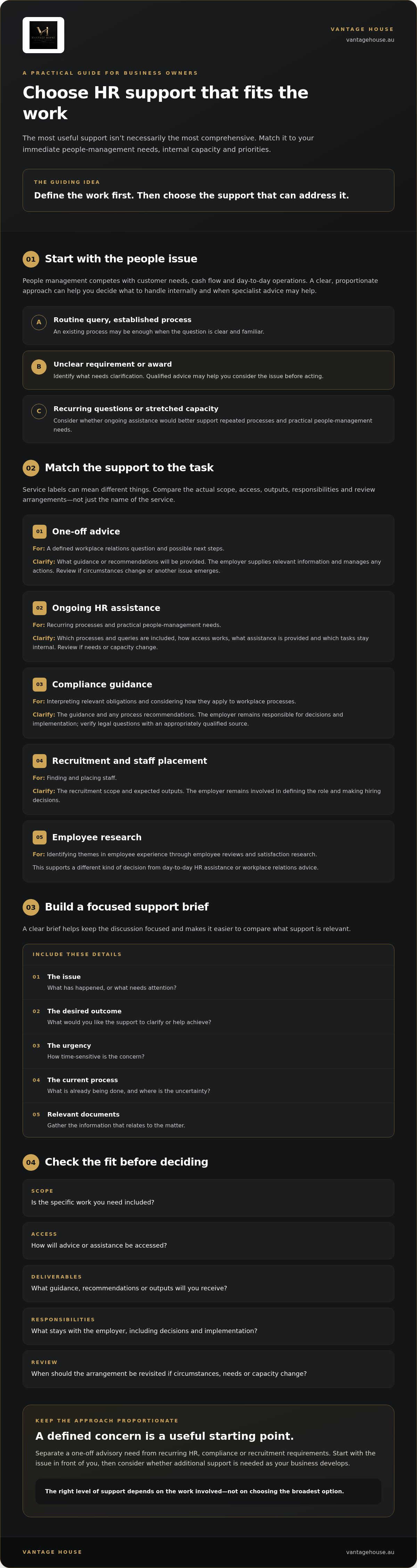
Create a Practical HR Support Brief and Set Clear Priorities
A concise brief helps an adviser understand what’s happening and what your business needs from the engagement. Separate facts from assumptions, and identify whether you need help with an immediate decision, a recurring HR process or a recruitment requirement. This makes practical HR support for business owners easier to scope and gives both parties a clear starting point.
Turn a people issue into a clear scope of work
Use this sequence to prepare your brief:
- Identify the issue. Describe the workplace situation factually, including relevant dates, roles and what has occurred. Avoid conclusions about fault or the response needed.
- State the desired outcome. Explain what decision or result the business needs help working towards, such as clarifying a process or understanding available next steps.
- Set out the urgency. Note any known deadlines or operational impacts. Distinguish a genuine time constraint from a preference to resolve the matter quickly.
- Describe the current process. Explain how the business has handled similar matters, who is involved and where the existing approach is unclear or difficult to apply.
- Gather available records. List relevant documents, communications, policies or notes. Share only information that relates to the issue, using a secure and appropriate method.
Identify who within the business can make decisions and provide instructions. This gives the adviser context without pre-judging the appropriate response. For questions involving an award, employment standard or regulator guidance, check current details against authoritative Australian sources and provide the reference or material already consulted. Requirements can depend on the circumstances, so avoid relying on assumptions or outdated documents.
Set review points that keep support useful
Before work begins, agree on the scope, responsibilities, expected outputs and communication arrangements. Clarify who will provide information, who will make business decisions, how recommendations will be recorded and when progress will be reviewed. This distinguishes advice from implementation and reduces uncertainty about what each party is expected to do.
Review the arrangement against the original need. A one-off workplace relations question may be resolved through defined advice, while repeated process questions could indicate a need for ongoing HR assistance. Scope recruitment requirements separately. Adjust support if priorities or internal capacity change, rather than assuming the same arrangement will remain suitable indefinitely.
For practical HR support tailored to your employer requirements, Discuss your HR support requirements with Vantage House.
Put Practical HR Support to Work With a Clear Next Step
Effective support can start with one defined people-management issue. Agree on the help needed, consider the outcome and review whether further support is warranted once the initial need is clear. This keeps practical HR support for business owners aligned with the work at hand, rather than committing to a broader arrangement without a business reason.
What working with an employer-focused adviser can cover
Workplace relations advisory can help employers consider a people-related decision and how it connects with internal processes. HR support and compliance guidance can assist with practical workplace needs, while the employer retains responsibility for business decisions and actions. Confirm the specific scope and deliverables before work begins.
Other requirements may call for different services. Recruitment and staff placement can support a defined hiring need, from attracting candidates to securing suitable staff. Employee reviews and staff satisfaction research can gather structured workforce feedback and identify themes for consideration. These are research and feedback services, not a promise of improved retention or a particular workforce outcome.
Vantage House provides Australian employers with workplace relations advice, HR support, compliance guidance, recruitment and staff placement, as well as employee review and satisfaction research. Each service addresses a distinct business requirement, so clarify which one is relevant and what remains an internal responsibility.
Choose a first step that matches the immediate need
Before approaching an adviser, prepare a concise summary of the issue, relevant records, the outcome you’re working towards and any decision timeframe. This gives the discussion a practical focus without requiring you to determine the right response in advance.
Then identify whether you need one-off advice, recurring HR support or a separate service such as recruitment or employee research. Discuss expected outputs, communication arrangements, responsibilities and service boundaries before proceeding. This helps you assess whether the proposed support fits your circumstances and how its value will be reviewed.
If you’re ready to clarify the appropriate scope, Discuss practical HR support with Vantage House and outline your business needs, expectations and the support you’re seeking.
Choose HR Support That Can Grow With Your Business
Effective people management doesn’t require choosing the broadest service. Start with the work that needs attention, define the outcome you’re seeking and agree on the scope, responsibilities and review points. This gives practical HR support for business owners a clear purpose while leaving room to adjust as business needs change.
The right support may be workplace relations advice for a specific decision, ongoing HR assistance for recurring processes, or recruitment and employee research for distinct workforce needs. Vantage House supports employers nationally across Australia with workplace relations advisory, HR support, compliance guidance, recruitment and staff placement, and employee review and satisfaction research. Confirm the relevant service boundaries and expected outputs before proceeding.
Prepare a brief description of your current need, then discuss practical HR support with Vantage House to clarify whether the available support fits your requirements. A focused first step can bring greater clarity to people-management decisions and help processes keep pace as the business develops.
Frequently Asked Questions
What does practical HR support for business owners include?
Practical HR support for business owners can include day-to-day HR assistance, workplace relations advisory and compliance guidance. The specific work depends on the employer’s needs and the adviser’s agreed scope. It may help clarify people processes or inform an employer’s next steps on a workplace issue. Recruitment, staff placement, employee reviews and satisfaction research address separate needs and should be scoped accordingly.
When should a business owner get external HR support?
Consider external HR support when people processes are unclear, similar questions keep coming up or your internal capacity is limited. It may also help when you need advice before making a workplace decision and aren’t confident about the appropriate next step. A growing workforce can create more coordination needs, but that doesn’t automatically require a full-time HR function or ongoing consulting.
Is HR support the same as legal advice in Australia?
No. HR support and workplace relations advisory can help employers manage people processes and consider workplace issues, but they aren’t the same as legal advice or representation. Check the provider’s scope before engaging them. Vantage House provides employer-focused consulting, not legal representation in court or Fair Work Commission hearings. Seek an appropriately qualified legal professional for legal advice or formal representation.
How do I compare HR consultants for my business?
Compare advisers against your specific concern, not just their service labels. Check their relevant experience, what falls within their scope, how they communicate, what deliverables they provide and when the engagement will be reviewed. Ask how recommendations will reflect your business context and what responsibilities remain with you. Clear answers help you assess whether the adviser’s approach suits your needs and internal capability.
Can a small business use HR support without hiring an in-house HR manager?
Yes. A business can seek external HR assistance for a defined issue or recurring people-management needs without employing an in-house HR manager. The right approach depends on the work required and the capacity available internally. You might seek advice on a particular workplace question, then consider ongoing assistance only if repeated needs emerge. Agree on scope and responsibilities so internal decision-making remains clear.
What should I prepare before speaking with an HR adviser?
Prepare a factual summary of the issue, including relevant dates, roles and steps already taken. Gather related records, such as existing policies or communications, and explain the outcome you’re seeking. Note any decision-makers and known deadlines. If your query involves an award, employment standard or regulator guidance, identify the source you’ve checked and verify current details against authoritative Australian information.
Can an HR consultant help with recruitment and staff satisfaction?
Yes, if those services are within the provider’s scope. Recruitment and staff placement can support a defined staffing requirement, while employee reviews and satisfaction research can gather structured feedback and identify workplace themes. These services complement HR and workplace relations support but address different needs. Clarify the intended outputs and responsibilities, and don’t assume research or recruitment guarantees a particular retention or staffing outcome.


