

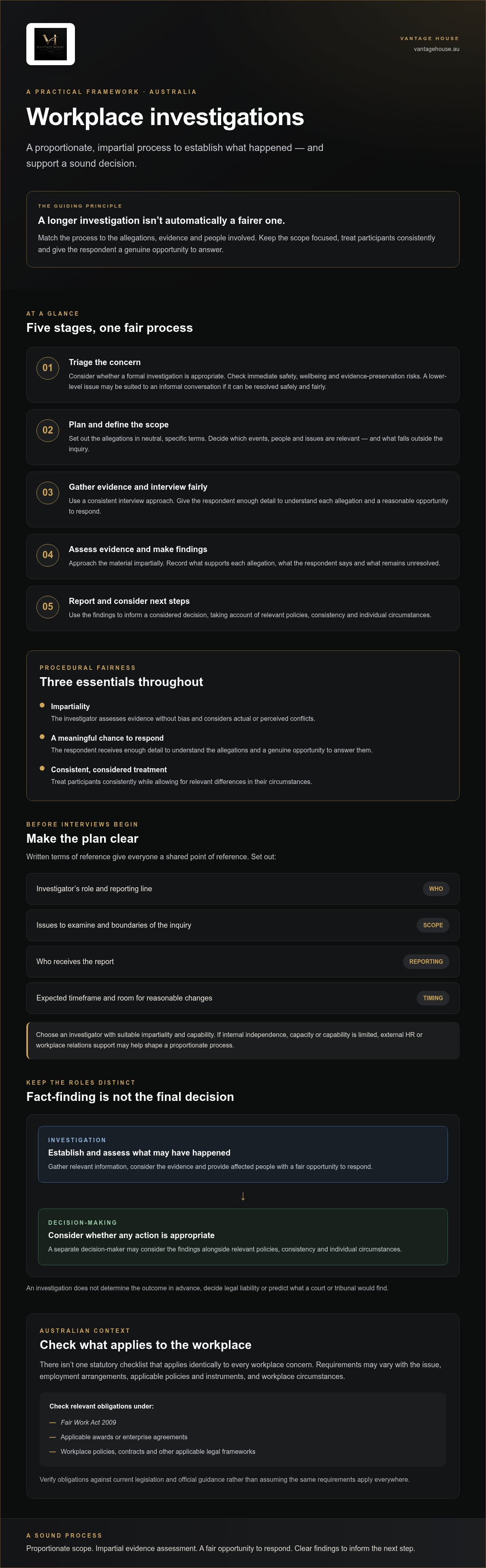
A longer workplace investigation isn’t automatically a fairer one. The right process depends on the allegations, the evidence and the people involved. If you’re searching for how to conduct a workplace investigation Australia-wide, a proportionate, impartial approach can help establish what happened without adding unnecessary complexity.
It’s understandable to be unsure who should investigate, how to handle interviews and evidence, or what to do when accounts conflict. Procedural fairness matters: the person responding to allegations should understand them and have a reasonable opportunity to respond. The investigator and decision-maker must also approach the evidence without bias.
This guide sets out a practical sequence for planning an investigation, gathering and assessing evidence, reaching findings and documenting next steps. It explains how to treat participants consistently and when external HR or workplace relations support may help, particularly if internal capacity or independence is limited. The aim is a clear, structured process that supports a sound decision, not a one-size-fits-all checklist.
Key Takeaways
- Start by matching the process to the concern. Not every workplace issue calls for a formal disciplinary investigation.
- Set clear terms of reference before gathering evidence, including the investigator’s role, scope and reporting line.
- Use a consistent interview approach and give the respondent enough detail to understand and answer each allegation.
- Assess evidence methodically. Record what supports each allegation, what the respondent says and what remains unresolved.
- Use the findings to inform a considered next step, taking account of relevant policies, consistency and individual circumstances.
How to conduct a workplace investigation in Australia: purpose, scope and principles
A workplace investigation is a structured fact-finding process. It examines what may have happened, considers relevant evidence and gives affected people a fair opportunity to respond. It does not determine the outcome in advance.
That distinction matters. An investigation gathers and assesses information. A separate decision-maker may then consider whether any action is appropriate. The investigator isn’t deciding legal liability or predicting what a court or tribunal would find. The process should be proportionate to the concern, with its scope and level of formality shaped by the facts.
A search for “how to conduct a workplace investigation Australia” may suggest there’s one standard procedure for every employer. In practice, requirements can vary with the issue, employment arrangements, applicable policies and instruments, and the circumstances of the workplace. For background on the national framework, see this overview of Australian labour law, then verify obligations against current legislation, official guidance and the instruments that apply to your workplace.
When should an Australian employer investigate a workplace concern?
An investigation may be appropriate when a concern involves alleged misconduct, bullying, harassment or a serious breach of workplace policy, and the facts need to be established before the employer can decide what to do. Assess each allegation promptly and consistently, while considering its particular facts. A lower-level concern, such as a minor misunderstanding, may be better addressed through a suitable informal conversation if the circumstances allow and the issue can be resolved safely and fairly.
First consider immediate safety and wellbeing. If someone may be at risk, assess that risk promptly and consider appropriate support or interim measures while the facts are being clarified. These steps should address safety, not imply that an allegation has already been proven.
What fairness means in a workplace investigation
Fairness means the investigator approaches the evidence impartially, the respondent receives enough detail to understand the allegations, and they have a genuine opportunity to answer them. It also means treating participants consistently while allowing for relevant differences in their circumstances. Everyone should be able to understand what is being examined and how information will be used.
There isn’t one statutory checklist that applies identically to every workplace concern. Before setting the process, check relevant obligations under the Fair Work Act 2009, applicable awards or enterprise agreements, and workplace policies. If internal capability, independence or capacity is limited, external workplace relations or HR advice can help shape a proportionate process without deciding the findings in advance.
Plan the workplace investigation: scope, investigator and Australian obligations
A clear plan keeps an investigation focused and helps avoid gaps. The scope should match the seriousness and complexity of the allegations, not expand by default. For employers searching “how to conduct a workplace investigation Australia”, this planning stage provides a practical starting point that can be adapted to the circumstances.
Work through these decisions before interviews begin:
- Triage the concern: Identify immediate safety, wellbeing or evidence-preservation risks that need attention.
- Define the allegations: Describe each concern in neutral, specific terms that can be examined and answered.
- Set the scope: Decide which events, people and issues are relevant, and what falls outside the investigation.
- Appoint an investigator: Assess impartiality, capability and any actual or perceived conflicts.
- Agree the terms: Document the investigator’s role, reporting line, scope and expected timeframe.
Written terms of reference give everyone a shared point of reference. They should identify the issues to examine, the boundaries of the inquiry, who receives the report and the timeframe. They can also allow for reasonable changes if relevant evidence emerges. Check the organisation’s policies and contracts, along with any applicable award or enterprise agreement. Verify relevant obligations under the Fair Work Act 2009 and other applicable legal frameworks rather than assuming the same requirements apply to every workplace. The Fair Work Commission guide offers practical material on investigations, conflicts and procedural fairness.
How to define allegations and preserve relevant material
Translate a broad complaint into clear allegations without treating claims as established facts. For example, describe the conduct and relevant context rather than relying on a conclusion such as “bullying” on its own. Identify potentially relevant emails, messages, rosters, records and witnesses early so material can be secured before it is lost or altered. Limit access to investigation records and set appropriate storage and retention controls, taking applicable privacy and recordkeeping requirements into account.
Who should investigate: an internal or external investigator?
An internal investigator may understand workplace systems and relationships, but prior involvement, reporting lines or seniority can undermine actual or perceived independence. Consider subject-matter knowledge alongside impartiality and capacity. External support may be appropriate for sensitive or complex matters, where a senior person is involved, or where a conflict could reasonably be perceived. Vantage House provides workplace relations advisory, HR support and compliance guidance. Its workplace relations advice may help employers plan a proportionate process when internal capability or independence is limited. For broader employer context, see the Strategic Workplace Relations: 2026 AU Employer Guide.
Gather evidence and interview participants fairly
For employers searching “how to conduct a workplace investigation Australia”, evidence gathering is where a clear plan becomes a fair, documented process. Use a consistent interview structure, adapting questions to each person’s role and knowledge. Explain who you are, the purpose of the meeting and how notes will be used. Make clear that no outcome has been decided. Invite an uninterrupted account, then clarify details and test relevant points neutrally.
How to interview the complainant, respondent and witnesses
Start with open questions, such as “What happened next?”, before asking about specific dates, conversations or differences between accounts. Avoid leading questions, assumptions about credibility and promises about the result. Give the respondent enough detail about each allegation, including relevant context, to provide a meaningful answer. If new information raises a material issue, put it to the relevant person and allow a reasonable opportunity to respond before reaching findings.
Explain confidentiality as a need-to-know approach, not a promise that information will never be shared. Relevant details may need to be disclosed so a person can respond or the organisation can take appropriate steps. Explain any support-person arrangements in line with workplace policy and applicable requirements, and be clear about the support person’s role.
How to document and protect investigation evidence
Make accurate, consistent records of each meeting, including the date, attendees, questions and responses. Give participants a suitable opportunity to identify factual errors in the notes, and record any agreed corrections without erasing the original account. Keep evidence organised so the later assessment can distinguish between different kinds of information:
- Direct observations: What a participant personally saw or heard.
- Documents and records: Messages, rosters or other material relevant to the allegation.
- Reported information: What someone says they were told by another person.
- Investigator analysis: Conclusions drawn from comparing the available material.
These distinctions help assess conflicting accounts without treating every version as equally supported. Check whether accounts align with contemporaneous records, whether a witness had a clear opportunity to observe events, and whether independent material supports or challenges a claim. A fair opportunity to respond means relevant claims are put and considered. It doesn’t mean every account carries equal evidentiary weight.
Limit access to investigation records to people who need them for the process, and use appropriate storage and retention controls. Verify privacy, confidentiality and recordkeeping obligations for the circumstances before sharing or retaining material. Careful notes and transparent evidence handling give the later assessment a reliable foundation.
Assess evidence, make findings and prepare a clear investigation report
Once information has been gathered, assess each allegation against the complete record rather than relying on a single account or document. Consider whether the evidence is relevant, reliable and consistent, whether independent material corroborates or challenges it, and whether the respondent had a fair opportunity to address significant information. In many workplace processes, factual findings are assessed on the balance of probabilities. Verify the applicable standard and legal context rather than assuming it applies universally.
A structured comparison makes gaps easier to identify and findings easier to explain. Use a separate entry for each allegation:
| Allegation | Supporting material | Response | Unresolved issues | Finding |
|---|---|---|---|---|
| Neutral summary of the specific conduct | Relevant records and evidence that support it | Respondent’s explanation and any evidence provided | Material conflicts or gaps that remain | Outcome under the organisation’s process, with reasons |
How to assess conflicting accounts and credibility
Compare each account with the available evidence. Consider its level of detail, consistency over time, corroboration and whether there’s a plausible explanation for differences. No single factor, including seniority or confidence, should decide credibility on its own. Explain why particular evidence was accepted, given limited weight or left unresolved. Identify any material gap that affects the conclusion.
For employers considering how to conduct a workplace investigation Australia-wide, the key is to make findings that follow from the evidence, not assumptions about what probably happened. Depending on the organisation’s process, findings may be described as supported, not supported or inconclusive. Define those terms clearly and use them consistently. A finding about whether an allegation is established is separate from a later decision about disciplinary or other management action.
What to include in a workplace investigation report
Keep the report neutral and organised so a decision-maker can follow the reasoning. Include the investigation’s scope, process, evidence considered, relevant responses and findings for each allegation. Separate established facts from analysis, conclusions and any recommendations. Exclude irrelevant personal details, and restrict distribution to people who need the report for the next decision.
Where the evidence points in different directions, state that directly. A clear report explains the reasoning and its limits rather than presenting an uncertain conclusion as settled fact. If your organisation needs support structuring an evidence-based process, seek workplace relations advice from Vantage House.
After the investigation: communicate outcomes and decide on next steps
Closing an investigation involves more than issuing a report. The organisation still needs to make a considered decision, communicate appropriately and check whether any workplace issues remain. A practical sequence is to review the findings, determine any action, tell relevant parties what they need to know, document the steps taken and monitor the workplace afterwards.
The decision-maker should consider the findings alongside relevant policies, consistency with how comparable matters have been handled, and the individual circumstances. The investigation report informs this decision, but it doesn’t automatically determine disciplinary or other management action. Keep a clear record of the rationale, who made the decision, what was communicated and any follow-up required.
How to communicate findings and management decisions
Tell relevant parties when the process has concluded and provide information appropriate to their role. The person who raised the concern may need to know that it was considered and whether any steps will follow. The respondent should be informed of findings relevant to them and any separate management decision. Avoid sharing unnecessary personal information about other participants. Explain any applicable review or internal process without implying that the investigation finding and a later decision are the same thing.
Be measured and clear. Don’t promise absolute confidentiality, but explain that information is being shared only as appropriate to the process and workplace responsibilities. Record what was communicated and to whom so the organisation can demonstrate a consistent close-out.
After the matter concludes, monitor for possible retaliation, continuing safety or wellbeing concerns, and effects on working relationships. The appropriate follow-up depends on the circumstances. A check-in with relevant people or a review of workplace arrangements may help identify issues that need further attention.
When Australian employers should seek external support
External support may be useful where allegations are complex or sensitive, a senior employee is involved, internal relationships create a perceived conflict, or the organisation lacks the capacity or independence to manage the process confidently. Workplace relations or HR advice can help employers assess practical next steps and structure a proportionate response. Questions requiring legal interpretation, or a need for legal representation, should be referred to an appropriately qualified legal practitioner.
For employers working through how to conduct a workplace investigation Australia-wide, Vantage House provides workplace relations advisory, HR support and compliance guidance. If your organisation needs assistance considering the process or next steps, discuss workplace relations support.
Move forward with a clear, fair process
A workplace investigation should help your organisation establish what the evidence supports and make considered decisions about next steps. The process works best when its scope fits the concern, the investigator can act impartially and each person has a fair opportunity to contribute. Clear records help decision-makers understand how findings were reached and what follow-up may be needed.
If you’re considering how to conduct a workplace investigation Australia-wide, keep fact-finding separate from any later management decision. Review the evidence carefully, communicate outcomes appropriately and continue to monitor workplace safety and relationships once the process ends.
Where internal capacity, independence or confidence in the process is limited, external advice can help you plan a proportionate approach. Vantage House provides workplace relations advisory to Australian employers, as well as HR support and workplace compliance guidance. Discuss practical workplace relations support if your organisation needs help working through its next steps.
A measured, well-documented process gives your organisation a practical basis for moving forward with clarity and care.
Frequently Asked Questions
How long should a workplace investigation take in Australia?
There’s no single timeframe that suits every workplace investigation. The duration depends on factors such as the number and complexity of allegations, how many people need to be interviewed, and whether relevant records are available. Set a realistic timeframe at the outset, keep participants updated if it changes, and progress the matter without avoidable delay. If you’re considering how to conduct a workplace investigation Australia-wide, document the reasons for any significant extension.
Does an employer have to investigate every workplace complaint?
No, not every complaint needs a formal investigation, but each concern should be assessed on its facts. A lower-level misunderstanding might be suitable for informal resolution, while allegations of serious misconduct, bullying or harassment may require a more structured response. Consider any immediate safety or wellbeing risks and check relevant workplace policies and obligations. If an informal approach is unsuitable or the facts are disputed, a formal fact-finding process may be appropriate.
Can an employer use an external investigator in Australia?
Yes. An employer can engage an external investigator where independence, specialist knowledge or internal capacity is a concern. This may be useful if an allegation involves a senior employee, the internal investigator has prior involvement, or workplace relationships could create a perceived conflict. The employer should define the investigator’s scope and reporting line. Using external support doesn’t automatically transfer the employer’s responsibility for decisions made after the investigation.
Does the respondent have to see the evidence in a workplace investigation?
The respondent should receive enough detail about each allegation and relevant material to understand and respond to the case being considered. That doesn’t necessarily mean giving unrestricted access to every document or another person’s full statement. Assess what needs to be shared for a meaningful response, while considering privacy, confidentiality and any applicable policies or legal obligations. If new material could affect a finding, consider whether the respondent needs a further opportunity to address it.
Can a manager investigate a complaint involving their own team?
A manager may investigate a concern in their team if they can act impartially and have the capability and capacity to handle the process. Their existing relationships, prior involvement, reporting lines or views about the people involved may affect actual or perceived independence. Consider these factors before appointing them. If neutrality may reasonably be questioned, or the allegation is sensitive or complex, an investigator from outside the team or external support may be more suitable.
What happens if the evidence is inconclusive?
If the available material doesn’t support a clear finding, record what remains uncertain and why the evidence doesn’t resolve it. Use the terminology provided for in your organisation’s process, such as “inconclusive” where appropriate, and explain the reasoning rather than implying the allegation was proven. A decision-maker can then consider any separate management steps, relevant policies and workplace risks. Any action should be based on the findings and circumstances, not an unsupported assumption about what occurred.
Can an employee bring a support person to an investigation meeting?
An employee may ask to bring a support person, but whether there’s a right to one depends on the circumstances, applicable workplace arrangements and the meeting’s purpose. Check relevant policies, awards, enterprise agreements and legal requirements, and respond to requests consistently. Explain the support person’s role before the meeting so expectations are clear. Don’t assume the person can answer questions on the employee’s behalf unless the applicable arrangements or agreed process provide for that.


