

The broadest outsourcing model isn’t automatically the best fit. For employers weighing outsourced talent acquisition australia, the central decision is how much hiring work needs external support, not which provider uses the biggest service label.
Internal teams often have competing priorities, and recruitment capacity can tighten when several roles need attention at once. Comparing recruitment assistance, candidate placement and broader outsourced models can be difficult when each describes its scope differently.
A workable choice depends on hiring volume, internal capability and the level of control your team wants to retain. This guide explains the main approaches available in Australia, how responsibilities can be divided and what to consider when matching support to workforce needs. It also looks at how recruitment can sit alongside HR and workplace relations guidance. Clear scope, decision rights and communication routines help make the external relationship practical and manageable.
Key Takeaways
- Outsourced talent acquisition australia can range from targeted recruitment assistance to a broader shared hiring function, depending on the responsibilities your organisation needs to delegate.
- Compare internal recruitment, agency recruitment, staff placement, staff augmentation and RPO by scope, continuity, workload and the oversight your team retains.
- Set clear owners for role briefs, candidate screening, interviews and final decisions to keep hiring coordinated.
- Match recruitment support to hiring frequency, role complexity, internal capacity and expected changes in demand.
- Vantage House provides recruitment and staff placement for Australian employers, with HR and workplace relations guidance available alongside hiring support.
Outsourced talent acquisition in Australia: what employers are actually outsourcing
Outsourced talent acquisition is an agreed transfer or sharing of recruitment activities between an employer and an external partner. The partner may support one stage, such as candidate sourcing, or coordinate a wider process through to placement. The arrangement should specify which tasks the partner manages and which decisions stay with the employer.
This differs from outsourcing non-recruitment roles to an offshore workforce. In talent acquisition outsourcing, the external partner helps the employer find and appoint people. The recruitment process is the work being supported, rather than the job itself being performed by an offshore team. Recruitment Process Outsourcing (RPO) describes a broader model in which recruitment processes are outsourced as a business function.
Activities can include assessing workforce needs, shaping role briefs, attracting candidates, screening applications, coordinating interviews, communicating with candidates and arranging placement. Employers generally retain authority over whether a role is approved, who progresses through key stages and who receives an offer. Documenting these decision points lets a partner take on agreed recruitment work without blurring who has hiring authority.
Which recruitment activities can an external partner support?
Planning and role definition establish what the organisation needs before candidate search begins. The employer sets the role’s purpose, budget and approval requirements, while a partner may help clarify the brief and recruitment approach. Candidate attraction and screening are distinct activities: one focuses on reaching potential applicants, the other on assessing them against agreed criteria.
Interview coordination, candidate communication and placement can also be scoped separately. A partner might manage scheduling and updates while the employer conducts interviews and makes the final decision. When defining outsourced talent acquisition australia, specify the tasks included and the hand-offs between the partner and your team.
When does outsourced talent acquisition make sense?
External support may suit an organisation whose internal team has limited recruitment capacity, needs help with specialist roles or is responding to changing hiring demand. A defined project can address a specific recruitment requirement, while ongoing support may provide continuity when hiring is a regular business activity.
The right approach depends on workload, capability and the level of oversight the employer wants to retain. Outsourcing isn’t automatically cheaper or better than internal hiring. Compare the work your team can reliably manage with the work that is slowing recruitment down, then define a scope that addresses the gap without transferring more responsibility than needed.
How outsourced talent acquisition works: scope, responsibilities and oversight
A clear workflow helps an employer share recruitment tasks without losing visibility or decision-making control. For outsourced talent acquisition australia, agree responsibilities before candidate work begins, then review them as hiring needs change.
- 1. Define the need. The employer confirms the business reason for hiring, the role’s priorities and any relevant constraints. The partner can help turn these into a workable recruitment plan.
- 2. Agree the scope. Both parties document which activities the partner will manage, such as advertising, sourcing, screening or interview coordination. They also identify approvals, response expectations and escalation contacts.
- 3. Brief the role. The employer supplies role details and identifies decision-makers. The partner clarifies any gaps in the brief before beginning candidate attraction.
- 4. Manage candidates. The partner carries out the agreed recruitment tasks and provides progress updates. The employer gives timely feedback and decides who to interview, shortlist and offer the role to.
- 5. Review outcomes. The parties review what worked, where delays occurred and whether the scope still fits. For ongoing support, regular review meetings can help adjust responsibilities as demand shifts.
Agree reporting, communication channels and escalation points at the outset. The Australian Bureau of Statistics data provides broader context on labour hire workers and labour supply services. A recruitment arrangement still needs governance suited to the employer’s roles, process and decision-makers.
For wider hiring context, see the Recruitment and Staffing Guide for Australian Employers. Vantage House also provides recruitment and staff placement support for Australian employers.
How should employers define the recruitment brief?
Set out the role requirements, capability priorities and business context before sourcing begins. Confirm who approves the role, who participates in interviews and who is responsible for candidate feedback. Include essential requirements and distinguish them from preferences, so everyone assesses candidates against the same criteria. A consistent brief reduces avoidable changes and mixed messages during the search.
How can employers maintain visibility and control?
Agree how often progress updates will be provided, who communicates with candidates and how issues are escalated. The partner can coordinate agreed recruitment activity, while the employer retains final role approval and selection authority. A simple update should show the current stage, actions completed, outstanding decisions and any delay requiring attention. This makes it easier to resolve issues without duplicating work.
Comparing outsourced talent acquisition models for Australian employers
The right model depends on how much recruitment work needs to move outside the organisation and how consistently that support is required. Labels aren’t used uniformly, so compare actual responsibilities, decision rights and reporting arrangements rather than relying on a service name alone.
| Model | Typical scope | Continuity | Internal workload and oversight | Changing demand |
|---|---|---|---|---|
| Internal recruitment | Employer-managed recruitment from role brief to appointment. | Ongoing, within the organisation. | Higher internal workload; direct oversight. | Capacity remains with the internal team. |
| Agency recruitment | External support to source and present candidates for roles. | Usually role-specific. | Less sourcing work internally; employer retains selection decisions. | Can be engaged for individual vacancies. |
| Staff placement | Support focused on filling defined roles and placing candidates. | Often tied to agreed vacancies. | Work is shared; employer retains role approval and final authority. | Can suit a defined hiring requirement. |
| Staff augmentation | Additional recruitment capacity working alongside the internal team. | Can continue while extra capacity is needed. | Tasks are shared; internal oversight remains active. | Can add capacity as hiring demand changes. |
| RPO | Ongoing transfer or sharing of multiple recruitment process responsibilities. | Designed for continuing recruitment activity. | More process responsibility is shared, with oversight agreed between the parties. | Can support sustained or changing hiring activity. |
Staff placement and agency recruitment versus broader outsourcing
Placement-focused support centres on filling defined roles. Agency recruitment can also be engaged vacancy by vacancy, while broader outsourcing may cover several activities across a continuing process. These labels can overlap in practice, so compare what is included, who makes decisions and how long support continues. For a closer look at placement, see the Staff Placement Solutions Australia buying guide.
RPO and staff augmentation versus internal recruitment
Internal recruitment keeps direct ownership within the employer’s organisation, including responsibility for resourcing and managing the process. Staff augmentation adds recruitment capacity alongside that team, while RPO shares or transfers broader process responsibilities on an ongoing basis. For employers comparing outsourced talent acquisition australia options, the distinction is the level of responsibility being shared, not simply whether an external partner is involved.
Use the comparison as a starting point. Then match the model to hiring frequency, internal capacity and the oversight your organisation wants to retain.
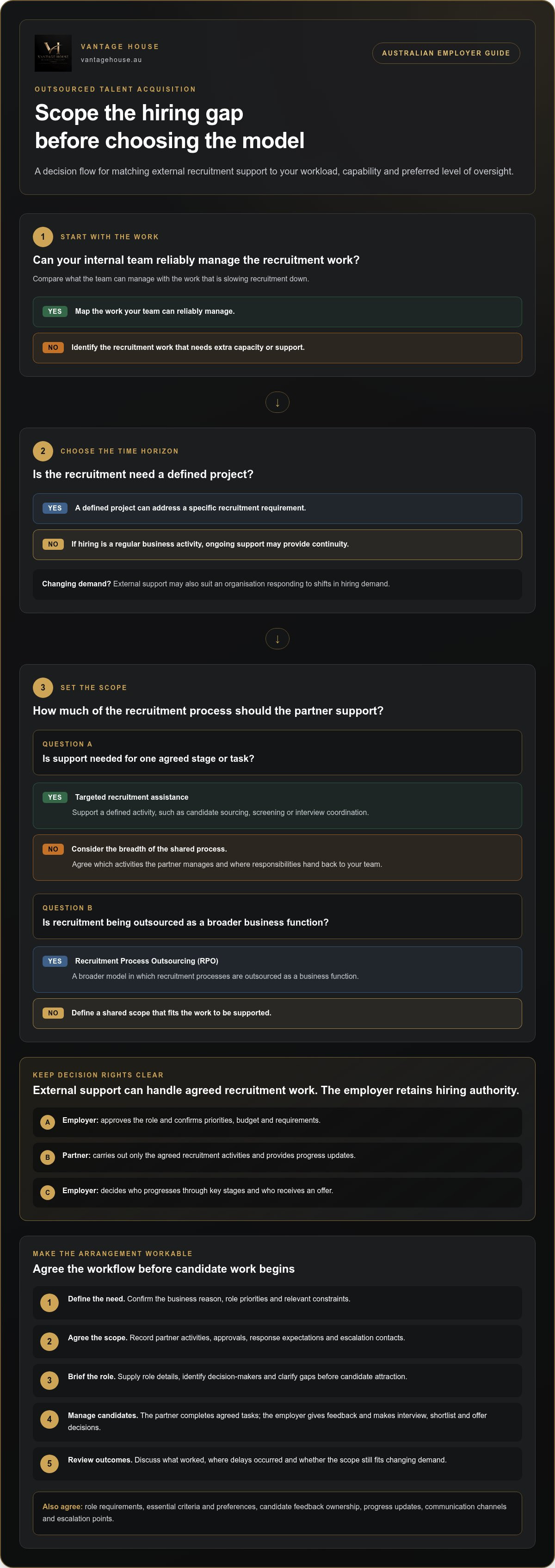
How to choose the right outsourced talent acquisition scope
The right scope should address a defined recruitment need without creating extra hand-offs or duplicating work your team already manages well. For outsourced talent acquisition australia, assess four factors together: hiring frequency, role complexity, available internal capacity and how likely demand is to change.
Start by mapping the work, not selecting a broad service label. For each recruitment activity, identify who leads it, who contributes and who approves the outcome:
- Role briefing: the employer sets business priorities and role requirements; the partner can help clarify the brief.
- Candidate attraction and screening: agree which tasks the partner handles and what information the employer needs to assess suitability.
- Interviews and feedback: confirm who coordinates interviews, gathers feedback and communicates with candidates.
- Final decisions: keep role approval and hiring authority with the employer, with the partner supporting the agreed process.
Match service scope to hiring volume and internal capacity
Defined, occasional vacancies may call for role-specific recruitment support, particularly when the team can manage interviews and decisions but has limited time for sourcing. If hiring is ongoing or fluctuates across roles, consider whether continuing external capacity would better complement existing processes. Role complexity matters too: a specialist search may need a different division of work from a familiar, repeat vacancy.
Include the internal team’s actual availability in the assessment. A process that appears manageable on paper may still stall if hiring managers can’t provide timely feedback or attend interviews. Retain the steps your team can reliably own and assign external support to activities that are stretching capacity.
Set practical measures and responsibilities before engagement
Agree how progress will be reported, how often updates are shared and who manages candidate communication at each stage. Set decision rights for shortlisting, interviews and offers, as well as an escalation pathway for issues such as a changing role brief or delayed feedback. These arrangements maintain visibility without requiring duplicate reporting.
Choose review measures that reflect the agreed scope. For example, a sourcing-focused arrangement may be reviewed against candidate flow and the relevance of profiles, while broader support may also involve reviewing coordination and communication. Avoid relying on universal hiring benchmarks or assumed performance outcomes. Instead, assess whether responsibilities are clear and the arrangement remains useful as demand changes.
Vantage House provides recruitment and staff placement support for Australian employers. Find out more about recruitment support.
How Vantage House can support outsourced recruitment and staff placement
Choosing an external recruitment model is only part of the decision. The hiring approach also needs to reflect the organisation’s structure, the role being filled and the people-management support available internally. Vantage House provides recruitment and staff placement for Australian employers, including end-to-end recruitment and candidate placement.
This gives employers practical external hiring support while keeping key business decisions with their team. The scope can be shaped around the recruitment activities required, from defining role needs through to candidate coordination and placement. Clear responsibilities help maintain a consistent process and keep hiring managers involved where their judgement is needed.
Connect recruitment support with the wider people-management context
Recruitment decisions sit within an organisation’s broader workforce needs. Role requirements should reflect the work, team priorities and relevant operational context, so the hiring process is aligned with what the business needs from the position.
People-management requirements may also arise alongside hiring. Vantage House provides day-to-day HR assistance, workplace relations advice and compliance guidance for Australian employers. These services can support organisations when recruitment connects with wider HR processes or workplace considerations. They complement hiring support, but are not legal representation in court or Fair Work Commission hearings.
Filling a role is one part of managing a workforce. A clear recruitment plan can sit alongside the organisation’s existing HR processes, helping leaders consider the transition from role approval through to appointment while keeping recruitment responsibilities distinct from broader employment matters.
Move from comparison to a defined recruitment plan
A practical plan records the role requirements, the activities assigned to the recruitment partner, the responsibilities retained by the employer and how progress will be reviewed. It should also identify who provides candidate feedback, who manages communication and who makes the final selection decision. These details create a shared working arrangement without transferring more control than the employer intends.
Begin with the organisation’s hiring requirement and the level of support that fits its capacity and priorities. This gives both parties a clear basis for defining an appropriate scope, whether the need is focused on a vacancy or includes broader recruitment activity.
Vantage House provides recruitment and staff placement support for Australian employers.
Set a recruitment approach that fits your business
The right recruitment arrangement is defined by the work you need to share, not the broadest service label. Compare options against hiring frequency, role complexity and your team’s available capacity. Then agree who owns each activity, how progress is reported and where final decisions sit.
That clarity helps you choose a scope that supports hiring without adding unnecessary complexity. It also makes it easier to connect recruitment with wider people-management needs when they arise.
Vantage House provides recruitment and candidate placement support for Australian employers, alongside HR support and workplace relations advisory. These services can keep hiring requirements connected to the practical needs of managing people at work.
Outline the roles you need to fill, the recruitment tasks requiring support and the responsibilities your team wants to retain. Discuss your recruitment and staff placement needs with Vantage House to define a clear, workable plan.
Frequently Asked Questions
What is outsourced talent acquisition?
Outsourced talent acquisition is an arrangement where an employer transfers or shares agreed recruitment activities with an external partner. Support may cover selected tasks, such as candidate sourcing or screening, or extend across a broader recruitment process. The employer and partner define responsibilities in advance, including who approves roles, communicates with candidates and makes hiring decisions. The model can be tailored to a specific vacancy or continuing recruitment needs.
What is the difference between recruitment outsourcing and recruitment agency services?
Recruitment agency services commonly focus on helping fill defined vacancies by sourcing or presenting candidates. Recruitment outsourcing can cover a wider set of activities and may involve ongoing responsibility for parts of the employer’s recruitment process. The terms can vary, so compare the actual scope, continuity and reporting arrangements. An agency engagement may be role by role, while an outsourcing arrangement can share responsibilities across multiple recruitment activities.
Is recruitment process outsourcing the same as staff augmentation?
No. Recruitment Process Outsourcing (RPO) involves an ongoing transfer or sharing of recruitment process responsibilities with an external partner. Staff augmentation adds recruitment capacity to work alongside an employer’s internal team, which generally retains direct process ownership. The distinction is the level of responsibility shared, not simply whether an external recruiter is involved. Define task ownership, oversight and decision rights for either arrangement.
How do I choose an outsourced talent acquisition partner in Australia?
Choose an approach by matching the recruitment work to your hiring frequency, role complexity and internal capacity. Set out which activities need support, who will brief roles and manage candidate communication, and where approvals and final decisions sit. For outsourced talent acquisition australia, also establish reporting expectations and escalation points that fit your organisation’s workforce and compliance context. A clear scope makes the working relationship easier to manage.
Can a small business outsource only part of its recruitment process?
Yes. A small business can outsource selected recruitment activities rather than transferring the whole process. For example, an external partner may assist with candidate sourcing and screening while the business manages interviews and makes the final selection. The scope should reflect the team’s available time and existing recruitment capability. Agreeing task ownership in advance helps avoid duplicated effort and keeps the employer involved in important decisions.
Does outsourcing talent acquisition mean employers lose control of hiring?
No. Outsourcing recruitment does not automatically transfer hiring authority. Employers can retain control over role approval, interview decisions and the final appointment while a partner manages agreed activities, such as sourcing, screening or coordination. Specify who can make each decision and how candidate recommendations are reviewed. Clear approvals and communication avoid uncertainty about the employer’s authority.
How much does outsourced talent acquisition cost in Australia?
There isn’t one standard cost for outsourced talent acquisition in Australia. Fees depend on the agreed model, the number and complexity of roles, the activities included and whether support is for a defined recruitment project or ongoing work. Compare the scope, responsibilities and reporting arrangements rather than a headline figure alone. Make sure the applicable fee basis and any included or excluded activities are documented clearly.
Can outsourced recruitment support Australian workplace compliance?
Yes, recruitment support can be structured with relevant Australian workplace requirements in mind, but outsourcing recruitment does not remove the employer’s responsibilities. Clear role briefs, consistent candidate assessment and defined approval processes can support a considered hiring approach. Vantage House also provides HR support, workplace relations advisory and compliance guidance to Australian employers. This is advisory support, not legal representation in court or Fair Work Commission hearings.


