

The quickest way to fill a vacancy isn’t always the most useful one. The staff placement solutions Australia businesses choose should match the role, the organisation’s capacity and the support needed from candidate search through to placement. A clear process matters as much as finding potential candidates.
When internal time or recruitment capability is limited, it helps to define what you need before engaging support. Clarify the role expectations, how candidates will be assessed, what the service includes and who is responsible for each decision. Recruitment and staff placement can cover different activities, so a clear brief is a practical first step.
This guide sets out a framework for comparing staff placement solutions, defining hiring needs and deciding where employer input belongs in candidate assessment. It also covers scope, fees, responsibilities and follow-up, so you can move from vacancy brief to placement with greater clarity. Vantage House provides recruitment and staff placement alongside HR support, helping Australian employers connect hiring decisions with broader people-management needs.
Key Takeaways
- Decide whether you need candidate sourcing and placement, internal recruitment capacity, job advertising or ongoing HR support.
- Set out the steps from role brief to shortlist, including employer input and responsibility for the final selection.
- Compare staff placement solutions in Australia by scope, assessment approach, communication and follow-up, not headline fees alone.
- Agree on decision-makers, interview availability and feedback responsibilities before candidates are introduced.
- Consider practical HR support alongside recruitment when your organisation’s needs continue beyond filling a vacancy.
Staff placement solutions in Australia: what employers are buying
Staff placement solutions support organisations to source, assess and place candidates. The work may start with clarifying the role, then continue through candidate search and assessment to a shortlist and placement. The employer defines what the role requires and makes the final hiring decision.
The service label alone doesn’t explain what is included. One arrangement may focus on sourcing candidates, while another may cover more stages of recruitment. To understand what your organisation is buying, compare the specific activities and deliverables with your hiring needs. This helps distinguish a focused placement service from broader recruitment support.
When external placement support can help
External support may suit an organisation facing hiring pressure, limited internal recruitment capacity or a role that is difficult to fill. A defined scope can reduce the recruitment administration handled by internal decision-makers, while keeping their attention on role requirements, candidate feedback and selection. It doesn’t guarantee a faster hire or long-term retention. Its value depends on whether the support fits the role and the organisation’s capacity to participate.
Placement, recruitment and HR support compared
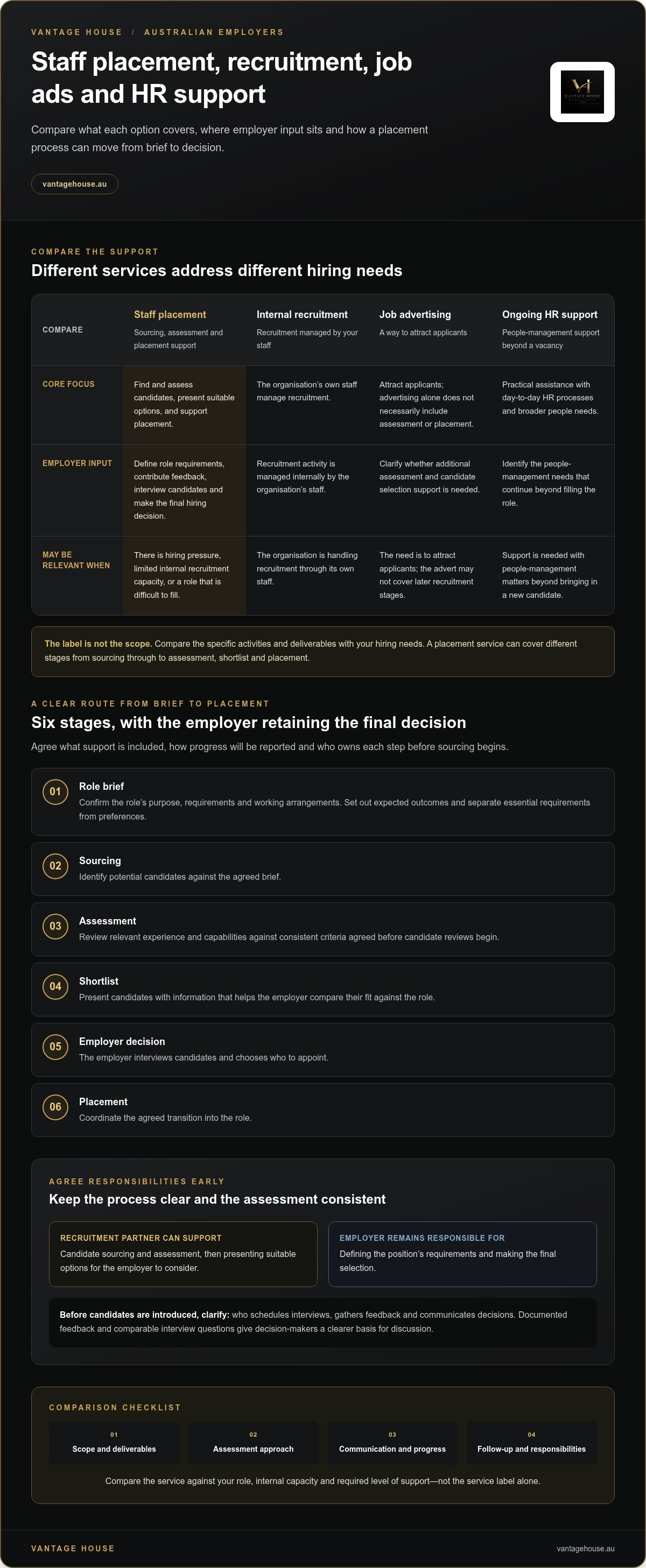
These terms overlap, but they describe different needs. Internal recruitment is managed by the organisation’s own staff. Job advertising is one way to attract applicants, but advertising alone doesn’t necessarily include candidate assessment or placement. A placement solution can add support with sourcing and assessing candidates, then presenting suitable options for the employer to consider.
Ongoing HR support addresses people-management needs beyond filling a vacancy. It can include practical assistance with day-to-day HR processes, while recruitment and placement focus on bringing a new candidate into the organisation. Some employers need one type of support; others benefit from connecting hiring with wider HR needs. Vantage House provides recruitment and staff placement alongside practical HR assistance for Australian employers.
The recruitment process can involve several stages, from sourcing and screening through to interviewing and hiring. Understanding those stages helps employers identify where they need assistance and where they’ll remain directly involved. For a broader explanation of workforce hiring approaches, see this recruitment and staffing guide.
When comparing staff placement solutions Australia wide, start by defining your internal capacity, the role’s complexity and the level of support required. A clear scope gives the discussion a stronger basis than a service label alone.
What a staff placement solution should include from brief to shortlist
A well-scoped placement process gives the employer and recruitment partner a shared understanding of the role, candidate requirements and decision points. Before sourcing begins, agree on what support is included, how progress will be reported and who is responsible for each step. This makes gaps easier to spot early and keeps employer input focused where it matters.
A practical process generally follows this sequence:
- Role brief: Confirm the role’s purpose, requirements and working arrangements.
- Sourcing: Identify potential candidates against the agreed brief.
- Assessment: Review relevant experience and capabilities against consistent criteria.
- Shortlist: Present candidates with information that helps the employer compare their fit.
- Employer decision: Interview candidates and choose who to appoint.
- Placement: Coordinate the agreed transition into the role.
The recruitment partner can support sourcing and assessment, while the employer defines what the position requires and makes the final selection. The process should also specify who schedules interviews, gathers feedback and communicates decisions. Employers can refer to the Fair Work Ombudsman’s guidance on your legal obligations when preparing to hire, including considerations around pay and employment arrangements.
Build a role brief that supports better matching
Start with the outcomes the person is expected to deliver, then identify the capabilities needed to achieve them. Separate essential requirements from preferences so the assessment stays focused on genuine role needs. Include working arrangements, team context and reporting relationships where they affect suitability. For example, if the role involves close coordination across a team, describe that responsibility instead of relying on a generic job title.
Assess candidates against consistent criteria
Agree on assessment criteria before reviewing candidates. Compare relevant experience, practical capabilities and alignment with the role, rather than treating qualifications or résumé keywords as proof of fit. Structured interviews help candidates address comparable requirements, while documented feedback gives decision-makers a clear basis for discussion. This makes it easier to distinguish a strong match from a polished application.
For organisations considering staff placement solutions Australia wide, these steps create a workable framework while keeping key decisions with the employer. Vantage House supports recruitment and staff placement for Australian employers. Explore Vantage House recruitment support as you plan a considered process from role brief to placement.
How to compare staff placement solutions without focusing on fees alone
A headline fee tells only part of the story. Compare the work included, how candidate fit is assessed and what support is provided as the brief develops. A narrower service may suit a straightforward vacancy, while a more involved role or limited internal capacity may call for broader recruitment support. Understand the scope and responsibilities before weighing the commercial terms.
Use a consistent framework to compare what each proposed service covers:
| Area | What to clarify |
|---|---|
| Scope | Which stages are included, from role brief and sourcing to placement and follow-up? |
| Sourcing | How will candidate search reflect the role’s requirements and workplace context? |
| Assessment | What criteria are used to assess relevant experience, capabilities and role alignment? |
| Communication | How often and in what format will progress and candidate information be shared? |
| Employer input | Which decisions and actions stay with your team, including interviews and final selection? |
| Follow-up | What support is provided after placement, and what happens if the brief changes? |
This comparison helps show whether a lower headline fee reflects a narrower scope, fewer assessment steps or less follow-up. It also keeps attention on the service your organisation needs, rather than the label attached to it. Employers can consider the industry best practice promoted by the Recruitment, Consulting and Staffing Association as a reference point for professional conduct.
Questions that reveal service scope and accountability
Before recruitment begins, map responsibility for each stage. Clarify what information the employer must provide, how candidate progress and feedback will be reported, and who coordinates interviews. Agree how changes to the role brief will be handled. It’s also useful to define the next steps if a candidate withdraws, so responsibilities are clear rather than improvised.
Compare value, fit and communication
Look for a process that assesses candidates against the agreed selection criteria and considers the realities of the workplace, not just résumé keywords. Communication should suit your organisation’s decision-making rhythm, with enough detail for stakeholders to provide timely, considered feedback. When comparing staff placement solutions Australia wide, remember that retaining control doesn’t mean managing every recruitment task. Your team can delegate agreed sourcing and assessment work while keeping authority over requirements, interviews and the final appointment.
Where hiring decisions intersect with broader workplace practices, the workplace relations advisory guide provides a related perspective.
Prepare your organisation for a clear, well-managed placement process
A placement process runs more smoothly when the organisation is ready to make decisions, not just receive candidate profiles. Before recruitment begins, confirm internal approval, settle the role brief and agree who will manage each step. This keeps the search connected to current team needs and helps create a consistent candidate experience.
A practical sequence is to:
- Confirm approval: Ensure the vacancy and hiring authority are clear.
- Align the brief: Check that responsibilities, essential capabilities and working arrangements reflect the role as it operates now.
- Assign decision-makers: Identify who will review candidates, conduct interviews and make the final selection.
- Plan feedback: Set a realistic timeframe for reviewing profiles and sharing considered feedback.
- Prepare onboarding: Agree how the successful candidate will be introduced to the role, team and relevant processes.
Set up the hiring team before recruitment starts
Clear ownership prevents decisions from stalling between stakeholders. Agree who approves changes to the brief, who is available to interview and who consolidates feedback after each discussion. If several people contribute, identify who will communicate the final decision. This gives the recruitment partner a clear point of contact and helps candidates receive consistent information.
Before the search begins, check that the role brief reflects actual work expectations and current team priorities. A position can change as workloads shift, so confirm its key outcomes and reporting relationships with the people who understand the day-to-day requirements. Employers can also refer to this Australian workplace compliance guide for related employer responsibilities.
Carry placement through to onboarding
Selection is not the end of the handover. Before the start date, prepare a clear outline of role expectations, reporting lines, initial priorities and the processes the new employee will need to understand. Decide who will communicate transition details to the successful candidate and who will provide initial support once they join. A consistent handover connects what was discussed during recruitment with the experience of starting the role.
Preparing these steps in advance helps organisations make better use of staff placement solutions Australia businesses rely on. The agreed recruitment work can then connect to a ready hiring team and a considered onboarding plan. To discuss recruitment support that fits your organisation’s process, discuss recruitment support for your organisation.
How Vantage House supports staff placement for Australian employers
Vantage House provides recruitment and staff placement for Australian employers, with support shaped around the organisation’s vacancy and hiring requirements. A clear understanding of the role establishes what candidate sourcing and assessment need to focus on, while agreed responsibilities keep employer decision-makers involved throughout the process.
This approach can help when internal teams need recruitment support but want to retain control of important decisions. The employer provides context about the vacancy, identifies essential role requirements and considers candidates against those needs. Clear communication helps keep the process aligned if priorities or role details change.
Match recruitment support to the organisation’s hiring need
Each vacancy has its own demands. A role with specialised responsibilities may call for different assessment considerations from a position with broader duties. The hiring brief provides the basis for shaping recruitment and placement, including which capabilities matter and what information decision-makers need to assess candidate suitability.
Responsibilities should be clear from the outset. Recruitment support can assist with candidate sourcing and placement, while internal leaders retain input on role expectations, interviews and the final appointment. Defined communication points also help everyone share feedback and make decisions with a common understanding of the brief.
Connect placement with wider people support
For some employers, filling a vacancy is one part of a broader people-management need. Vantage House also provides practical HR assistance for organisations whose requirements extend beyond recruitment. Keeping these needs in view helps employers consider how placement fits alongside day-to-day people processes without confusing the purpose of each type of support.
Across staff placement solutions Australia wide, a well-managed engagement starts with a realistic brief, clear employer input and a defined scope. These foundations keep recruitment relevant to the organisation’s needs while ensuring internal decision-makers remain responsible for the choices that shape their team.
Take the next step with a defined brief
A useful first discussion can cover the role, the reason for hiring, the capabilities required and the support your organisation needs through candidate selection and placement. Sharing who will make decisions and how your team prefers to manage communication can also help define an appropriate scope for the engagement.
To discuss your organisation’s recruitment requirements, discuss staff placement solutions with Vantage House.
Set your placement process up for a considered hire
A suitable placement starts with a clear role brief and an agreed process. Define the support your organisation needs, set candidate assessment criteria and decide how your team will provide input. Comparing service scope and communication alongside fees helps you choose support that fits the vacancy, not just a label.
Vantage House provides recruitment and candidate placement for employer staffing requirements across Australia. When people-management needs continue beyond hiring, practical HR support can sit alongside recruitment. The focus is a considered process, guided by role clarity and employer input.
Share your hiring context and recruitment requirements to begin a focused discussion about the support that suits your organisation. Discuss your recruitment requirements with Vantage House.
Frequently Asked Questions
What do staff placement solutions include?
Staff placement solutions can support some or all stages of recruitment, from preparing a role brief and sourcing candidates to assessing suitability and coordinating a shortlist. The scope depends on the engagement. Before recruitment starts, agree who manages each stage, what information the employer provides, how decisions are made and whether follow-up is included. A clear scope helps match the process to the vacancy and the organisation’s hiring requirements.
How do I choose a staff placement solution in Australia?
Start by defining the role, essential capabilities and limits on your internal hiring capacity. Then compare the staff placement solutions Australia employers may consider by scope, sourcing and assessment approach, communication, employer input and follow-up. Check whether the proposed process fits your workplace and decision-making structure. Comparing deliverables and responsibilities side by side gives you a clearer basis for assessing value than relying on a service label or headline fee alone.
Is staff placement the same as recruitment?
Not necessarily. Recruitment is a broad term for attracting and assessing candidates, while staff placement may describe support that continues through selection and placement. Organisations may use these terms differently, so the label doesn’t define what’s included. Review the specific activities, responsibilities and follow-up set out for the engagement. This clarifies which tasks the recruitment partner will manage and which decisions, including the final candidate choice, remain with the employer.
Can a placement partner help with onboarding?
A placement engagement may include coordination between candidate selection and the new employee’s start, depending on the agreed scope. Employers should prepare role expectations, reporting lines, internal contacts and initial support before the start date. They should also decide who will communicate transition details to the successful candidate. A clear handover helps the hiring team provide consistent information and gives the new employee a more organised introduction to the role and workplace.
How much does staff placement cost in Australia?
Staff placement fees vary with the role, recruitment requirements and agreed service scope. Rather than relying on a general estimate, compare what each proposal covers, how its fees are structured and which responsibilities remain with your team. Review clear written terms so you can assess the proposed work against your hiring needs and budget. This helps distinguish a lower headline fee from a service that includes more sourcing, assessment or follow-up support.
What should an employer provide to start a placement process?
Prepare a role brief that outlines expected outcomes, essential capabilities, working arrangements and relevant team context. Identify who will approve the vacancy, interview candidates, consolidate feedback and make the final decision. Set realistic internal timeframes for reviewing candidate information and communicating decisions. Sharing these details before candidate introductions helps align sourcing and assessment with the vacancy, while agreed communication points keep the process clear for everyone involved.
Does a placement solution guarantee the right candidate?
No recruitment process can guarantee that a candidate will perform as expected or remain in a role. Employers can support more consistent decisions by defining the role clearly, using relevant assessment criteria and taking part in candidate selection. A structured process can inform the hiring decision, but the employer retains responsibility for the final choice and for setting the new employee up to succeed through clear expectations and appropriate onboarding support.


