

A compliant employment contract doesn’t, on its own, show whether every employment obligation is being met. Australian employment standards operate as a connected framework, and a mismatch between minimum entitlements, award conditions and workplace processes can create gaps across a workforce. Australian employment standards advisory helps employers interpret requirements in the context of their roles and working arrangements.
It can be difficult to determine which standards apply when employees have different duties, classifications or arrangements. Consistent decisions also depend on clear records and processes that keep pace with changing requirements. The practical task is to connect the rules to everyday decisions, from setting employment terms and managing pay to reviewing workplace practices.
This guide explains how the Fair Work Act, National Employment Standards, modern awards, registered agreements and employment terms fit together. It also outlines practical records and processes that support consistent decisions throughout the employment lifecycle, and how workplace relations advisory and HR support can help employers interpret and apply their obligations.
Key Takeaways
- Map employment obligations to the relevant legislation, industrial instruments and employment arrangements instead of relying on one generic checklist.
- Review each role’s actual duties and applicable instruments to establish which standards and conditions apply.
- Use a repeatable process at recruitment, during employment and at separation to keep decisions and records consistent.
- Australian employment standards advisory helps employers interpret requirements in their workplace context and turn them into practical processes.
- Structured HR support helps leaders review how standards are applied as roles, arrangements and requirements change.
What Australian employment standards cover and why employers need a clear framework
Employment standards are the linked minimum workplace requirements that shape pay, leave, working hours and other conditions of employment. In Australia, obligations can come from legislation, industrial instruments and individual employment arrangements. An employment contract is part of the picture, not a substitute for applicable minimum entitlements.
The framework that applies depends on the employing entity, the employee’s role and duties, and the working arrangement. A checklist can help organise a review, but it can’t establish coverage for every role or resolve how different requirements interact. Start by identifying the source of each obligation, then assess how it relates to the work being performed.
The main sources of employment standards in Australia
The Fair Work Act 2009 is a central part of Australia’s workplace relations framework. It provides for the National Employment Standards (NES), which set a statutory safety net of minimum conditions. For background on their place in the system, see the National Employment Standards (NES).
Modern awards may add industry or occupation-specific minimum pay rates and conditions for covered employees. Enterprise agreements can also set employment conditions for the employees they cover. An employment agreement records terms between an employer and employee, but operates alongside applicable statutory requirements and industrial instruments. The document alone doesn’t establish that all minimum conditions have been met.
Why a connected view matters to employers
Pay, leave and record-keeping processes may sit with different people or systems. When each is managed in isolation, it can be harder to see whether a role’s classification, pay settings and recorded entitlements align. A role-based review brings these details together and helps leaders identify where closer attention is needed, particularly when duties or working arrangements change.
For example, a change in an employee’s responsibilities may warrant a review of whether their classification and employment terms still reflect the work. The outcome can then inform payroll and record-keeping processes, rather than leaving each function to make assumptions independently.
This guide provides general information, not a determination of how a particular law or instrument applies to an individual workplace. Australian employment standards advisory helps employers interpret requirements in their workplace context and establish practical processes. This is distinct from formal legal representation in a court or Fair Work Commission hearing. Vantage House provides employer-focused workplace relations advice, not representation in those proceedings.
The core employment standards employers need to understand
A useful way to review employment standards is to group them by the decisions and workplace processes they affect. Treat this as an orientation map, not a complete compliance checklist. The applicable award or agreement, an employee’s circumstances and current official guidance can all affect how a requirement applies.
Minimum entitlements, awards and employment terms
The National Employment Standards (NES) provide a baseline of minimum entitlements under the national workplace relations system. Employers can use the Fair Work Ombudsman's guide to the NES as a starting point, then consider how those entitlements interact with the instrument and arrangement relevant to each employee.
Modern awards may set classifications, pay rates and other conditions for covered roles. An enterprise agreement sets conditions for employees it covers, while an individual employment contract records agreed terms between an employer and employee. These instruments aren’t interchangeable, and a contract doesn’t remove applicable minimum entitlements.
Pay, leave, hours and workplace records
Pay, leave, working hours and records are connected management responsibilities. Role classification and recorded hours, for example, can inform pay processes, while leave administration and employee information should reflect applicable conditions. Because eligibility and requirements may vary with the employment arrangement and relevant instrument, compare specific entitlements and record obligations with up-to-date Fair Work Ombudsman guidance.
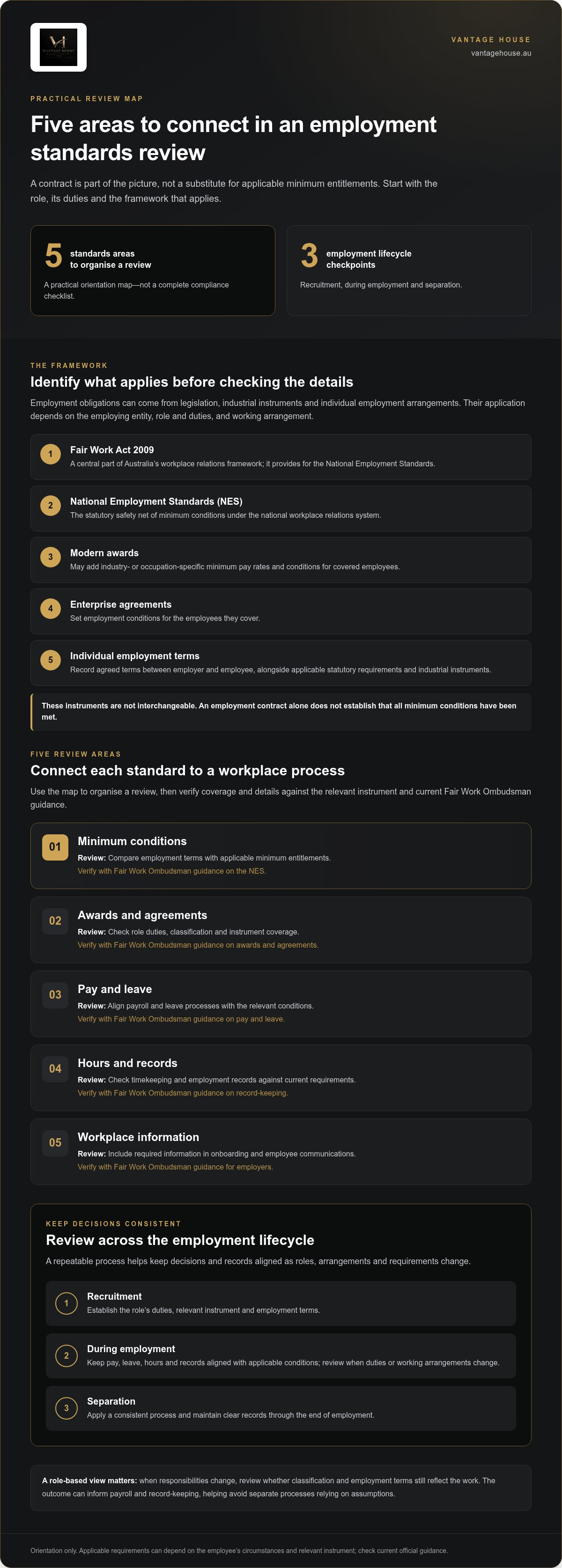
Use the table as a starting point for organising a review. It shows what to examine and where to verify details, rather than determining coverage for a particular employee.
| Standards area | Employer process to review | Official reference to verify |
|---|---|---|
| Minimum conditions | Compare employment terms with applicable minimum entitlements. | Fair Work Ombudsman guidance on the NES |
| Awards and agreements | Check role duties, classification and instrument coverage. | Fair Work Ombudsman guidance on awards and agreements |
| Pay and leave | Align payroll and leave processes with the relevant conditions. | Fair Work Ombudsman guidance on pay and leave |
| Hours and records | Review timekeeping and employment records against current requirements. | Fair Work Ombudsman guidance on record-keeping |
| Workplace information | Include required information in onboarding and employee communications. | Fair Work Ombudsman guidance for employers |
For employers managing different roles or instruments, australian employment standards advisory can help turn these reference points into consistent workplace processes. Vantage House workplace relations advisory supports award interpretation and practical implementation in an employer’s context.
How to identify which Australian employment standards apply
A generic checklist can organise a review, but it won’t resolve coverage for every employer and role. Start with the employing entity and the workplace relations framework that applies to it. Then map the workforce by role, actual duties and working arrangements before identifying relevant awards, agreements and employment contracts.
Job titles alone don’t settle award classification or coverage. Two employees with similar titles may perform different work, and duties can change without the title being updated. Full-time, part-time and casual arrangements also provide important context for assessing conditions and entitlements. Use the Fair Work Ombudsman’s current tools, including award and entitlement resources, for initial research. Then compare the results with the specific role and applicable instruments.
Compare the main sources of workplace requirements
These sources serve different purposes and should be considered together. The table is a practical guide to their roles, not a determination of coverage.
| Source | Primary function | Employer review focus |
|---|---|---|
| Legislation | Sets the statutory framework and minimum requirements, including the National Employment Standards. | Identify the legislation and minimum entitlements relevant to the employment relationship. |
| Modern award | May set minimum pay and conditions for covered industries and occupations. | Assess coverage and classification against the work actually performed. |
| Enterprise agreement | Sets conditions for employees covered by that agreement. | Confirm whether an agreement applies and how its terms relate to other obligations. |
| Employment contract | Records agreed terms between the employer and employee. | Check that written terms align with applicable minimum requirements and instruments. |
Recognise when an interpretation needs closer review
Use a structured assessment if classification is unclear, more than one instrument appears relevant, or records don’t match the terms being applied. Changes to the business, duties, workforce structure or working arrangements can also make earlier assumptions worth revisiting.
Keep a clear record of the role duties considered, the instruments reviewed and the reasoning behind decisions. This gives managers a consistent reference point and makes unanswered questions easier to identify. Australian employment standards advisory supports employers with award interpretation and practical application in their workplace context. Vantage House provides employer-focused workplace relations advice, not representation in court or Fair Work Commission hearings.
A practical process for applying standards across the employment lifecycle
Employment standards are easier to manage when they’re built into a repeatable people-management workflow. The steps below help assign responsibility, keep key information accessible and identify when an issue needs further review. They’re a management framework, not legal advice or a guarantee of compliance. Tailor the process to the employer, its roles and applicable requirements.
Build standards into everyday people processes
At recruitment and onboarding, establish who checks role duties and relevant employment terms, who provides required workplace information, and who sets up payroll and record-keeping inputs. Clear handovers help prevent details such as classification, hours or agreed arrangements from being lost between hiring and administration.
During employment, provide a straightforward way to record changes to duties, hours or working arrangements. Assign someone to review each change, update relevant records and communicate resulting decisions to the employee and the people responsible for implementation. At separation, use a defined process to check final administrative steps, retain relevant records and escalate unresolved questions. The detail will vary by workplace, so one template or policy won’t suit every situation.
For broader context on organising these responsibilities, see the Australian small business workplace compliance guide.
Review changes and keep records usable
Set review triggers for changes to workforce structure, role duties, applicable instruments or internal processes. Routine reviews can also identify mismatches between written employment terms, payroll settings and the records managers rely on. Keep the rationale for decisions with the relevant role and employment records, so it remains available when responsibilities change or a question arises.
Where award coverage or classification needs closer interpretation, compare the role’s actual duties with the relevant instrument. The modern award compliance guide offers further context on that review. A broader HR compliance checklist can also help organise routine checks.
Australian employment standards advisory helps employers interpret requirements in their workplace context and connect decisions to workable HR processes. Vantage House provides workplace relations advisory and practical support with award interpretation and consistent implementation.
How employment standards advisory supports consistent employer decisions
Reference materials can help employers identify relevant standards, but applying them to a particular workforce may require closer interpretation. Structured support is useful when award coverage or classification is unclear, when different roles appear to be treated inconsistently, or when a workplace change raises questions about existing processes. Australian employment standards advisory connects requirements to the employer’s operating context, helping leaders make informed decisions and apply them consistently.
What employer-focused advisory can help clarify
Workplace relations advisory helps employers interpret employment standards and applicable awards, then consider how those requirements fit existing people processes. A review might clarify which role information needs to be considered, where current records or procedures need attention, and how managers can communicate decisions consistently.
The value is practical: clearer processes, a shared basis for decisions and better alignment between workplace requirements and day-to-day administration. Advice can inform internal action, but it doesn’t guarantee a particular compliance outcome or replace formal legal representation. It is also distinct from employee advocacy and union representation. Vantage House provides employer-focused advisory and compliance guidance, not representation in court or Fair Work Commission proceedings.
Establish a proportionate next step
Make a review more useful by first identifying the specific question or process that needs attention. This might be a group of roles with uncertain award classifications, an onboarding handover that needs clarification, or records that no longer reflect current working arrangements. Gathering relevant role details, existing employment terms and process documents gives the review a clear starting point.
Some matters call for a focused interpretation; others benefit from ongoing HR support as roles, workforce arrangements and workplace processes evolve. A consistent review approach helps managers understand what to do, who is responsible and when an issue should be escalated, without turning every decision into a one-off exercise.
Vantage House’s workplace relations advisory helps employers interpret employment standards and award requirements in their workplace context.
Build a consistent approach to workplace standards
Employment standards are best managed as a connected framework. Legislation, applicable awards or agreements, and employment terms each have a role, while the requirements for a particular employee depend on their work and arrangements. A role-based review helps employers identify relevant obligations and keep decisions, records and processes aligned throughout the employment lifecycle.
Where interpretation is unclear or workplace processes need closer review, australian employment standards advisory helps turn requirements into practical steps. Vantage House provides national workplace relations advisory and compliance guidance to Australian employers, including practical support with employment standards and award interpretation. This is employer-focused advisory, not legal representation in court or Fair Work Commission hearings.
Start by identifying the roles, records or processes that need attention. For support applying standards consistently in your workplace, contact Vantage House about workplace relations advisory.
Frequently Asked Questions
What are Australian employment standards?
Australian employment standards are the minimum workplace requirements that apply through legislation and relevant industrial instruments. They cover areas such as pay, leave, hours of work and workplace information. The National Employment Standards, modern awards, enterprise agreements and employment contracts each have a role, but they aren’t interchangeable. Employers need to consider the employee’s role and working arrangement to understand how these sources fit together.
Do the National Employment Standards apply to every employee in Australia?
The National Employment Standards apply to employees covered by Australia’s national workplace relations system. They provide minimum entitlements, but the system’s coverage is not identical for every worker or employer. State public sector and local government employees, for example, may be covered by different arrangements. Check current Fair Work Ombudsman guidance to establish which system applies before relying on the NES as the sole reference for a particular employee.
How do I find the right modern award for an employee?
Start with the employer’s business activities and the employee’s actual duties, then use the Fair Work Ombudsman’s Find my award tool as an initial reference. A job title alone may not establish award coverage or classification. If an enterprise agreement may apply, include it in the review. Compare the role and working arrangements with the relevant instrument. If coverage remains unclear, Vantage House workplace relations advisory can help employers interpret award requirements in their workplace context.
Can an employment contract provide conditions below minimum employment standards?
No. An employment contract can’t displace applicable minimum entitlements or reduce conditions below the relevant legal and industrial requirements. It can set out agreed terms and may provide conditions above the minimum, but the document needs to be read alongside applicable legislation, awards or agreements. If a contract term appears inconsistent with a minimum requirement, review the relevant instrument and current Fair Work Ombudsman guidance before applying it.
What records should employers keep to manage employment standards?
Employers should maintain clear, accessible employment records that support decisions about pay, hours, leave, role details and applicable employment terms. Records may also include changes to duties or working arrangements, relevant agreements and information used to determine classification. The precise record requirements and retention periods depend on current rules and the circumstances. Use Fair Work Ombudsman guidance, and organise records so managers can apply processes consistently.
When should an employer review its employment standards processes?
Review processes when roles, duties, workforce arrangements, instruments or internal procedures change. A review is also useful when records don’t align with current practices, managers handle similar situations differently, or a routine check identifies unanswered questions. Set clear ownership for assessing changes, updating records and communicating decisions. Regular reviews help keep processes relevant, while a specific concern may call for a focused assessment rather than waiting for the next scheduled review.
Can an employment standards adviser represent an employer at the Fair Work Commission?
Vantage House provides employer-focused workplace relations advisory, not representation at the Fair Work Commission or in court. Australian employment standards advisory helps employers interpret standards and awards, assess workplace processes and make informed internal decisions. That support is distinct from formal representation in a proceeding, as well as employee advocacy or union representation. Treat advisory guidance and representation as separate functions when a matter proceeds to a formal forum.


