

A hire that fills a vacancy but misses the role or workplace can create more work than it resolves. Recruitment and staff placement services can help employers organise the process, but clear requirements and considered decisions are essential to finding a sound fit.
Recruitment takes time away from operational and leadership responsibilities. A rushed process can also leave expectations unclear for both employer and candidate. A structured approach helps define the role, identify relevant capabilities and keep each hiring stage aligned with workplace needs.
This guide explains what recruitment and placement involve, from setting role requirements and attracting candidates through assessment and placement. It also outlines the responsibilities employers retain throughout the process and how practical HR and workplace relations support can complement hiring. Vantage House supports employers across Australia with recruitment and staff placement, alongside HR support, workplace relations advice and employee research that can inform longer-term workforce decisions.
Key Takeaways
- Clarify the role’s purpose and essential capabilities before starting the search, so hiring stays focused on business needs.
- Understand how recruitment and staff placement services can structure the process from candidate attraction through assessment and placement.
- Compare internal hiring with external recruitment support and placement assistance, including who coordinates each stage and who makes the final decision.
- Set selection stages and decision-making responsibilities early to support a consistent, considered process.
- Consider how recruitment can sit alongside practical HR and workplace relations advice, with employee research informing longer-term retention decisions.
What recruitment and staff placement services do for Australian employers
Filling a vacancy takes attention, while operational and leadership responsibilities continue. External support can help organise the work of finding and assessing candidates, with the employer’s priorities guiding the process.
Recruitment and staff placement services provide structured assistance to attract and assess candidates, then match a selected person with an employer’s role based on its requirements.
The distinction matters. Finding a promising candidate is one part of hiring. Placement connects that person with a specific position, its responsibilities and the team they will join. The employer remains responsible for defining its needs and making the hiring decision.
Recruitment support and staff placement serve connected purposes
Recruitment involves identifying potential candidates and assessing their suitability against the role. The broader recruitment process commonly includes activities such as sourcing, screening and interviewing. Placement follows by matching a selected candidate with the employer’s position, based on the requirements and expectations agreed for that role.
A clear role brief gives candidate assessment a relevant frame. For example, explaining the position’s core responsibilities, required capabilities and team context helps distinguish candidates whose experience relates to the actual work. Without that clarity, someone may appear suitable in general terms but not align with the position’s day-to-day requirements.
When employers may benefit from external recruitment support
External support may be useful when internal teams have limited capacity to coordinate hiring, when role requirements are difficult to define, or when operational priorities are competing for attention. Structured assistance can bring order to the search and assessment stages, while the employer retains oversight of its needs and the final appointment.
For instance, a growing business might know it needs additional capability but still need to decide which responsibilities belong in the role and which skills are essential from day one. Resolving those questions before candidate selection can focus the search and reduce confusion between decision-makers.
A clear role brief gives the search a practical focus and keeps assessment relevant to the work the successful candidate will do.
Vantage House supports employers across Australia with recruitment and staff placement, from considering role requirements through to candidate placement. This gives employers a structured way to progress hiring while keeping workforce needs and workplace context in view.
How recruitment and staff placement services work from brief to appointment
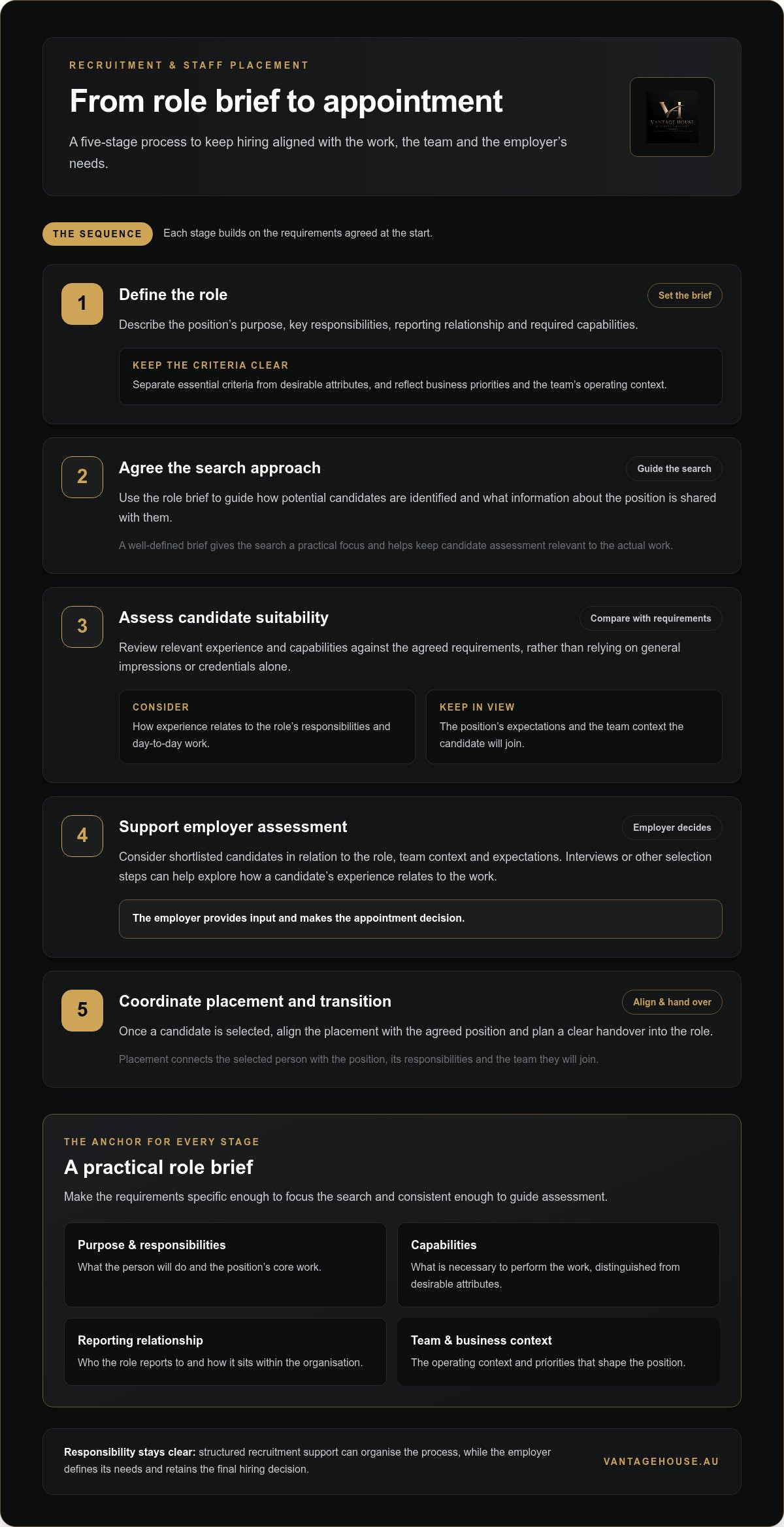
A clear sequence helps employers understand what needs to happen, who is responsible and where decisions sit. Recruitment and staff placement services should be guided by the work to be done, the team the new employee will join and the organisation’s priorities. The process can be organised into five stages:
- 1. Define the role. Set out its purpose, key responsibilities, reporting relationship and required capabilities. Separate essential criteria from desirable attributes so the brief reflects the actual position.
- 2. Agree the search approach. Use the role brief to guide how potential candidates are identified and what information about the position is shared with them.
- 3. Assess candidate suitability. Review relevant experience and capabilities against the agreed requirements, rather than relying on general impressions or credentials alone.
- 4. Support employer assessment. Consider shortlisted candidates in relation to the role, team context and expectations. The employer provides input and makes the appointment decision.
- 5. Coordinate placement and transition. Once a candidate is selected, align the placement with the agreed position and plan a clear handover into the role.
Build a role brief around genuine business requirements
A useful brief describes what the person will do, which capabilities are necessary to perform that work and who the role reports to. It should also reflect business priorities and the team’s operating context. For example, a customer-facing role may require particular communication capabilities, while a role supporting internal processes may place more emphasis on organisation and accuracy.
Distinguishing essential criteria from desirable attributes keeps the search focused and supports clearer conversations with candidates about responsibilities and expectations. If the brief combines too many unrelated duties or leaves key requirements open to interpretation, assessment can become inconsistent.
Move from candidate assessment to staff placement
Assess applications and candidate information against the role brief, focusing on relevant capability, experience and alignment with the position. Interviews or other selection steps give the employer an opportunity to explore how a candidate’s experience relates to the work. Look beyond a résumé alone: team context and day-to-day expectations also matter.
Placement is the coordinated move from selection to the agreed position, not simply a referral of a candidate. Clear communication about the role and transition helps both employer and candidate understand what has been decided. Recruitment support can structure these stages, while the employer retains responsibility for its requirements and final choice.
For support that connects role requirements with candidate placement, explore Vantage House recruitment and staff placement.
Compare internal hiring, recruitment support and staff placement
Employers can manage hiring internally, use targeted external recruitment support, or bring in assistance that extends through candidate placement. The right approach depends on the vacancy’s complexity and the time and capability available within the organisation. These options can also be combined, with the employer responsible for defining its needs and deciding who to appoint.
| Approach | Search coordination | Candidate assessment | Employer decision-making |
|---|---|---|---|
| Internal hiring | The employer manages advertising or other search activity and candidate communication. | Internal decision-makers assess applicants using their knowledge of the role and workplace. | The employer oversees the process and makes the appointment decision. |
| Targeted external support | An external adviser helps organise recruitment activity and identify suitable candidates. | Candidate information can be considered against requirements agreed with the employer. | The employer provides direction and decides which candidate, if any, to appoint. |
| Placement assistance | Support extends from identifying a suitable candidate towards matching them with the agreed position. | Assessment considers capability, experience and alignment with the role. | The employer remains responsible for selection and the appointment decision. |
What internal hiring keeps within the organisation
Internal hiring keeps role definition, candidate communication and selection close to the business. The people involved bring direct knowledge of workplace priorities, team relationships and the practical demands of the position. That context is valuable, but coordinating the search, reviewing applications and arranging selection activities takes time. These tasks may fall to a manager or another team member, even where the organisation has no dedicated HR staff.
What external recruitment and placement support can add
External support can help organise search activity and identify candidates against the employer’s stated requirements. The support may focus on recruitment tasks or extend to matching a selected candidate with the role. Vantage House provides recruitment and staff placement alongside practical HR support, helping employers connect hiring activity with day-to-day people management.
External recruitment support can organise the search and inform assessment, while the employer retains the appointment decision.
For a clearly defined vacancy, internal hiring may be manageable. A specialised or difficult-to-scope position, or a period of high operational demand, may call for more structured assistance. Recruitment and staff placement services can be tailored to the support required, while the employer remains responsible for its workforce needs and final choice.
Prepare for recruitment with clear role, selection and workplace requirements
Preparation helps keep recruitment decisions consistent and connected to the work the person will actually do. Before starting a search, agree on the role’s purpose, the capabilities required and how candidates will be assessed. This gives everyone involved a shared reference point and helps prevent selection criteria from shifting during the process.
Set consistent criteria before reviewing candidates
Use this checklist to establish a practical basis for recruitment:
- Role purpose: Summarise why the position is needed and the outcomes it is expected to support.
- Responsibilities and reporting: Describe the main duties, who the role reports to and how it fits within the team.
- Capabilities: Identify the experience and skills needed to perform the work. Separate essential requirements from desirable attributes.
- Selection stages: Decide which assessment steps will be used and who will take part in interviews or other evaluations.
- Decision-making: Confirm who gathers feedback, who weighs the evidence and who makes the appointment decision.
Apply the same role-related criteria to each candidate. Consistency makes comparisons more useful because decision-makers can consider relevant evidence against agreed requirements, rather than relying on shifting impressions. It also keeps assessment focused on the position instead of unrelated preferences.
Align recruitment decisions with workplace responsibilities
A role needs to work within the organisation, not just on paper. Consider how its duties connect with existing reporting lines, team workflows and responsibilities. If the position changes how work is allocated or supervised, clarify those practical arrangements before finalising the role brief.
Some employment questions may need workplace relations or compliance guidance before an offer is made. For example, employers may need to consider whether an award or employment standard is relevant to the role and its conditions. Avoid making assumptions where coverage or requirements are unclear. Vantage House provides practical HR support and workplace relations advice alongside recruitment planning, including strategic workplace relations guidance and Australian workplace compliance guidance.
With the role and selection framework defined, recruitment and staff placement services can be guided by clear employer requirements. This makes the process easier to coordinate and gives candidate assessment a consistent basis.
Discuss recruitment planning and workplace support with Vantage House to connect role requirements with practical HR and workplace relations advice.
How Vantage House connects recruitment, placement and practical employer support
Recruitment decisions have a longer reach than filling an immediate vacancy. The role needs to fit the organisation’s priorities, while the people practices around it shape how expectations are understood once someone joins. Vantage House works with employers across Australia through recruitment and staff placement, with practical HR support and workplace relations advice alongside hiring activity.
Connect hiring with day-to-day HR and workplace relations support
Recruitment sits within a wider set of people processes. Employers may need to consider how the position fits existing policies, reporting arrangements and the way responsibilities are managed. Day-to-day HR support can help organise these processes, while workplace relations advisory provides guidance on employer responsibilities and workplace matters connected with the role.
This support is advisory. It can help employers consider people practices and workplace requirements as they plan for a new appointment, without replacing the employer’s own decisions or responsibilities. Clear and consistent practices also help set understandable expectations for incoming employees and existing team members.
For example, a new position may change how work is allocated or who provides supervision. Considering those arrangements alongside recruitment can help the employer explain the role and its place in the team. Recruitment and staff placement services can therefore form part of a broader, practical approach to managing the workforce.
Use employee feedback to inform longer-term workforce decisions
Hiring is one part of workforce planning. Employee reviews, research and staff satisfaction programs can help employers identify themes in how people experience their work, communication and workplace practices. Considered alongside recruitment decisions, that feedback can inform questions about role design, team expectations and retention.
Feedback does not guarantee a particular outcome, but it can give leaders a more grounded view of what is working and where further attention may be useful. For instance, recurring comments about unclear responsibilities could prompt a review of how roles are described or managed. This connects the process of hiring new employees with understanding the experience of the current workforce.
Vantage House brings recruitment and placement together with HR support, workplace relations advice and employee research to help employers consider immediate hiring needs and longer-term workforce priorities. To discuss recruitment and staff placement needs, contact Vantage House and outline the role or workforce priorities you’re working through.
Make your next hiring decision with confidence
A considered hiring process starts with a clear role brief, consistent selection criteria and a shared understanding of who makes the appointment decision. These foundations connect candidate assessment with the work, team and priorities the new employee will join.
Recruitment and staff placement services can provide structured support from defining role requirements through to candidate placement, while the employer retains control of its hiring decision. Vantage House supports employers across Australia, with recruitment and placement complemented by practical HR support, workplace relations advice and employee research that can inform longer-term workforce decisions.
Whether you’re preparing for a vacancy or reviewing how your hiring process fits broader people priorities, a clear next step can help bring the work into focus. Discuss recruitment and staff placement support with Vantage House to connect hiring with your wider workforce needs.
Frequently Asked Questions
What do recruitment and staff placement services include?
Recruitment and staff placement services help employers attract and secure talent, from clarifying role requirements through candidate assessment and placement. Recruitment focuses on finding and considering potential candidates, while placement matches a selected candidate with the employer’s position. The employer’s workforce needs guide the process, and the employer retains responsibility for its requirements and appointment decision. Support can also sit alongside practical HR and workplace relations advice.
How does a staff placement service work?
A staff placement service starts with an understanding of the role, its responsibilities and the capabilities required. Candidates can then be identified and assessed against those agreed needs, considering relevant experience and alignment with the position. The employer contributes to assessment and makes the final appointment decision. Placement coordinates the selected person’s move into the agreed role, rather than simply passing on a candidate’s details.
Can recruitment services help a small business hire staff?
Yes. Recruitment support can help a small business organise hiring when managers are balancing recruitment with day-to-day operations or have limited internal HR capacity. A clear role brief gives the search a defined purpose and keeps candidate assessment relevant. The business remains involved in setting requirements and choosing who to appoint, while external support can structure recruitment activity and candidate placement around its needs.
What is the difference between recruitment and staff placement?
Recruitment is the process of identifying and assessing potential candidates for a vacancy. Staff placement matches a selected candidate with a particular employer and role. The activities are connected: recruitment builds a field of suitable candidates, while placement focuses on how a chosen person aligns with the position’s responsibilities and workplace context. The employer defines its needs and makes the appointment decision.
How can employers improve the chance of finding the right candidate?
Employers can focus a search by describing the role’s purpose, responsibilities, reporting line and essential capabilities before recruitment begins. Separate must-have criteria from desirable attributes, then use consistent, role-related questions and assessment criteria for each candidate. For example, if the role requires coordinating competing tasks, assess relevant experience against that requirement. Clear expectations also help candidates understand the position and decide whether it suits them.
Can recruitment support also help with HR and workplace relations?
Yes. Recruitment support can be complemented by practical HR assistance and workplace relations advice, helping employers consider the people processes around a new appointment. This may include clarifying how a role fits existing responsibilities or identifying workplace questions that need guidance. Vantage House provides these services to employers across Australia. Its workplace relations advisory provides employer guidance, not legal representation in court or Fair Work Commission proceedings.
How should an employer prepare before starting a recruitment process?
Prepare a concise role brief that sets out why the position is needed, its main duties, reporting relationship and essential capabilities. Decide which criteria are desirable, what selection stages will be used, who will take part in assessment and who will make the appointment decision. Also consider how the role fits team workflows and whether workplace requirements need review. This preparation gives candidates and decision-makers a clear, consistent basis for recruitment.


