

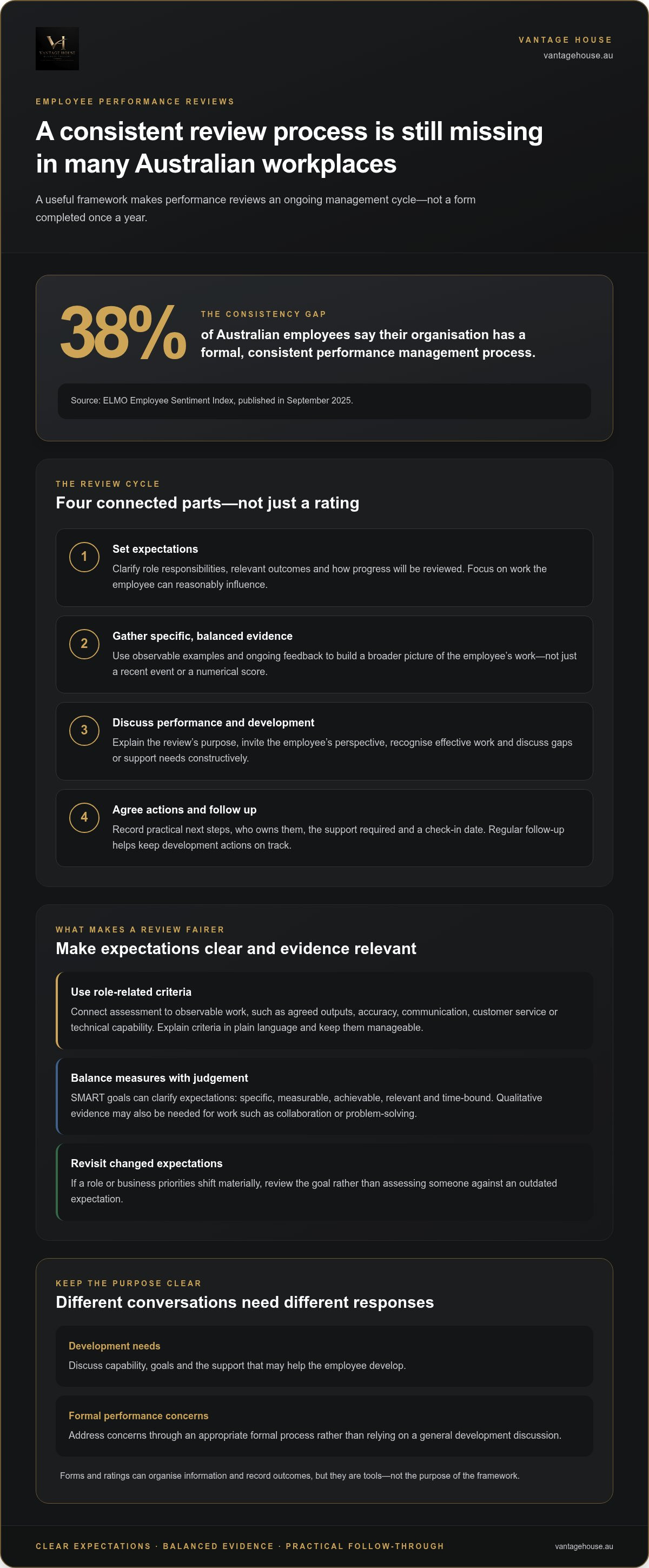
Only 38% of Australian employees say their organisation has a formal, consistent performance management process, according to the ELMO Employee Sentiment Index published in September 2025. An employee performance review framework gives managers a shared process to follow, helping reduce vague examples, inconsistent standards and reviews that focus only on ratings or past performance. It treats reviews as an ongoing management cycle, not a form completed once a year.
A useful framework combines clear expectations with honest, constructive conversations. Set expectations early, use specific and balanced evidence, listen to the employee’s perspective and agree on practical next steps. Regular follow-up helps keep development actions on track after the meeting.
This guide explains what an effective review framework should include and how Australian employers can put it into practice. It covers setting objectives, gathering evidence, preparing for conversations, documenting outcomes and following up on agreed actions. Vantage House’s employee review and staff satisfaction work can also help employers connect individual feedback with broader workplace needs.
Key Takeaways
- Build your employee performance review framework around clear role expectations and measures employees can influence.
- Use specific examples and invite the employee’s perspective to make review discussions more balanced.
- Keep the process manageable with clear responsibilities for preparation, discussion, documentation and follow-up.
- Turn review outcomes into practical actions with an owner, the right support and a check-in date.
- Distinguish development needs from formal performance concerns so each receives an appropriate response.
Purpose of a Performance Review Framework
An employee performance review framework is a repeatable cycle for setting expectations, gathering evidence, discussing performance and development, and agreeing on practical action.
It gives managers and employees a shared basis for understanding what good performance looks like, how contributions are assessed and what support may be needed. Reviews should help people do their work well and build capability over time, not reduce a person’s contribution, circumstances or potential to a single score.
A planned cycle is more consistent than feedback delivered only when a problem arises. When expectations and check-ins are informal, employees may receive different guidance depending on their manager, and concerns can surface late. A structured approach makes room to recognise effective work and address gaps, while giving both parties a clearer record of what was discussed and agreed.
Performance appraisals can take different forms. Their value depends on how well they support workplace objectives and meaningful discussion. A review framework makes those elements clear without treating the form itself as the outcome.
Separate performance reviews from ratings and annual paperwork
Forms and ratings can organise information, prompt consistent questions and record outcomes, but they are tools rather than the purpose of the framework. A numerical score without supporting evidence or discussion can seem precise while leaving the employee unsure what to continue, change or develop.
Ongoing feedback gives scheduled reviews useful context. Managers who discuss progress throughout the cycle can draw on a broader picture of an employee’s work instead of relying on a recent event or trying to reconstruct the year from memory. Brief check-ins, for example, can clarify a changing priority or recognise a strong contribution before the formal review. The timing and frequency should suit the role and workplace; one annual meeting is not automatically enough for every team.
Set a clear purpose for each review cycle
Before reviews begin, explain what the cycle will cover. Employees should know whether the conversation considers role expectations, contribution, development goals, support needs or a combination of these. Clear notice helps them prepare relevant examples and raise matters they want discussed.
Keep the purpose distinct from decisions about remuneration or a formal disciplinary process. Those matters may involve different considerations and should not be introduced unexpectedly as routine review outcomes. If performance concerns need a formal response, address them through an appropriate process rather than relying on a general development discussion.
A clear purpose also helps managers prepare consistently. They can explain the review’s scope, invite the employee’s perspective and keep the conversation focused on its objectives. A well-defined purpose gives the cycle direction while leaving room to agree on support or development actions that reflect the employee’s role and circumstances.
Build the employee performance review framework around clear expectations
Clear criteria give employees a practical basis for understanding their role and help managers assess contributions consistently. Start with the position’s responsibilities and expected outcomes, then focus on work the employee can reasonably influence. For example, avoid assessing someone against results driven largely by shifting priorities or decisions made elsewhere in the organisation.
Role-related criteria make reviews easier to understand because they connect assessment to observable work, not personal impressions. Keep measures relevant and manageable. A long checklist can obscure what matters; a focused set of outcomes, work standards and role-specific capabilities is easier to discuss and apply.
Translate role expectations into observable review criteria
Turn broad responsibilities into examples of effective performance. Depending on the role, criteria might cover agreed outputs, accuracy, communication with colleagues, customer service or technical capability. Avoid labels such as “good attitude” unless you can describe the behaviour behind the assessment, such as sharing information promptly or responding constructively to feedback.
Explain each criterion in plain language and check that employees understand how it relates to their day-to-day work. Managers can use common criteria for comparable roles while accounting for differences in duties and operating conditions. The Performance Management Standard offers a public-sector reference point for structured performance management. Its scope is limited, so it should not be treated as a universal requirement for every Australian employer.
Set goals employees and managers can review fairly
Goals work best when they state the intended outcome, a realistic timeframe and the support or resources available. SMART criteria, specific, measurable, achievable, relevant and time-bound, can help clarify expectations. They’re a guide, not a substitute for judgement: valuable work such as collaboration or problem-solving may need qualitative evidence alongside numerical measures.
Agree on how progress will be checked and what may affect delivery. If a role changes or business priorities shift materially, revisit the goal rather than judging the employee against an outdated expectation. This keeps assessment connected to the work actually assigned.
To apply criteria consistently, managers can compare their interpretations before reviews begin. HR can provide shared guidance and check that measures reflect role differences without creating arbitrary standards. A short calibration discussion can clarify what counts as evidence for a criterion and surface inconsistent assumptions.
- Outcome: What result or deliverable is expected?
- Quality: What standard should the work meet?
- Behaviour or capability: What observable action supports effective performance?
- Influence and support: What can the employee control, and what assistance is available?
For employers refining role-based criteria, Vantage House’s employee review support can help connect clear expectations with a practical review process.
Use balanced evidence and a structured conversation to make reviews fairer
Review feedback is more actionable when it’s linked to specific examples of work. General statements such as “communication needs to improve” don’t show the employee what happened or what to do differently. A useful employee performance review framework connects each assessment to an agreed criterion, an observed example and a constructive response.
A simple evidence record keeps preparation focused and gives the employee a clear opportunity to add context. For each criterion, note:
- Criterion: the role expectation being considered.
- Observed example: what happened and when, described factually.
- Employee perspective: relevant context, explanation or additional evidence.
- Agreed response: recognition, clarification, support or a practical next step.
This structure helps distinguish what was observed from what a manager inferred. For example, “missed two agreed handover deadlines in March” is more useful than “unreliable”. The employee may explain whether priorities changed, information was delayed or support was needed. Consider that response before settling on a conclusion.
Prepare evidence from more than one moment in time
Keep concise notes throughout the review period instead of relying on memory at the meeting. Include strengths, progress, missed expectations and changes that affected the work. This reduces recency bias, where the latest events dominate, and halo bias, where one strong or weak impression colours the whole assessment. Similarity bias can also affect judgement, so assess evidence against role criteria rather than personal style.
Feedback from colleagues can add perspective when collaboration is part of the role. Use 360-degree feedback only when its purpose, scope and confidentiality are clear to participants. Explain how input will be used, and consider its relevance and context rather than treating every comment as established fact.
Guide the review conversation from reflection to agreement
Invite the employee to identify achievements, barriers and development priorities before sharing your assessment. Present observations neutrally, link them to agreed criteria and allow time for questions or clarification. The discussion should test understanding, not become a contest over whose account prevails. A calm, specific exchange makes it easier to recognise contributions and address gaps constructively.
Close by summarising what both parties have agreed. Record each action, who owns it, what support is needed and when progress will be checked. If there’s disagreement about an observation, note the differing perspectives and any follow-up required rather than presenting an unresolved point as settled. This gives the next conversation a clear starting point.
Balanced evidence informs decisions without replacing judgement. Managers should consider whether examples are relevant to the role, whether the employee had a reasonable opportunity to meet expectations and whether comparable work is assessed by similar standards. Consistent records also help identify patterns over time, rather than letting one incident or a general impression determine the review.
Implement a consistent review cycle without creating unnecessary administration
A repeatable cycle makes the employee performance review framework easier to use across teams without turning it into a paperwork exercise. Keep the process to four connected steps:
- Prepare: the manager reviews role expectations, relevant evidence and previous actions; the employee reflects on progress and identifies topics to discuss.
- Meet: both parties discuss performance, contribution, barriers and support in line with the review’s stated purpose.
- Document: the manager records key points, employee comments and agreed actions, then shares the summary through the workplace’s usual process.
- Follow up: the employee and manager check progress against agreed actions, with HR supporting consistency and process where needed.
Clarify responsibilities before the cycle starts. Employees can prepare reflections and raise relevant context. Managers lead the discussion, explain their assessment and provide agreed support. HR can set common guidance, coordinate timing and monitor whether the process is applied consistently. This division reduces duplicated administration and makes ownership of each next step clear.
Choose a review rhythm that suits the work
Set review timing with the role, team size and pace of operational change in mind. A role with shifting priorities may need brief check-ins between scheduled reviews, while a more stable role may suit fewer formal discussions. Keep the rhythm proportionate: check-ins should address progress or changing needs, not recreate the full review each time.
Publish the schedule and explain how changes will be handled. If priorities or responsibilities change materially, update relevant goals and record the adjustment. If a review date is missed, arrange a new date and note any interim feedback or support rather than letting the cycle lapse without follow-up.
Keep documentation useful and workplace obligations in view
Record information that supports the review and its next steps: expectations, relevant examples, the employee’s comments, support discussed, action owners and review dates. Keep notes factual and relevant. Avoid unnecessary personal detail, assumptions about motives or conclusions unsupported by observed work. Store and manage records in line with the employer’s established workplace processes.
Performance reviews sit within the broader employment relationship. Australian employers should consider the Fair Work Act, National Employment Standards and any applicable modern award or enterprise agreement when reviewing relevant workplace requirements. The instruments that apply can depend on the employment context, so a general review template is not a substitute for considering workplace obligations. Vantage House’s Australian workplace relations advisory supports employers in considering people processes alongside workplace relations and compliance matters.
To keep administration manageable, use a consistent record format and capture only what will clarify decisions or track actions. HR can periodically review whether managers are completing the cycle and whether documentation is clear, without adding unnecessary approval steps. A straightforward process is easier to maintain, and regular follow-up keeps agreed support part of day-to-day management rather than a note filed after the meeting.
Turn review findings into development, follow-through and better people decisions
A review creates value when agreed outcomes shape what happens next. Translate the discussion into a manageable action plan that links each priority to an owner, the support or resources required and a check-in date. The employee may own a learning goal, while the manager arranges coaching, clarifies priorities or removes a work barrier. Clear ownership makes follow-through part of normal management, not an extra document that sits untouched.
Keep the plan focused. A small number of relevant actions is easier to sustain than a long list of aspirations. For each action, record what progress would look like and when both parties will revisit it. If workload or priorities change, discuss whether the action remains practical and adjust it with the employee rather than treating an outdated plan as a measure of commitment.
Make development actions specific and reviewable
Connect development to the employee’s role and agreed goals. If an employee needs to strengthen a role-specific capability, for example, the plan might identify a suitable learning opportunity, a chance to apply the skill at work and the manager support needed. Agree how progress will be assessed, such as reviewing completed work or discussing what the employee has applied. At the check-in, recognise progress, identify remaining barriers and revise the action if circumstances have changed.
Keep development needs distinct from formal performance concerns. A learning opportunity or coaching action supports capability building; a concern about unmet expectations may require a separate, appropriate management process. Be clear about which conversation is taking place, what expectations apply and what support or next steps are involved. Don’t rely on a development plan alone to address a concern that needs more formal attention.
Review the framework itself and seek structured support
Check whether employees understand the criteria and managers apply them consistently across comparable roles. Review completion patterns, employee feedback about the process and whether agreed actions are followed up. If a criterion is unclear or managers interpret it differently, refine the guidance before the next cycle. Keep records relevant to the review and manage them through established workplace processes.
Look for recurring themes across reviews, such as repeated requests for clearer priorities or similar development needs. These patterns can point to team-level support or process improvements, but individual review notes aren’t a substitute for staff satisfaction research. Consider themes in context, protect individual information and use a suitable research approach to assess broader workplace sentiment.
A well-maintained employee performance review framework supports considered people decisions by connecting individual development with wider workplace needs. Vantage House designs and conducts employee performance reviews and feedback mechanisms, and its staff satisfaction research can help employers identify retention risks and inform workplace culture. Used together, these insights can help leaders distinguish individual support needs from broader patterns that may call for a team or organisational response.
Put a practical review process into action
Make your employee performance review framework workable in day-to-day management by defining a review cycle, explaining its purpose to employees and establishing how managers will assess whether it is helping. Use what you learn to refine the process over time, keeping it relevant as roles and workplace needs change.
For Australian employers, Vantage House provides practical workplace guidance alongside employee review and feedback work. Its staff satisfaction research can help identify broader workplace themes and retention risks, adding context to people decisions without replacing individual discussions.
Explore Vantage House’s HR and workplace relations support to strengthen your approach to employee reviews and people management. A clear, considered process gives managers and employees a constructive basis for progress. Start with one review cycle and improve it with what you learn.
Frequently Asked Questions
What should an employee performance review framework include?
An employee performance review framework should explain how expectations are assessed and how outcomes lead to support or action. Include role-relevant criteria, review timing, responsibilities, a way for employees to provide their perspective and a consistent record format. For example, a service team might assess response quality alongside agreed output targets. Clarify how managers will handle changed duties so employees aren’t assessed against responsibilities they no longer hold.
How often should employee performance reviews be conducted?
Choose a review rhythm that reflects the work rather than assuming one annual meeting suits every role. A team working through frequent operational changes may benefit from shorter check-ins to reset priorities, alongside more formal discussions. More stable roles may need fewer scheduled reviews. Set a clear timetable, then adjust it when responsibilities or circumstances shift. Address important changes promptly instead of waiting for the next calendar review.
Are employee performance reviews required in Australia?
Australian workplace laws don’t set a universal requirement for employers to conduct formal annual performance reviews. However, employers must still meet applicable workplace obligations, including those under the Fair Work Act, National Employment Standards and relevant awards or agreements. If underperformance may lead to dismissal, a fair process matters. The Fair Work Commission considers factors such as whether there was a valid reason, a warning about performance and a reasonable chance to improve. There’s no fixed three-warning rule.
How can managers make performance reviews fair and objective?
Managers can improve fairness by applying role-related criteria consistently and checking assessments against evidence from across the review period. Before finalising an outcome, consider whether the employee had the resources and opportunity to meet the expectation, and invite them to explain relevant circumstances. A manager calibration discussion can help identify different interpretations of the same standard. Separate personal impressions from evidence, and record any unresolved disagreement accurately.
What is the difference between a performance review and performance management?
A performance review is a planned discussion or assessment at a particular point in time. Performance management is the broader, ongoing work of clarifying expectations, supporting capability, addressing concerns and monitoring progress. A review may identify a need to improve a particular task, for example, while performance management covers the coaching, work opportunities and check-ins that follow. A review is one part of the wider approach, not a replacement for regular manager guidance.
What should be documented after an employee performance review?
Document the key outcomes needed for continuity: the matters discussed, the employee’s response, agreed development or support actions, who is responsible and when progress will be revisited. If the employee disagrees with an assessment, record their perspective rather than implying they accepted it. Keep notes factual and relevant, and manage them through the organisation’s established recordkeeping processes. Clear documentation helps a future manager understand what was agreed without relying on memory.
Can a performance review be used to address underperformance?
A review can identify a performance concern, but a routine appraisal may not be enough if the matter requires a formal response. Explain the specific concern, the standard expected and the improvement required, then give the employee a reasonable opportunity to respond and improve. Consider appropriate support and keep records of discussions and next steps. If dismissal is being considered, handle the process carefully in light of applicable workplace requirements.
How can employers know whether their review framework is working?
Assess whether employees understand the criteria, managers complete reviews as planned and agreed actions receive follow-up. Look for recurring process issues, such as managers interpreting a rating differently or employees being unclear about how outcomes are decided. You can also ask employees whether review discussions help them understand expectations and available support. Consider these findings alongside broader staff satisfaction information, since review records alone don’t measure overall workplace sentiment.


