

A routine people decision can create confusion when one manager documents it and another handles the same issue differently. Practical people management advisory helps Australian employers turn everyday decisions into clear, consistent steps, so managers know what to record, how to communicate and what to follow up.
Managers often need to address conversations, performance concerns and workplace expectations while keeping business needs in view. A repeatable process can help them distinguish observed facts from assumptions, explain decisions clearly and give employees an opportunity to share relevant context.
This article outlines practical ways to document decisions, communicate with employees and follow through. It also explains how workplace relations advice and HR support can help employers build consistent processes for recurring or more complex matters. The aim is a measured approach that supports employees and helps employers manage people decisions with greater clarity.
Key Takeaways
- Use practical people management advisory to connect day-to-day decisions with clear records, communication and follow-through.
- Apply a repeatable decision cycle, checking relevant workplace requirements before acting.
- Use planned guidance to review processes and support managers before an issue escalates.
- Prepare a neutral timeline and relevant workplace information to make advice more focused.
- Workplace relations advice, HR support and employee feedback can all inform consistent people practices.
Practical people management advisory: why everyday decisions need a clear approach
People management is shaped by ordinary decisions: how a manager sets expectations, responds to a performance concern, gives feedback or records a conversation. Practical people management advisory gives employers structured guidance for making these decisions consistently, while taking the circumstances of each matter into account. A shared approach gives managers a common basis for action rather than leaving each situation to individual judgement alone.
These interactions can affect how employees understand expectations and experience workplace processes. If expectations are unclear or managers respond differently to similar matters, misunderstandings can follow. Useful records help leaders see what happened, what was communicated and what action was agreed. These activities sit within the broader foundations of human resource management, including performance, training and recruitment.
Guidance can be planned rather than reserved for a crisis. Employers can review recurring processes and help managers prepare for common conversations. Not every conversation needs formal intervention. The value is in having a considered approach ready when a decision is uncertain, without assuming that guidance will guarantee a particular outcome.
What practical people management advisory helps employers do
Advice can bring structure to recurring decisions, such as setting role expectations, responding to feedback or managing a performance conversation. Managers can explain the required standard, listen to the employee’s perspective and make the next steps clear. A consistent process supports fairer management across teams while allowing leaders to account for the circumstances of each situation.
Guidance works alongside leadership and internal HR responsibilities, rather than replacing them. Managers remain responsible for day-to-day conversations and decisions. Advisory support can help them consider relevant information, clarify options and align their approach with workplace processes and applicable requirements.
When a business may benefit from a more structured approach
Growth, changing team needs or different manager responses can be good prompts to review how people matters are handled. Recurring questions about performance, employee feedback or workplace expectations may also show that managers need clearer guidance. A review can identify where approaches differ and where a shared process would help.
Seeking guidance early gives leaders time to understand the issue, consider relevant information and weigh possible next steps. This guide provides general information for Australian employers. It isn’t legal advice or legal representation, and specific workplace requirements may need to be considered in context.
How practical people management advisory connects decisions, records and follow-through
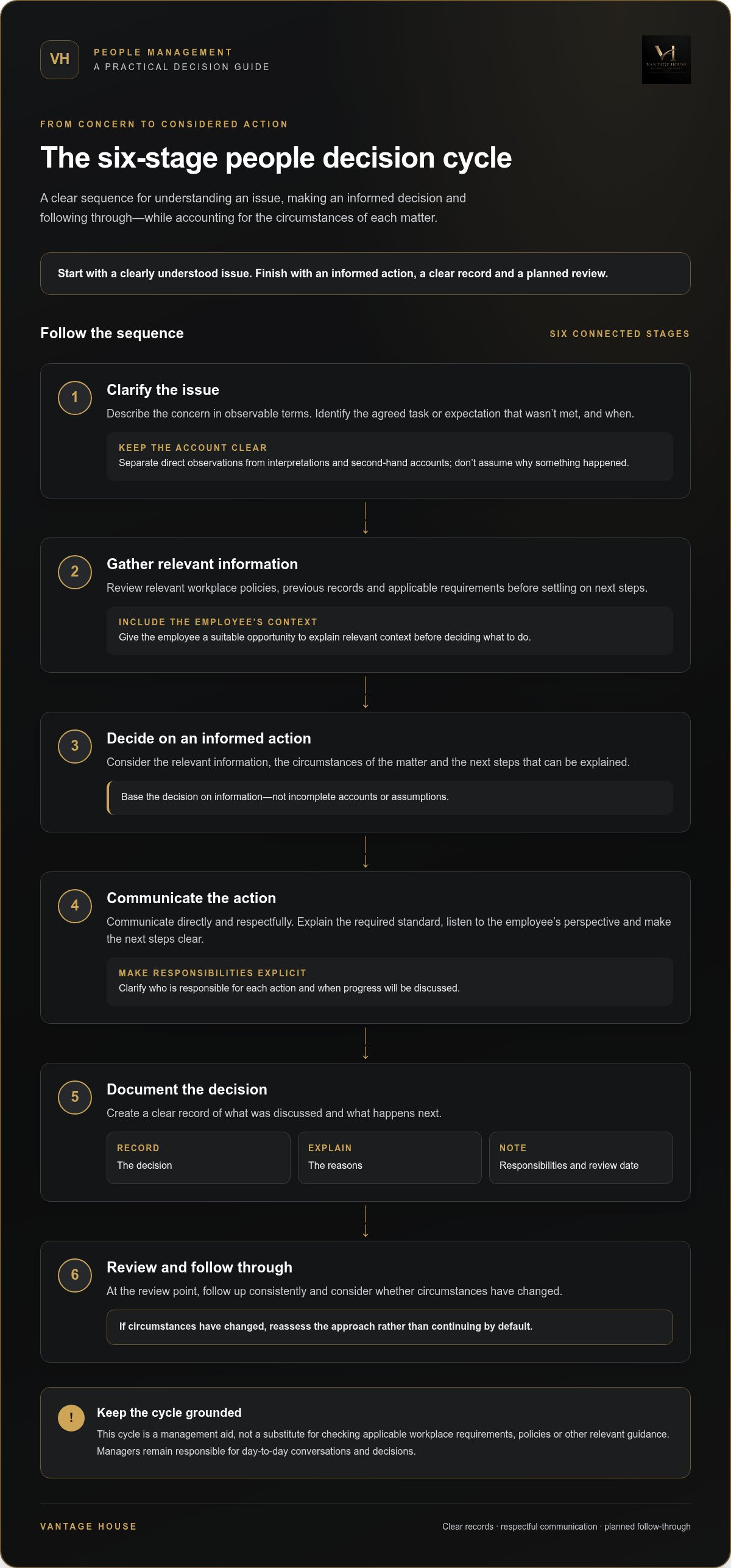
A consistent process helps managers move from an initial concern to a considered action without skipping important steps. Use this decision cycle: clarify the issue, gather relevant information, decide, communicate, document and review. It provides a clear sequence while leaving room to account for the circumstances of each matter.
A sound people-management decision starts with a clearly understood issue and leads to an informed action, a clear record and a planned review. This cycle is a management aid, not a substitute for checking applicable workplace requirements, policies or other relevant guidance. Research into management practices in Australian firms provides a broader local context for considering how management approaches relate to business performance.
Clarify the issue and gather relevant information
Describe the concern in observable terms. For example, record which agreed task or expectation wasn’t met and when, rather than assuming why it happened. Separate direct observations from interpretations and second-hand accounts. Give the employee a suitable opportunity to explain relevant context before deciding what to do.
Review relevant workplace policies, previous records and applicable requirements before settling on next steps. This helps managers base decisions on information they can explain, rather than incomplete accounts or assumptions.
Communicate, document and review the agreed action
If a performance expectation needs clarification, a manager might explain the required standard, listen to the employee’s perspective, agree on appropriate support and set a review point. Communicate directly and respectfully. Make clear who is responsible for each action and when progress will be discussed.
Record the decision, its reasons, agreed responsibilities and review date. The record should make it possible to understand what was discussed and what happens next. At the review, follow up consistently and consider whether circumstances have changed. If they have, reassess the approach rather than continuing by default.
Workplace relations guidance and HR support can help employers apply this cycle to their internal processes. For support with practical people decisions, explore Vantage House workplace relations advisory.
Practical advisory versus reactive HR: what employers often misunderstand
People guidance isn’t useful only after a dispute or serious performance issue emerges. Practical people management advisory can help employers review recurring questions, clarify internal processes and give managers a consistent basis for routine decisions. Not every concern needs external advice or formal action, but repeated uncertainty may be a sign that a process needs clarification.
Planned guidance and reactive responses serve different purposes. Preparation gives employers time to gather relevant information and consider how to communicate and follow up. A response made under pressure may leave less room for reflection. Early guidance doesn’t determine the outcome, but it can help leaders consider options before deciding on next steps.
Early guidance gives employers room to consider options. Waiting until an issue escalates can leave less time to make a measured decision.
Planned guidance and reactive responses serve different purposes
Use the comparison below to identify the focus of the situation. Routine internal management remains central, while advisory support can help address recurring questions or clarify a process.
| Approach | Typical focus | When it may help |
|---|---|---|
| Planned advisory | Reviewing a recurring issue, relevant information and options, with follow-up in mind. | Managers need a clearer shared approach to a common people matter. |
| Reactive response | Addressing an immediate concern, often with limited time to prepare. | A specific issue needs attention. The response should still be considered and informed. |
| Routine internal management | Day-to-day communication, feedback and decisions handled by leaders or HR. | The matter is within existing responsibilities and established processes. |
Repeated questions about performance expectations, feedback or workplace processes can help employers identify where guidance or clearer internal steps may be useful. Australian resources on strategic people management education also reflect the value of building people-management capability. A structured approach can support consistency, but it can’t guarantee a particular employee or business outcome.
Practical advisory is distinct from legal representation
Vantage House provides employer-focused workplace relations advisory, HR support and compliance guidance, including guidance on employment standards, award interpretation and compliance frameworks. This support can inform workplace decisions and processes. Vantage House doesn’t represent employers in court or Fair Work Commission hearings. General information isn’t individual legal advice; specific legal questions should be considered in light of the circumstances. For support with workplace processes, explore Vantage House workplace relations advisory.
How to apply practical people management guidance in your business
Advice is most useful when it relates to a defined management decision. Before seeking practical people management advisory, prepare a concise brief that explains the issue, the outcome you’re aiming for and who may be affected. This keeps the discussion focused on the business need and the people involved, rather than assumptions about what should happen.
Prepare a clear brief for a people-management decision
Set out what happened, when it occurred and what has already been communicated. Gather the relevant policies, records and notes from earlier discussions. A neutral timeline makes the sequence easier to understand without presenting one person’s interpretation as established fact.
Include the decision you need to make and note practical constraints, such as who needs to be involved or what workplace process applies. Separate confirmed information from what remains unclear. For example, a manager may have records of missed deadlines but still need to clarify whether priorities or support changed during that period.
- Issue: Describe the management matter in plain, factual terms.
- People affected: Identify the employee, manager and others who may be relevant.
- Desired outcome: State what a workable next step would address.
- Information: List relevant records, policies and unanswered questions.
For broader Australian workplace relations context, read the Strategic Workplace Relations: 2026 AU Employer Guide. It can help frame wider considerations around a specific people-management decision.
Turn guidance into consistent management practice
Advice needs a clear route into day-to-day action. Record the agreed next steps, assign responsibility for each one and decide how the employee and relevant managers will be updated. Keep communications direct and respectful, and share only the information managers need to carry out their responsibilities. Protect employee confidentiality throughout the process.
Set a proportionate review point, such as a check-in after an agreed action or a review of whether a process is being applied consistently. At that point, consider what has changed, whether the action was completed and whether further support is needed. If circumstances shift, revisit the plan rather than following it automatically.
This approach connects guidance to accountable follow-through while leaving decisions with the employer. For support applying workplace relations guidance to your business, explore Vantage House advisory support.
How Vantage House supports practical people management for Australian employers
Consistent people practices draw on more than a single policy or conversation. Vantage House supports Australian employers with workplace relations advisory, HR support and compliance guidance. This practical people management advisory can help leaders consider day-to-day decisions alongside wider workplace processes, including employment standards, award interpretation and compliance frameworks.
Connect workplace relations advice with day-to-day HR support
Workplace relations guidance helps employers consider the requirements and frameworks relevant to a decision. Ongoing HR assistance can complement that advice by helping streamline internal people processes, giving managers a more consistent way to handle recurring tasks and workplace matters. Leadership and HR responsibilities remain with the employer; advisory support informs how those responsibilities are carried out.
The focus is employer guidance, not legal representation. Vantage House doesn’t represent employers in court or Fair Work Commission hearings. Where a matter raises specific legal questions, general advisory information should not be treated as individual legal advice.
Use recruitment and employee insight as part of people planning
People planning also includes who joins a business and how employees experience the workplace. Recruitment and staff placement help employers address staffing requirements. Employee reviews and staff satisfaction research can help leaders understand workplace culture and identify retention risks. These inputs can sit alongside HR and workplace relations processes, helping employers consider people priorities in context without assuming a particular outcome.
For more detail on hiring, read the Recruitment and Staff Placement Guide or the Staff Placement Solutions Australia buying guide. Each provides further context for employers considering recruitment and staff placement as part of workforce planning.
Workplace relations advice, HR support, compliance guidance and employee insight can help employers take a considered approach to people decisions. To explore support for your workplace processes, visit Vantage House workplace relations advisory.
Build consistency into everyday people decisions
Clear people-management workflows help managers make decisions consistently, communicate expectations and keep useful records. A repeatable process, from understanding the issue to reviewing agreed actions, gives employers a practical basis for handling routine matters and recognising when further guidance may help.
Practical people management advisory can support those workflows without replacing the employer’s leadership responsibilities. Vantage House provides employer-focused workplace relations advisory and compliance guidance, alongside HR support to help streamline internal processes. Recruitment and staff placement address staffing needs, while employee reviews and satisfaction research can inform wider decisions about workplace culture and retention.
These services help bring structure to everyday people priorities while keeping decisions grounded in the needs of the business and its employees. For guidance on workplace relations and practical management decisions, explore Vantage House workplace relations advisory.
Frequently Asked Questions
What is practical people management advisory?
Practical people management advisory is employer-focused guidance for making clear, workable decisions about employees and workplace processes. It can help managers consider how to communicate expectations, respond to performance concerns and apply internal processes consistently. The advice supports leadership and HR responsibilities rather than replacing them. Depending on the business need, it may draw on workplace relations, HR processes and compliance guidance relevant to the decision.
When should a business seek people management advice?
A business can seek advice when managers are unsure how to approach a people decision, when the same questions keep arising or when team changes make existing processes harder to apply. For example, differing approaches to performance feedback may prompt a review of expectations and manager guidance. Advice can help leaders consider options before deciding on next steps. Not every routine conversation requires external support.
Can practical people management advisory help small businesses?
Yes. Small businesses can use practical people management advisory to bring structure to recurring decisions, even when HR responsibilities sit with business owners or line managers. A clear process for recording discussions, communicating expectations and following up can help managers handle matters consistently. The right approach depends on the business and its circumstances, so employers should consider applicable workplace requirements and internal policies when making decisions.
How can managers handle people issues consistently?
Managers can follow a shared process: clarify the concern, gather relevant information, consider the decision, communicate it, keep an appropriate record and review agreed actions. They should distinguish observed facts from assumptions and give employees a suitable opportunity to explain relevant context. Consistency doesn’t mean treating every situation identically. It means applying a fair, considered process while accounting for the circumstances of each matter.
Is people management advisory the same as legal representation?
No. People management advisory offers employer-focused guidance on workplace relations, HR processes and compliance frameworks. It is distinct from legal representation in proceedings. Vantage House provides workplace relations advisory and compliance guidance, but doesn’t represent employers in court or Fair Work Commission hearings. General information and advisory support should not be treated as individual legal advice for a specific matter.
What information should an employer prepare before seeking HR advice?
Prepare a brief, neutral summary of what happened, when it occurred and what has already been communicated. Gather relevant policies, records and previous notes, then identify the decision required, the people affected and the outcome the business is considering. Separate confirmed information from unanswered questions. A clear timeline helps organise the facts and makes it easier to discuss relevant options without relying on assumptions.
Can workplace advice help prevent employee issues from escalating?
Workplace advice can help employers consider concerns early, review relevant information and choose a measured response before a matter becomes more difficult to manage. Clear expectations and consistent follow-up may also reduce avoidable misunderstandings. Advice cannot guarantee that an issue will be resolved or prevent every concern from developing. It gives leaders a structured way to assess the circumstances, consider appropriate next steps and keep communication clear.


