

A payroll check can appear correct while the underlying award, employee classification or roster settings are out of step. A reliable modern award compliance review checks the full employment-to-payroll chain, not just the hourly rate, so you can assess discrepancies in context.
Employers need to know which award applies to each role and whether pay settings reflect current requirements. Bringing HR records, rosters and payroll evidence together can be challenging, particularly when work patterns vary across teams. A structured review connects these records and gives follow-up a clear starting point.
This guide explains what to examine, which records to prepare and how to assess findings systematically. It also covers how to prioritise discrepancies, plan practical next steps and establish a repeatable process for monitoring relevant award changes.
Key Takeaways
- A modern award compliance review should connect award coverage and employee classifications with actual work patterns and payroll outcomes.
- Follow the chain from the applicable award through classification and conditions to payroll settings, so an early error does not flow into later calculations.
- Choose a review approach that reflects workforce complexity, recent role changes and confidence in existing processes.
- Prepare employment terms, position descriptions, rosters, time records and payroll outputs to make discrepancies easier to test and document.
- Turn findings into assigned actions. Workplace relations advice can help internal teams interpret issues and strengthen their review process.
What a modern award compliance review checks for Australian employers
A modern award compliance review checks whether award coverage, employee classifications, conditions and pay practices align with the work people actually perform. It follows the connection between each role, its work patterns and the settings used to calculate pay, rather than assessing payroll figures in isolation. A Modern award provides minimum employment conditions for covered employees alongside the National Employment Standards.
Define the scope before you begin. A targeted award review focuses on how relevant award requirements apply to roles and payroll. A broader workplace compliance audit may also examine other employment processes. Keeping the scopes distinct helps you identify what the review will test and where further assessment may be needed.
What does an award compliance review examine?
Start with the role, not just the job title. Review the employee’s duties, then check whether the selected award and classification appear to align with those duties and the relevant award wording. Next, examine applicable conditions and pay practices, including ordinary hours, rates, penalties, overtime, allowances and leave conditions.
Trace the evidence from the roster and time records through payroll calculations to payslips. For example, if a roster records work outside an employee’s ordinary pattern, check how those hours were recorded and treated in payroll. This can help pinpoint whether a discrepancy relates to rostering, timekeeping, payroll settings or an earlier coverage or classification decision.
Findings are only as reliable as the information provided. Missing roster records, incomplete position details or inconsistent payroll data can limit what the review establishes. Record evidence gaps clearly instead of treating an assumption as a confirmed result.
Why can one business need more than one award assessment?
Employees in the same business may perform different kinds of work, so one award or classification assessment may not fit every role. Coverage depends on the work performed and the relevant award terms. Separate checks may be needed for distinct roles, even when employees work for the same employer.
For example, a role may gain new duties after a team restructure. Its previous assessment may no longer reflect the work being done, so compare the changed responsibilities with current award wording and classification descriptions. Give borderline roles particular attention where duties overlap or have evolved.
Document the basis for each assessment, including the role information and records considered. This gives HR and payroll teams a consistent reference point and makes it easier to revisit decisions when duties, work patterns or award requirements change.
How modern award rules connect coverage, classification and pay
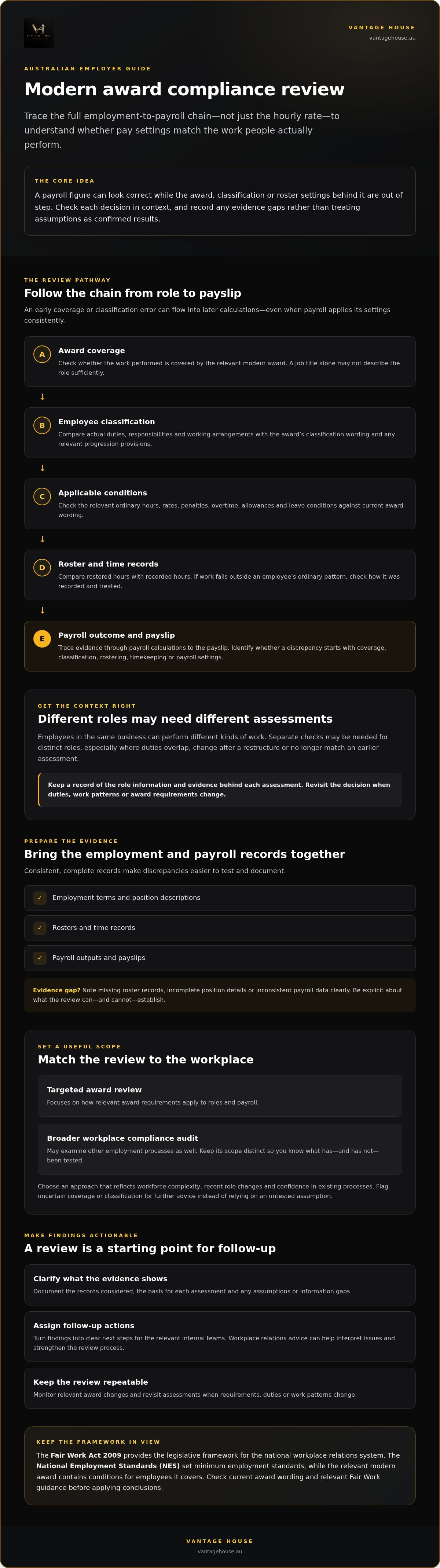
Award-based pay depends on several connected decisions. A modern award compliance review traces them in order: confirm whether an award covers the work, identify the applicable classification, interpret the relevant conditions, then check how payroll applies them and what appears on the payslip. If the coverage or classification decision is wrong, later calculations may be processed consistently but still use the wrong settings.
These checks involve different reference points. The Fair Work Act 2009 provides the legislative framework for the national workplace relations system. The National Employment Standards (NES) set minimum employment standards, while the relevant modern award contains conditions for employees it covers. Check the current award wording and relevant Fair Work guidance before applying conclusions, as award terms and pay information can change.
Confirm award coverage and classification against the work performed
Begin with the employee’s actual work. Compare their position description with their duties, responsibilities and working arrangements, then assess the role against the coverage and classification wording in the relevant award. A job title alone may not describe the work sufficiently.
Check whether the award includes classification levels or progression provisions that may apply as duties or experience change. Record the evidence and any assumptions behind the decision. If coverage or classification remains uncertain, flag it for further advice rather than letting an untested assumption determine pay settings.
Test pay conditions against rosters and payroll records
Once coverage and classification are established, compare relevant conditions with the employee’s records. Check whether rostered and recorded hours are treated in line with applicable ordinary hours, overtime and penalty provisions. Review allowances and leave-related settings against the award wording and employee information.
Then trace sample pay outcomes from recorded time through payroll calculations to payslips. If a roster includes hours that may receive different treatment under the applicable award, verify how those hours were coded and calculated. Check which current pay information payroll uses, and document any differences for investigation. This sequence helps identify whether a potential issue relates to role assessment, interpretation, rostering or system configuration.
Where internal teams need help interpreting award terms or organising follow-up, workplace relations advisory from Vantage House can provide practical support. Vantage House provides advisory and compliance guidance, not representation in court or Fair Work Commission hearings.
Which modern award compliance review approach suits your business?
The right approach depends on workforce variety, how often roles change and how confident you are in existing records and processes. A focused internal check may suit stable roles and well-organised information. A payroll-focused review can trace how roster and time data flow into pay calculations. Broader external advisory support may help when coverage, classifications or processes are more complex.
Payroll software can apply rules configured in its system, but it cannot independently confirm that the selected award or classification suits the work performed. A reliable modern award compliance review checks both the system settings and the decisions behind them.
- Focused internal check: Review selected roles, conditions and records using your own HR and payroll capability.
- Payroll-focused review: Trace recorded hours and pay outcomes to identify possible gaps in payroll rules or data handling.
- Broader external advisory support: Get help interpreting award requirements and planning follow-up when internal capacity or confidence is limited.
For obligations beyond award settings, see the Australian small business workplace compliance guide.
When is an internal review a reasonable starting point?
An internal check can be a practical starting point when roles are stable, records are clear and the team can interpret the relevant award provisions. Define the scope, how employees or pay periods will be sampled, which evidence will be checked and what assumptions are being made.
Keep a record of the method and findings. Complex classifications, changing duties or inconsistent roster and payroll records can make an internal assessment harder to rely on. Treat these as reasons to seek further guidance rather than trying to resolve uncertainty through payroll settings alone.
When should employers consider external award interpretation support?
Consider external support if award coverage is unclear, roles have changed or payroll results appear inconsistent. Before engaging an adviser, assess whether they can explain their approach, the evidence they need and how findings can translate into practical next steps. Workplace relations advisory can help employers interpret issues and organise follow-up. It is not legal representation before a court or tribunal.
Match the scope to the questions that need answering and the areas of uncertainty. A defined review can help clarify where internal checks are sufficient and where additional interpretation may be warranted.
How to prepare for a modern award compliance review and act on findings
A clear process helps employers move from scattered records to decisions that can be checked and followed up. Use this sequence to structure a modern award compliance review:
- 1. Define the scope. Set the roles, award areas, pay arrangements and review period to examine.
- 2. Gather records. Collect employee details, employment terms, position descriptions, rosters, time records and payroll outputs for the period.
- 3. Test requirements. Compare the records and pay outcomes with current award terms and applicable conditions.
- 4. Document gaps. Record discrepancies, missing evidence and assumptions separately, so uncertainties are not mistaken for confirmed issues.
- 5. Assign actions. Identify an owner for each follow-up task and note how the outcome will be checked.
For wider review planning, refer to the Australian workplace compliance audit guide and the employer HR compliance checklist.
Build an evidence pack before testing pay
Bring the records together before comparing entitlements. Select samples across relevant roles, classifications, work patterns and pay arrangements, rather than relying on one employee or one type of roster. If records conflict, such as a position description that does not match current duties, record the inconsistency and seek clarification before drawing conclusions.
Review materials may include sensitive employee information. Limit access to people who need it for the review and store the evidence in an appropriately controlled location.
Record findings, corrections and ongoing controls
For each finding, document the requirement checked, the evidence reviewed, the discrepancy and the person responsible for the next action. Prioritise follow-up by considering potential employee impact, whether the issue appears across repeated pay periods, the quality of the available evidence and any unresolved uncertainty. These are practical considerations, not automatic risk ratings.
Confirm proposed corrective steps with appropriate advisers and verify calculations before communicating outcomes. Then establish review triggers, such as award updates, role changes, new roster patterns or payroll configuration changes. This makes the process easier to repeat and helps teams recognise when an earlier assessment may need to be revisited.
Vantage House’s workplace relations advisory can help employers interpret findings and organise practical next steps.
How workplace relations advisory can support ongoing award compliance
A review is more useful when its findings feed into workplace relations governance rather than sitting in a report. Workplace relations advisory can help employers interpret award-related issues, organise follow-up and refine how HR and payroll teams review changes. This support can clarify practical next steps, while responsibility for workplace decisions remains with the employer.
The service boundary is clear. Advisory support can assist with understanding requirements and planning actions, but it is not legal representation in court or advocacy before the Fair Work Commission. If a matter requires representation, employers should seek a suitably qualified legal representative.
What to clarify before engaging an adviser
Set out the purpose and boundaries of the work before it begins. Confirm the employee groups and review period, the records required and what the adviser is expected to provide. Ask how assumptions, uncertain interpretations and matters outside the agreed scope will be recorded, so the team can distinguish firm conclusions from issues that need further consideration.
Discuss implementation as well. Clarify how findings may translate into practical actions for HR and payroll, and how progress will be tracked. Advisory support can provide structured guidance, but no review can guarantee a particular outcome.
Turn review findings into a repeatable management process
Build ongoing checks into existing workplace relations processes. Assign responsibility for monitoring award changes and assessing which employee groups or pay settings may be affected. When a change is verified as relevant, update the associated HR and payroll processes and retain a record of what changed, why and who approved the action.
Review the process after material changes, such as a role evolving, a new roster pattern being introduced or payroll configuration being altered. The extent of each check can reflect the change. A small adjustment may call for a focused validation, while wider changes to duties or work arrangements may require a broader assessment. This keeps award interpretation connected to actual workplace practices.
Before seeking guidance, prepare a concise summary of the issue, relevant roles, review period and available employment, roster and payroll records. Note what has already been checked and where uncertainty remains. To discuss structured workplace relations guidance, contact Vantage House with this information.
Build a review process your team can maintain
A dependable modern award compliance review connects award coverage and classification decisions with the conditions applied in rosters, payroll and payslips. Its value lies not only in identifying discrepancies, but also in documenting evidence, assigning follow-up and revisiting decisions when roles or processes change.
Choose a review scope that reflects your workforce and your confidence in existing records. Keep clear notes on assumptions and unresolved questions, then build proportionate checks into HR and payroll routines. This creates a practical link between workplace relations governance and day-to-day people processes.
Vantage House provides workplace relations advisory and compliance guidance for Australian employers, as well as HR support. To discuss a practical approach for your organisation, discuss an award compliance review with Vantage House.
With clear evidence, assigned actions and a repeatable process, your team can approach award obligations with greater confidence and consistency.
Frequently Asked Questions
What is included in a modern award compliance review?
A modern award compliance review checks whether the award and classification selected for employees align with their work, and whether relevant conditions are reflected in pay practices. It can compare ordinary hours, overtime, penalties, allowances and leave-related settings against rosters, time records, payroll calculations and payslips. The review should also note missing information and assumptions, as incomplete or inconsistent evidence can limit what its findings establish.
How do I know which modern award applies to an employee?
Assess the work performed against the coverage terms of potentially relevant awards, rather than relying on the employee’s job title alone. Review their duties, responsibilities and working arrangements, then compare the role with the award’s coverage and classification descriptions. Check the current award wording and relevant Fair Work guidance. If coverage remains uncertain, document the issue and seek appropriate workplace relations advice before treating an assumption as settled.
Can employees in the same business be covered by different modern awards?
Yes. Employees in one business may perform different kinds of work, and their award coverage can depend on the work and applicable award terms. Assess roles separately where duties or working arrangements differ. For example, a change in responsibilities may mean an earlier coverage or classification assessment needs to be revisited. Keep a record of the reasons and evidence for each decision so HR and payroll teams can apply the right settings to each role.
How often should an employer review modern award compliance?
There is no single review interval that suits every employer. Set a regular check that reflects workforce complexity and the reliability of current processes, then review sooner when a relevant award changes or there are material changes to roles, rosters or payroll settings. A trigger-based approach helps teams identify when an earlier assessment may no longer fit. Record who monitors changes and how their relevance to affected employees is assessed.
What records should I prepare for an award compliance review?
Prepare employee details, employment terms and position descriptions, along with rosters, time records and payroll outputs for the period being reviewed. Include information that helps explain duties, work patterns and pay arrangements. Organise records by employee group or role where practical, and note missing or inconsistent documents instead of filling gaps with assumptions. Limit access to personal information to people who need it for the review and handle the material appropriately.
What happens if a review identifies an underpayment or incorrect classification?
First, verify the finding against the relevant award wording and reliable employee, roster and payroll evidence. Establish which employees and pay periods may be affected, document what remains uncertain and assign an owner to investigate. Confirm proposed corrections and calculations with appropriate advisers before communicating outcomes or making changes. Also examine why the issue occurred, such as a role assessment or payroll setting, so follow-up can address the process as well as the identified discrepancy.
Does payroll software automatically ensure modern award compliance?
No. Payroll software applies configured rules, but it does not independently determine whether the award or classification selected matches an employee’s duties. Results also depend on accurate employee details, rosters, time records and system settings. Review how data flows into calculations and payslips, and check that configurations reflect current award terms. Treat software as part of the process, not a substitute for sound interpretation and periodic checks.


