

An employee redundancy should reflect a genuine business change, not simply a change to an organisation chart. Employers need to consider what work is still required, applicable consultation obligations and reasonable redeployment options before reaching an outcome.
It’s understandable to be cautious. Redundancy can affect an employee’s livelihood, while a poorly planned process can create compliance and workplace risks. It’s also important to distinguish a role-based redundancy from a performance-related dismissal, as they involve different considerations.
This guide explains what employee redundancy means in Australia and the key decisions employers should work through before communicating an outcome. It covers how to assess whether a role is genuinely redundant, consider consultation and redeployment, and review notice and redundancy pay entitlements. It also outlines a practical sequence for managing the process fairly and systematically. Where circumstances are complex, tailored workplace relations advice can help employers organise the relevant considerations and compliance checks.
Key Takeaways
- Start with the business change and assess whether the role itself is no longer required.
- Use consultation and redeployment checks to inform decisions before confirming an outcome.
- Keep employee redundancy distinct from performance or conduct management, with a clear rationale for each process.
- Document the steps from planning through to communication, adapting the process to applicable workplace requirements.
- Prepare to answer individual questions about transition support, final pay and redundancy-related entitlements.
Employee redundancy: what it means for an Australian employer
Redundancy concerns a job an employer no longer needs performed, rather than a judgement about the person doing it. An employee may lose their position because of that change, but the role becoming unnecessary and the employee’s employment ending are related, distinct events.
Changes in business needs can prompt a review of roles. An organisation might restructure a team, stop providing a service, introduce different technology or reduce particular operations. None of these circumstances automatically makes a position redundant. Consider what work remains, how it will be done and whether the employer still needs the job to be performed.
For Australian employers, the classification matters because it shapes which process and entitlements may apply. An overview of Australian labour law and redundancy provides broader context, but an individual decision depends on the facts and relevant workplace requirements.
When is a role genuinely redundant?
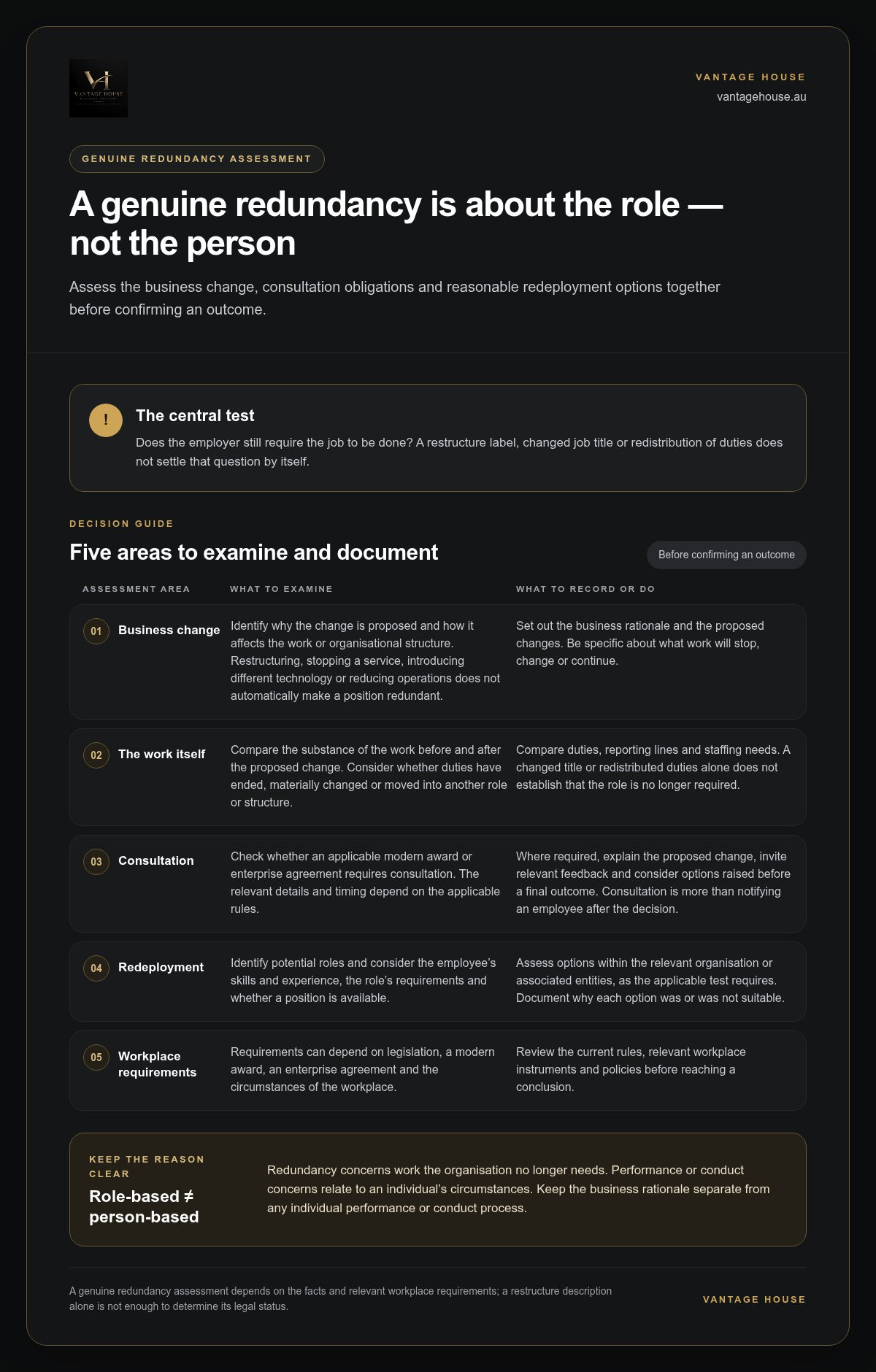
The assessment centres on whether the employer still requires the job to be done. A job title changing, or duties being redistributed, does not settle the question by itself. Compare the substance of the work before and after the proposed change: have the duties ended, materially changed, or moved into another role or structure?
For example, a business may merge two functions after changing how it delivers a service. That may alter its staffing needs, but the employer should examine the work that continues and how it will be performed, rather than relying on the restructure label alone. Record the business rationale and the proposed changes to duties and reporting lines.
Whether a redundancy is genuine also depends on applicable consultation obligations and reasonable redeployment options. Requirements can be affected by legislation, a modern award, an enterprise agreement and the circumstances of the workplace. Review the current rules and relevant instruments before reaching a conclusion. A short description of a restructure is not enough to determine its legal status.
Redundancy is not the same as every job ending
Employment can end for different reasons, and each may call for a different process. Resignation is initiated by the employee. A fixed-term agreement may reach its end date. Performance or conduct concerns relate to an individual’s circumstances, rather than whether the role is still required. The actual reason for the employment ending should guide how the employer manages the decision.
These categories can be less clear in practice. A role may change while an employee also has performance concerns, for instance. That overlap does not establish which reason is decisive. Keep the business rationale separate from any individual performance or conduct process, and seek tailored workplace relations guidance where the facts are complex.
Redundancy is a role-based decision about work the organisation no longer needs, not a substitute label for dismissal based on an employee’s performance or conduct.
Assessing genuine redundancy, consultation and redeployment
Genuine redundancy is an assessment of the circumstances, not a label that makes a decision valid by itself. Employers need to understand why the change is proposed, how it affects the work and what options may be available to the employee. A clear rationale helps separate the business decision from assumptions about the person currently doing the job.
A practical assessment brings three areas together: whether the job is no longer required, whether applicable consultation obligations have been met, and whether reasonable redeployment is available. Consider the business change, consultation requirements and redeployment options together before confirming an employee redundancy outcome. The Fair Work Ombudsman's guide to redundancy explains the Fair Work framework. Employers should also review the current legislation and workplace instruments relevant to their circumstances.
What should an employer consider before confirming a role change?
Start by recording the business reason for the proposed change and how it affects the work or organisational structure. Compare current and proposed duties, reporting lines and staffing needs. A different job title alone doesn’t establish that the role is no longer required. Review relevant legislation, modern awards, enterprise agreements and workplace policies for requirements that may apply.
For example, a restructure may combine functions, but some affected work could continue in another part of the organisation. Identify what will stop, what will change and what work will remain. This gives decision-makers a factual basis to assess the proposal, rather than relying on broad descriptions such as “efficiency” or “reorganisation”.
How do consultation and redeployment fit into the decision?
Where an applicable award or agreement requires consultation, treat it as a meaningful discussion before a final outcome. Explain the proposed change, invite relevant feedback and consider the options raised. Consultation is not simply notifying an employee after the decision has been made. The required details and timing depend on the applicable rules.
At the same time, identify potential redeployment roles and record how they were assessed. Consider the employee’s skills and experience, the role’s requirements and whether a position is available within the relevant organisation or associated entities, as the applicable test requires. Document why an option was or wasn’t suitable, rather than recording only the final conclusion.
A concise decision record can capture the business rationale, comparison of duties, consultation steps, employee feedback and redeployment options considered. This makes the reasoning easier to review and helps ensure each part of the assessment is addressed before communication. For broader employer decision-making context, the workplace relations advisory guide outlines how structured processes can support workplace decisions. Vantage House provides workplace relations advisory support to help employers organise relevant considerations and compliance checks.
Redundancy versus dismissal: the distinction employers must get right
The central distinction is what prompted the decision. Redundancy concerns whether the organisation still needs a role performed; performance-related dismissal concerns an individual’s work or conduct. Calling an employment ending a redundancy doesn’t determine its character. The underlying business change, the work that continues and the process followed all matter.
| Assessment area | Redundancy | Performance-related dismissal |
|---|---|---|
| Reason for the decision | The employer’s need for the role has changed. | Concerns relate to the employee’s performance or conduct. |
| Focus of assessment | Whether the job is still required and relevant options are available. | The individual’s work or behaviour and the circumstances around it. |
| Process considerations | Applicable consultation, redeployment and redundancy requirements. | The relevant performance or conduct process and workplace requirements. |
How does redundancy differ from performance-related dismissal?
Keep the decision-making records distinct. Business-change documents should explain the organisational rationale and how it affects roles or duties. Performance records should address individual expectations and concerns. Mixing them can obscure the real basis for a decision and make it harder to show that the appropriate process was followed. For guidance on the separate topic of managing individual performance, see the employee performance review guide.
There can be overlap. A restructure may change duties, reporting lines or staffing needs while an employee also has performance concerns. Neither factor automatically settles the classification. Assess the facts and applicable workplace obligations, and don’t use a role-change label to bypass a process that relates to conduct or performance.
What does a genuine business change look like in practice?
Hypothetical example: An organisation combines two administrative functions after changing its operating structure. Some duties stop, while others are distributed across existing teams, changing how the work is organised. That pattern may support an assessment that a role is no longer required, subject to the full circumstances and applicable requirements.
By contrast, changing a position’s title while retaining substantially the same duties and need for the work is not, by itself, evidence that the role has become redundant. These examples illustrate the distinction; they don’t determine the outcome in a specific case. Document the actual change and assess its practical effect.
Classification also helps identify related obligations beyond an individual decision. For example, employers planning redundancies affecting 15 or more employees should review Services Australia employer redundancy obligations. Where the reason for an employment ending is unclear, workplace relations advisory support from Vantage House can help structure the assessment and keep the relevant considerations separate.
Planning an employee redundancy process step by step
A consistent process helps employers test a proposal before treating it as a final decision. Assign responsibility for each stage, keep sensitive information on a need-to-know basis and check current legal requirements, including any consultation timing, before communicating an outcome.
- Confirm the business rationale. Record the operational change prompting the proposal and how it is expected to affect the work, structure or staffing needs. Be specific about the problem the change is intended to address.
- Map the roles and duties affected. Gather current position descriptions, reporting lines and relevant organisational information. Compare the existing and proposed arrangements so the assessment reflects the work itself, not just changes to job titles.
- Check applicable requirements. Review relevant legislation, modern awards, enterprise agreements and workplace policies. Identify consultation obligations, applicable timeframes and other process steps before approaching affected employees.
- Prepare for consultation. Explain the proposed change and its anticipated impact, invite feedback and allow time for the employee to raise questions or alternatives. Keep an open mind where consultation is required before a decision.
- Assess redeployment options. Identify possible roles and assess them against the employee’s circumstances and relevant requirements. Record the options considered and the reasons they may or may not be suitable.
- Reach, record and communicate the outcome. Consider feedback and alternatives before making a final decision. Document the rationale and process, then communicate the outcome in line with applicable obligations.
What should employers prepare before speaking with affected staff?
Prepare a clear explanation of the proposal, the business reason behind it and its anticipated effect on roles. Bring relevant role information and organisational records, along with details of potential redeployment options. Decide who will lead the conversation and how questions will be recorded and followed up. The discussion should be respectful and make clear that consultation is genuine, rather than presenting an outcome as settled before the process is complete.
How should employers communicate and document decisions?
Keep a decision record that follows the process chronologically. Include the rationale, consultation steps, feedback received, alternatives considered and the basis for the final decision. Store sensitive material securely and limit access to people involved in the process. Communicate directly, use consistent information and respond promptly to questions. Broader obligations can also sit alongside redundancy planning, as outlined in this small business workplace compliance guide.
Clear ownership and reliable records make a complex process easier to manage and review. Vantage House provides tailored workplace relations advisory support to help employers plan workplace decisions and organise compliance checks.
Supporting employees and managing next steps after redundancy
How an employer handles the period after communicating an outcome can affect how clearly employees understand what happens next. Be direct, respectful and consistent. Explain the decision in plain language, outline the next steps and give the employee a suitable opportunity to ask questions. If an answer needs checking, acknowledge the question and follow up once the information is confirmed.
Protect confidentiality throughout. Share information only with people who need it to carry out their responsibilities, and avoid discussing an individual’s circumstances more widely than necessary. Where appropriate, practical transition support may include a clear handover plan, information about final administrative steps and a nominated contact for follow-up questions.
Which entitlements and final-pay details need careful checking?
Assess final pay, notice and redundancy pay as separate items. They relate to the employment ending, but each can involve different rules and calculations. Eligibility and amounts may depend on factors such as the employee’s service, the employer’s size and the applicable modern award or enterprise agreement.
Before confirming figures, review the current Fair Work Act, National Employment Standards and any relevant award or agreement. Check the employee’s circumstances against the applicable requirements, rather than relying on a previous calculation or a general rule of thumb. Record the basis for each amount and explain the components clearly in the final communication. If an entitlement is uncertain, resolve it before presenting a figure as final.
How can employers support employees through the transition?
Give employees a clear point of contact and respond promptly to questions about timing, documents and practical arrangements. Acknowledge the impact of the change without making promises that haven’t been confirmed. If several people are affected, communicate consistently while still responding to each person’s individual circumstances. A thoughtful approach helps reduce avoidable confusion during an already difficult transition.
Once the process is complete, review how it was managed. Consider whether decisions were consistent, records were complete, questions were handled effectively and the change has affected remaining teams or workloads. This review can identify practical improvements for future workforce decisions without revisiting confidential employee details unnecessarily.
When can workplace relations advice help an employer?
Tailored workplace relations and HR advice can help employers clarify process steps, identify compliance considerations and organise decisions around the circumstances at hand. This can be useful where entitlements, workplace instruments or employee questions require careful assessment. Vantage House provides employer-focused advisory support to bring structure to complex workplace decisions.
For support with workplace relations or HR considerations, explore workplace relations support.
Build a steadier approach to future workforce decisions
A redundancy decision can also prompt a broader review of how your organisation plans and manages change. Consider whether responsibilities are clear, decision-makers have the right information and workplace processes are applied consistently. Building these habits into ordinary workforce planning can help leaders respond more deliberately when business needs shift.
Each situation has its own context. Australian workplace relations advisory, HR support and compliance guidance tailored to employer circumstances can help bring structure to decisions with operational and people impacts. Vantage House works with employers to clarify workplace processes and support practical, informed decision-making.
If you’re preparing for a workforce change or reviewing your approach to employee redundancy, explore Vantage House’s workplace relations support.
Frequently Asked Questions
Can an employer make an employee redundant while they are on leave?
Yes, an employee can be made redundant while on leave if the decision is based on a genuine business change and the applicable process is followed. Being on leave doesn’t by itself prevent an employee redundancy. However, leave must not be the reason for selecting someone, and employers should take care not to disadvantage an employee for taking a workplace entitlement. Keep records of the selection rationale and check applicable consultation and other legal obligations.
Are casual employees entitled to redundancy pay in Australia?
Casual employees generally aren’t entitled to redundancy pay under the National Employment Standards. An award, enterprise agreement or employment arrangement may provide different or additional terms, so check the instrument that covers the employee. This is separate from paying any outstanding wages or other amounts due. Confirm the employee’s status and applicable terms before calculating final payments, particularly where the work arrangement or pattern of employment has changed over time.
What happens to unused annual leave when employment ends due to redundancy?
Accrued, unused annual leave is generally paid out when an employee’s employment ends, including where it ends because of redundancy. The amount and any applicable leave loading depend on the employee’s circumstances and relevant workplace instrument. Casual employees generally don’t accrue paid annual leave. Check the leave balance and applicable terms in payroll records, and show the leave payout separately from redundancy pay so the employee can see how final amounts have been calculated.
Can an employee refuse redeployment to another role?
An employee can decline a proposed role, but the effect of refusing it depends on the circumstances. Consider whether the role was suitable, its terms and duties, and the employee’s situation. A refusal may affect redundancy pay in some cases, but it doesn’t automatically settle the issue. Record the offer and response, and assess the relevant legal requirements before deciding what the refusal means for the employment outcome or any entitlement.
Is voluntary redundancy the same as compulsory redundancy?
No. Voluntary redundancy usually involves an employer inviting employees to express interest in leaving, with an employee choosing whether to accept an offer. Compulsory redundancy is initiated by the employer when a position is selected to end. Both require careful consideration of the circumstances and applicable obligations. Don’t assume that accepting a voluntary offer removes other entitlements; check the written terms alongside the relevant award, agreement and legislation.
Can an employee challenge a redundancy decision?
Yes, an employee may be able to challenge a redundancy decision, depending on their circumstances and the relevant legal pathway. For example, they may dispute whether the redundancy was genuine or whether required consultation or redeployment steps were followed. Other issues, such as alleged discrimination or adverse action, may raise separate considerations. Eligibility rules and time limits apply to formal claims, so employers should retain decision records and seek tailored workplace relations guidance if a dispute arises.


