

A first-day induction isn’t an onboarding process. Employee onboarding is a managed transition that starts before a new employee arrives and continues as they learn their role, workplace and responsibilities.
Employers often focus on immediate tasks such as system access, paperwork and introductions. But when each manager handles these differently, new employees can miss important information or remain unclear about expectations and support. A single day of induction rarely provides enough structure to track how someone is settling in.
This practical checklist will help you prepare for a new employee’s arrival, give managers a consistent framework and identify support needs during the first few months. It covers pre-start arrangements, employment documents, first-day essentials, role expectations, workplace health and safety induction, and regular progress conversations. You’ll also find ways to gather early feedback and use it to improve your process. The result is a clearer, more consistent start for employees and the people supporting them.
Key Takeaways
- Map onboarding from offer acceptance onwards, with a clear owner and completion point for each task.
- Use a role-based learning plan to sequence essential information, skills and responsibilities at a manageable pace.
- Make employee onboarding compliance checks relevant to the role, including employment conditions, records, tax and superannuation administration.
- Schedule check-ins around the employee’s needs and review access, training, workload clarity and available support.
- Use early feedback to find process gaps and make onboarding more consistent across managers and teams.
Employee onboarding starts before day one: set a clear foundation
Employee onboarding is the planned transition from an accepted offer to confident participation in a role. It goes beyond a welcome session: preparation, induction, role learning and planned follow-up help a new employee understand how work gets done and where to find support. The term is often used alongside induction in Australia; this employee onboarding Wikipedia overview provides broader context on the concept.
Consistent information can reduce avoidable confusion, particularly when managers, HR and team members all contribute to a new starter’s experience. It doesn’t guarantee retention or productivity. It does give the employee a clearer reference point and gives managers a shared process to follow.
Use this checklist as a framework, not a fixed script. In a small workplace, one manager might own several tasks; in a larger organisation, responsibilities may sit across HR, IT and a team leader. Adapt the steps to the role, workplace and employment arrangements, while keeping task ownership and expectations clear.
Set onboarding outcomes and responsibilities before the start date
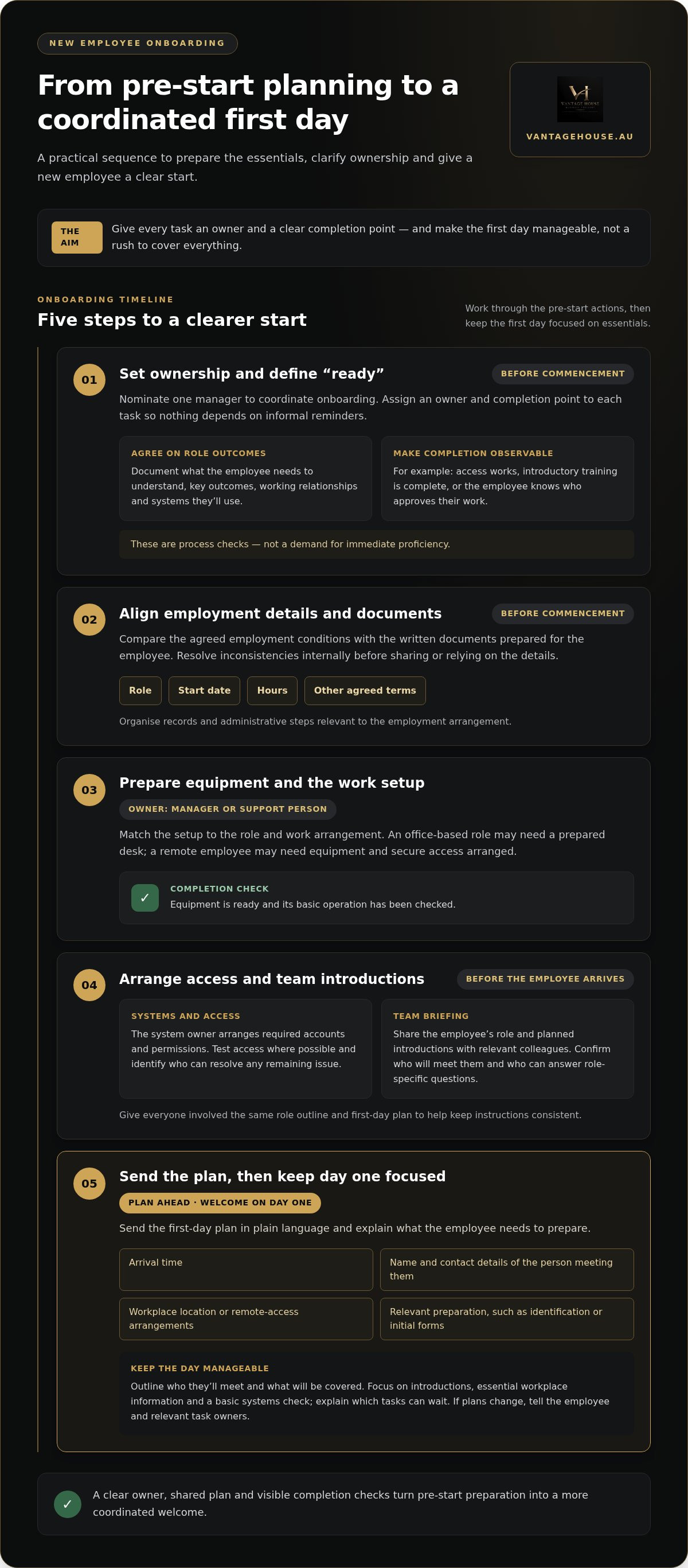
Nominate one manager to coordinate onboarding, then assign an owner and completion point to each task. This stops practical details from relying on informal reminders and makes it easier to follow up on anything outstanding.
Before the employee starts, document what they need to understand and what “ready” means for their role. Identify key outcomes, working relationships and systems they’ll use. Choose observable indicators, such as whether system access works, required introductory training is complete, or the employee knows who approves their work. These are process checks, not a demand for immediate proficiency.
A simple responsibility list can capture:
- Manager: agrees on priorities, explains role expectations and schedules check-ins.
- Task owners: arrange equipment, system access, introductions and relevant learning resources.
- Completion indicators: show what’s ready, what remains outstanding and who will follow up.
If more than one person is involved, give everyone the same role outline and first-day plan. This reduces the risk of conflicting instructions about priorities, processes or who can answer a particular question.
Agree on employment details and communicate the first-day plan
Before commencement, compare the agreed employment conditions with the written documents prepared for the employee. Resolve any inconsistencies internally before sharing or relying on those details. Check that the role, start date, hours and other agreed terms are presented consistently, and organise records and administrative steps relevant to the employment arrangement.
Then send a practical first-day plan in plain language. Include the arrival time, the name and contact details of the person meeting them, and the workplace location or remote-access arrangements. Explain anything they need to prepare, such as bringing identification or allowing time for initial forms, where relevant to your process.
Set realistic expectations for the day. Outline who they’ll meet, what will be covered and which tasks can wait. The first day might include introductions, essential workplace information and a basic systems check, rather than an attempt to cover every procedure. If plans change, tell the employee and relevant task owners so the welcome remains coordinated.
Employee onboarding checklist: pre-start to first day
A checklist turns the plan into coordinated action. For each task, record who owns it and how completion will be confirmed, such as a successful access test or a completed team introduction. The handover from recruitment matters too: information gathered during hiring should give the manager a practical starting point for role preparation. A recruitment and staffing guide for Australian employers can help frame that transition.
Adapt the checklist to the work. An office-based role may need a prepared desk, while a remote employee may need equipment and secure access arranged. Some roles require particular introductions or safety information. Assign each step to a named owner rather than assuming the manager will remember every detail.
Pre-start checklist: prepare access, equipment and introductions
Complete these tasks before the employee arrives. Set a clear due point, such as “before commencement”, and mark anything that needs follow-up.
- Equipment and work area: The manager or relevant support person prepares role-appropriate equipment, a workstation or remote setup. Completion means the equipment is ready and its basic operation has been checked.
- Systems and access: The system owner arranges required accounts and permissions. Test access where possible and identify who can resolve any remaining issue.
- First-day information: The manager sends the schedule, arrival time, contact details and workplace location, or remote-access instructions. Include dress expectations only where relevant, along with any preparation the employee needs to complete.
- Team briefing: The manager shares the employee’s role and planned introductions with relevant colleagues. Confirm who will meet the new starter and which contacts can answer role-specific questions.
Keep preparation proportionate. A small team might combine several responsibilities under one owner; a larger workplace may assign equipment, access and introductions to different people. The essential point is that every task has an accountable person and a visible completion status.
First-day checklist: welcome, orient and confirm immediate needs
Use the day’s schedule as a guide, not a demand to cover every topic at once. Leave time for questions and practical checks.
- First morning: The manager or nominated colleague welcomes the employee, walks through the schedule and makes the planned introductions. Show them relevant facilities and explain everyday communication channels, including where routine updates and requests are handled.
- During the day: The manager or appropriate workplace contact covers relevant emergency procedures and safety information. Check that equipment and access work in practice, and record any issue with an owner and follow-up point.
- Close of day: The manager checks in privately before the employee finishes. Confirm what’s clear, what remains outstanding and who will respond to open questions. Update the checklist so unfinished tasks don’t disappear between teams.
A consistent checklist supports clearer handovers without forcing every role into the same routine. Employers refining task ownership or broader people processes can also draw on practical HR support.
Build role clarity and support into the first weeks of employee onboarding
Once first-day arrangements are complete, the focus shifts to how the employee will learn the role and contribute over time. Don’t treat every responsibility as a first-week requirement. Separate information needed to work safely and handle immediate tasks from skills that need practice, context or approval. A staged plan helps the new starter understand what to focus on now, what comes next and who can help.
Name a contact for each key area. A manager may explain priorities, while an experienced colleague demonstrates a system or workflow. List the relevant resources, the order of learning activities and a practical sign of understanding, such as completing a task with guidance before taking it on independently.
Make role expectations specific and usable
Translate the position description into day-to-day guidance. Explain which responsibilities take priority, what decisions the employee can make, when approval is needed and how updates should be shared. Clarify how progress will be assessed during the settling-in period, using role-relevant indicators rather than vague expectations such as “show initiative”.
Show how the role connects with other people and work. Explain which team provides information for a task, who reviews the finished work and how the employee should raise a delay. Where appropriate, share an example of completed work or demonstrate a process. These references give the employee a practical standard without implying that every task must be mastered immediately.
Record key expectations in a short role learning plan. Include the responsibility, who can provide guidance, a useful resource and the next learning step. Keep it accessible and update it if priorities change. This gives the employee and manager a shared basis for checking understanding.
Plan learning, feedback and manager check-ins
Sequence learning around immediate needs. Cover safety information and essential systems before tasks that depend on them, then introduce more complex responsibilities as the employee builds context. Avoid filling every available hour with training. Allow time to practise, observe colleagues and ask questions.
Schedule regular manager conversations during the first weeks, adjusting their frequency to the role and the employee’s progress. A short, focused check-in can cover:
- Work and priorities: Are current tasks and deadlines clear, and do they match the agreed priorities?
- Access and learning: Are required systems, information and training available and working?
- Support: What remains uncertain, and who will help resolve it?
Close each conversation by recording agreed actions, the person responsible and a follow-up point. Invite the employee to identify missing information or support that would make the next task manageable. This can surface small barriers before they become established frustrations.
As the employee becomes more familiar with the role, early conversations can inform later performance discussions. The employee performance review guide offers context for that future stage, without replacing the regular support and role-specific learning needed during onboarding.
Check Australian employment and workplace requirements during onboarding
Compliance checks should reflect the employee’s role, employment arrangement and workplace, rather than relying on a generic document pack. Record what applies, who checked it and when each item was completed. Verify current requirements against authoritative Australian guidance, particularly when awards, agreements or workplace arrangements change. This checklist supports administration and is not individual legal advice.
For a broader view of employer responsibilities, use this Australian workplace compliance guide alongside role-specific checks.
Confirm employment information and applicable conditions
Check the employee’s written employment documents against the agreed conditions and the applicable modern award or enterprise agreement, where relevant. Confirm that the recorded role, classification, pay basis, hours and other conditions are consistent. If an item needs clarification, assign it to an appropriate person before payroll and personnel records rely on it.
Check the Fair Work Ombudsman’s current guidance on information statements. As at October 2026, the Fair Work Information Statement (FWIS) must be provided to new employees, the Casual Employment Information Statement (CEIS) to new casual employees, and the Fixed Term Contract Information Statement (FTCIS) to employees on new fixed-term contracts. Record which statement applies and when it was provided. Keep the record securely with relevant employment documents, and use a consistent process so completion evidence can be located later.
Cover safety, records and workplace conduct
Induction should explain the practical requirements employees need to follow in their work. Tailor safety information to the role and location, including relevant hazards, how to report an incident or concern, emergency procedures and any required training. Explain applicable workplace policies on respectful conduct, discrimination, harassment and raising concerns. Provide clear reporting pathways rather than assuming a new starter already knows them.
- Workplace safety: Identify the hazards and controls relevant to the tasks, equipment and work setting. Include remote-work considerations where they apply, and explain who can respond to safety questions.
- Employment records: Explain how employees submit time and leave information, who approves it, and how payroll questions are raised. Limit access to personnel and payroll records to people who need it for their work.
- Tax and superannuation: Clarify how the employee’s tax details are collected and passed to payroll. From 1 July 2026, superannuation contributions are required to be paid on the same day as wages, so payroll processes should reflect the current Payday Super rules.
- Privacy and conduct: Explain how personal information is handled, where employees can find relevant policies, and how to raise a concern confidentially through the organisation’s established channels.
WHS frameworks and regulators vary across Australia, and Victoria operates under an OHS framework. Keep induction material aligned with the applicable jurisdiction and review it when work or procedures change. Vantage House provides practical HR and compliance support to help employers organise workplace processes and compliance checks.
Review employee onboarding progress and improve the process over time
A checklist creates consistency, but it won’t show by itself whether a new employee has the access, guidance and support needed to settle into the work. Review progress at points that make sense for the role. A position involving complex systems may need earlier access checks, while a role with responsibilities that build gradually may benefit from reviewing learning milestones over a longer period.
Keep the review proportionate. The aim isn’t to add meetings for their own sake, but to identify barriers while there’s still time to address them. Check whether agreed training is complete, systems and resources are available, workload priorities are understood and the employee knows where to turn for help.
Use early check-ins to identify gaps and agree next actions
Make check-ins practical and two-way. Ask what’s clear, what remains difficult and whether important information, resources or introductions are missing. Invite the employee to describe a task they feel ready to manage and one where they’d benefit from further guidance. Their answers can reveal a gap that a completed checklist alone won’t show.
Use the discussion to confirm priority outcomes and adjust learning steps if the role demands it. A delayed system permission, for example, may mean a planned task needs to wait until access is resolved. Record the agreed action, the person responsible and a suitable review date. This gives both the employee and manager a clear way to follow through.
- Access and tools: Confirm required systems and resources are working for the assigned tasks.
- Learning: Note which training or demonstrations are complete and what remains useful.
- Workload and expectations: Check that priorities, deadlines and decision boundaries are understood.
- Support: Identify outstanding questions and agree who will help resolve them.
Not every concern needs a formal process change. Some can be addressed through a timely conversation or a clearer explanation. Record recurring issues separately so they can inform a broader review of employee onboarding.
Create a repeatable onboarding improvement cycle
At regular intervals, review completion records alongside employee feedback. Look for patterns across roles, such as repeated delays in arranging access or uncertainty about who owns a particular introduction. These patterns can point to process friction, but they don’t establish that onboarding alone caused a later outcome. Consider role differences and workplace context before changing the checklist.
Assign an owner to each practical improvement. Update the relevant template, manager briefing or handover step, then check whether the change was applied and whether the same issue appears again. Keep the process usable: remove steps that no longer serve a clear purpose and retain checks that help managers provide consistent information.
Structured HR support can help employers review responsibilities, onboarding processes and employee feedback. Discuss practical HR support to strengthen the people processes behind a consistent start.
Make onboarding a process your organisation can keep improving
A new employee’s first months can also show where your people processes need clearer ownership or better coordination. Treat that insight as useful operational feedback, not as a judgement on one manager or new starter. Small, well-chosen adjustments can make the next transition easier to organise and more consistent across teams.
Vantage House provides Australian employers with workplace relations and HR advisory, alongside employee reviews and staff satisfaction research. These services can help organisations consider how they gather feedback and refine people practices, without assuming that a single onboarding change will guarantee retention or performance outcomes.
Choose one practical next step: review how responsibilities are handed over, strengthen the support available to managers or examine how new employees can share early feedback. A structured employee onboarding process can then develop alongside the organisation’s needs, rather than remaining a static checklist.
Explore support for a more consistent onboarding process with Vantage House. With clear ownership and thoughtful review, your organisation can build a steadier start for each new employee.
Frequently Asked Questions
How long should employee onboarding take?
Employee onboarding can take weeks or months, depending on the role, workplace and support required. A first-day induction covers immediate orientation, but it’s only one part of the transition. A new employee might need more time to learn specialist systems, build working relationships or take on responsibilities progressively. Set an appropriate endpoint by checking whether the person can manage agreed duties with the expected level of guidance.
What should be included in an employee onboarding checklist?
Include pre-start preparation, relevant employment information, working access and equipment, induction topics, safety information, role learning and planned follow-up. Tailor the checklist to the position: a role involving specialised equipment may need task-specific instruction, while a remote role may need extra digital access checks. Give each item an owner and record completion, so managers can identify outstanding tasks without relying on memory or informal messages.
When should employee onboarding start?
Begin preparing after the employee accepts the offer and before their start date. Use this period to coordinate internal tasks, prepare role-relevant resources and provide practical arrival information. Some steps depend on details that become available closer to commencement, so record what is pending and who will complete it. Starting early gives the employer time to resolve preventable issues without expecting the new employee to complete work before their agreed start.
What documents should a new employee receive in Australia?
Provide written employment information relevant to the arrangement, and check the Fair Work Ombudsman’s current guidance on applicable information statements. This may include the Fair Work Information Statement, or the Casual Employment Information Statement or Fixed Term Contract Information Statement where relevant. Keep a secure record of what was given and when. Employment records, tax details and superannuation administration also need a consistent process suited to the employee’s circumstances.
Can employee onboarding be done remotely?
Yes. Employers can organise remote onboarding through suitable digital processes, including secure delivery of documents, tested system access, scheduled video introductions and clear instructions for requesting help. Share relevant safety information for the employee’s work setting, including how to raise a concern or report an incident. Avoid relying on a single video call. Follow up with manager check-ins and confirm that access, equipment and communication channels work in practice.
Who is responsible for onboarding a new employee?
Responsibility is shared, but one manager should coordinate the process and make sure tasks have owners. HR or people support can manage relevant records and provide consistent guidance, while team members can explain local workflows or demonstrate specialist tasks. The employee also contributes by asking questions and identifying gaps in their understanding. Clear ownership prevents duplicated messages and makes it easier to resolve outstanding tasks.
How can an employer tell whether onboarding is working?
Review whether planned tasks were completed, required access is functioning and the employee can explain their current priorities. Ask for specific feedback, such as which process remains unclear or which introduction would have helped. Compare recurring themes across roles, while accounting for differences in duties and workplace arrangements. These checks can identify areas to refine, but they don’t by themselves prove that onboarding caused later performance or retention outcomes.


