

A signed contract can still leave an employer exposed. This employment contract australia guide explains why a document’s value depends on more than getting it signed: its terms need to align with the Fair Work Act, the National Employment Standards (NES) and any applicable Modern Award.
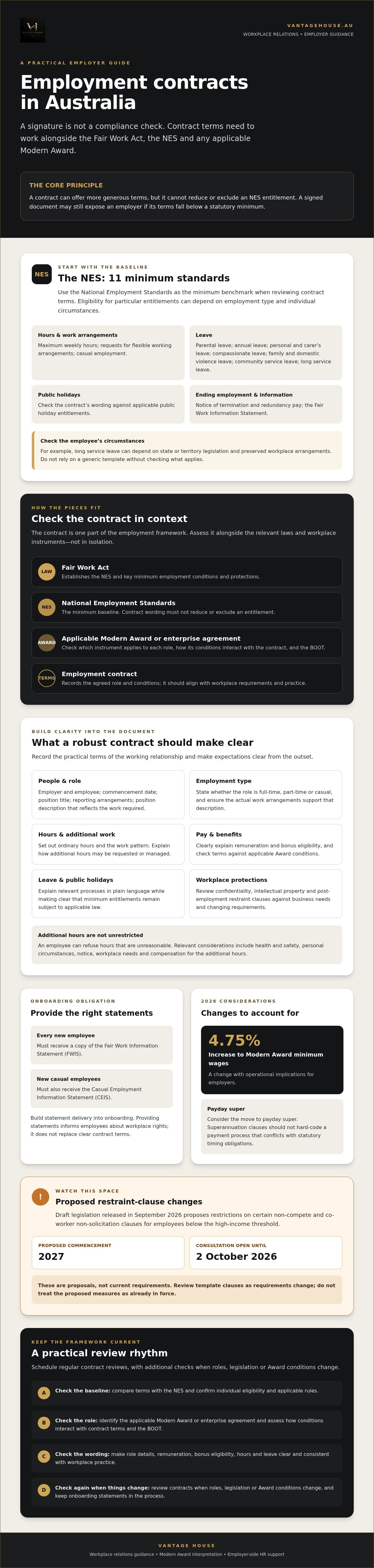
For employers, that interaction can complicate hiring. Different roles and employment types may need different terms, and a contract can’t override the 11 minimum standards in the NES. In 2026, changes such as the 4.75% increase to Modern Award minimum wages and the move to payday super add operational considerations.
This guide covers the relationship between contracts and Awards, core employer obligations, and practical ways to reduce compliance risk and workplace friction. It also sets out steps for building a consistent framework that reflects your business needs. Vantage House provides workplace relations guidance, including Modern Award interpretation and employer-side HR support, to help businesses assess complex compliance questions and align contract terms with workplace practices.
Key Takeaways
- Use the NES as the minimum baseline when checking contract terms against employer obligations.
- Build an employment contract australia framework that records key role details and clearly explains remuneration and bonus eligibility.
- Check which Modern Award applies to each role and how Award conditions interact with contractual terms and the BOOT.
- Review confidentiality, intellectual property and post-employment restraint clauses against business needs and changing requirements.
- Schedule regular contract reviews, with additional checks when roles, legislation or Award conditions change.
The Foundation of Australian Employment Law and the NES
For employers searching “employment contract australia”, the practical starting point is the National Employment Standards (NES). These 11 minimum standards form a statutory baseline for national system employees, although eligibility for particular entitlements can depend on employment type and circumstances. A contract may offer more generous terms, but it can’t reduce or exclude an NES entitlement.
The Fair Work Act 2009 establishes the NES and sets key minimum employment conditions and protections. Assess a contract alongside any applicable Modern Award or enterprise agreement, as well as other relevant laws. Terms that fall below a statutory minimum can create compliance risk even if the employee has signed the document. For broader context, this overview of Australian labour law outlines the framework in which employment contracts operate.
The 11 Minimum Standards Every Employer Must Know
The NES covers maximum weekly hours, requests for flexible working arrangements, casual employment, parental leave, annual leave, personal and carer’s leave, compassionate leave and family and domestic violence leave, community service leave, long service leave, public holidays, notice of termination and redundancy pay, and the Fair Work Information Statement.
Use these standards as a contract-review checklist, not as a substitute for checking individual eligibility and applicable rules. For example, review an ordinary-hours clause against the maximum-hours standard and relevant Award provisions. Leave clauses should accurately describe applicable entitlements, while termination provisions should not suggest that notice or redundancy obligations can be contracted away. Long service leave can depend on state or territory legislation and preserved workplace arrangements, so check the employee’s circumstances before relying on a generic template.
The Fair Work Information Statement
Employers must give each new employee a copy of the Fair Work Information Statement (FWIS). New casual employees must also receive the Casual Employment Information Statement (CEIS). Build these steps into onboarding so the statements are provided at the required time, rather than relying on a manager to remember after the employee starts.
Providing the statements doesn’t replace clear contract terms. The statements give employees information about workplace rights, while the contract records the agreed role and conditions. Failing to meet these disclosure obligations can amount to a breach of the Fair Work Act and add to an employer’s compliance exposure. Sound onboarding administration remains essential.
In 2026, check that standard wording still reflects current requirements. For example, superannuation clauses should not hard-code a payment process that conflicts with statutory timing obligations. Draft legislation released in September 2026 proposes restrictions on certain non-compete and co-worker non-solicitation clauses for employees below the high-income threshold, with proposed commencement in 2027 and consultation open until 2 October 2026. These are proposals, not current requirements, but they are a reason to review template clauses rather than assume they will remain suitable.
Essential Components of a Robust Employment Contract
A well-structured employment contract records the practical terms of the working relationship and makes expectations clear from the outset. Identify the employer and employee, commencement date, position title, reporting arrangements and a position description that reflects the work required. If duties may evolve, describe the role’s scope without making it so broad that it no longer matches the position.
Set out ordinary hours, the work pattern and how additional hours may be requested or managed. Under the Fair Work Act, an employee can refuse hours that are unreasonable. Relevant considerations include health and safety, personal circumstances, notice, workplace needs and compensation for the additional hours. Clear wording helps managers apply the clause consistently instead of treating it as an unrestricted requirement.
Address leave and public holidays in plain terms, while making clear that minimum entitlements remain subject to applicable law. The National Employment Standards (NES) provide the baseline. A contract can explain internal processes for requesting leave and notifying the employer of an absence, but it shouldn’t suggest that an employee has fewer statutory rights.
Defining the Employment Relationship Type
State whether the role is full-time, part-time or casual, and ensure the actual work arrangements support that description. For part-time employees, record the agreed hours and pattern. For casual employees, don’t rely on the label alone: the working relationship and applicable legal tests matter. Fixed-term contracts specify an end date or event, while maximum-term contracts may allow earlier termination under their terms. Check current limits and information requirements before using either arrangement.
Calling a worker a contractor doesn’t determine their legal status. The substance of the relationship matters, including the rights and obligations created by the agreement and how the work is performed. Misrepresenting an employment relationship as contracting can amount to sham contracting, so assess the arrangement before issuing documents.
Remuneration and Superannuation Compliance
Specify whether pay is an hourly rate or salary, the payment cycle, superannuation and any bonus eligibility. Check the employee’s classification and applicable Modern Award before setting the base rate. From the first full pay period on or after 1 July 2026, Modern Award minimum wages increased by 4.75%. Check rates against the correct Award rather than relying on an older template.
The superannuation guarantee rate is 12%. Since payday super began on 1 July 2026, clauses and payroll processes should accommodate contributions aligned with payday, generally reaching the employee’s fund within seven business days. Refer to statutory requirements rather than hard-coding a rate that may change. Describe salary review timing without promising an increase, and state whether a performance bonus is discretionary, how eligibility is assessed and when it is paid.
For an employment contract australia review involving Award interpretation and workplace practices, employers can consider Vantage House’s workplace relations advisory as part of a broader compliance process.
Navigating the Hierarchy: Contracts vs. Modern Awards
An employment contract operates within a wider framework of workplace obligations. The NES set the minimum floor. Where a Modern Award or enterprise agreement applies, its relevant terms must also be observed. A contract can provide more favourable conditions, but it can’t remove an applicable entitlement by stating a different arrangement. Identify which instruments cover each role, then check that the contract and payroll practices are consistent with them.
Modern Awards cover employees in specified industries and occupations. Coverage and classification depend on the Award’s terms and the work performed, not just the job title. An employee’s duties, responsibilities and relevant qualifications can affect their classification. If the role changes, reassess the classification and applicable pay conditions, then update records and contract details where needed. An outdated classification can create underpayment risk.
Award Interpretation and Classification
Review the coverage provisions of potentially relevant Awards against the employer’s industry and the employee’s actual duties. Then check the Award’s classification descriptions and associated conditions. If coverage is unclear, document the basis for the decision and seek advice before relying on a broad or generic classification. For complex coverage questions, workplace relations advisory australia can help employers assess the issue as part of a structured compliance review.
The BOOT and Set-Off Clauses
The Better Off Overall Test (BOOT) is relevant when the Fair Work Commission assesses an enterprise agreement against the applicable Modern Award. It is not a general test that makes an individual employment contract compliant. An above-Award salary alone doesn’t establish that every Award obligation has been met. The underlying entitlements and working arrangements still matter.
A set-off clause may describe how an over-Award payment is intended to satisfy specified Award obligations. Make it precise: identify the payment, the obligations it is intended to cover and the period for comparison. Broad wording that refers to “all entitlements” without explaining what is covered may create uncertainty. The contract shouldn’t imply that a salary automatically absorbs every possible payment or allowance.
- Check applicable Award rates, classifications, allowances and penalty-related obligations against actual work and pay records.
- Reconcile remuneration against those obligations regularly, and when duties, hours or Award conditions change.
- When a classification changes, confirm the effective date and review any resulting pay differences rather than relying on the previous contract wording.
This instrument-by-instrument review gives employers a clearer basis for managing employment contract australia requirements and reducing avoidable workplace relations friction.
Strategic Risk Management Through Contractual Clauses
Well-designed clauses should protect legitimate business interests while remaining workable in day-to-day operations. A clause that is too broad can create uncertainty and damage trust without providing reliable protection. For an employment contract australia framework, assess each term against the role, the information or relationships at risk, and how the organisation operates.
Confidentiality and Intellectual Property
Define confidential information to reflect how the business works, including sensitive material stored in shared drives, messaging platforms, cloud systems and devices used for remote work. Clarify that the ordinary skills and experience an employee carries between roles are not confidential information. For intellectual property, specify which work created as part of the employee’s duties is assigned to the employer, and identify any relevant pre-existing material or agreed exceptions.
Include practical exit steps: return devices, keys and documents, remove business data from personal accounts where appropriate, and hand over access credentials through secure processes. A clause is more useful when managers can apply it consistently.
Restrictive Covenants and the Right to Disconnect
Non-compete and non-solicitation restraints should be tied to a genuine business interest, such as protecting confidential information or established customer relationships. Consider the employee’s role and the restraint’s duration, geographic reach and restricted activities. Cascading clauses can set out alternative limits, such as shorter periods or narrower locations, if a broader option is found unenforceable. They don’t guarantee enforceability, so avoid restrictions that go beyond what the business can reasonably justify.
There is also a proposed 2026 reform to consider. Draft legislation released in September proposes banning non-compete and co-worker non-solicitation clauses for employees earning below the high-income threshold, with changes expected from 2027 if enacted. Consultation is open until 2 October 2026. Treat this as a proposal, not current law, and review restraint templates as the position develops.
Contract wording and workplace practices should also respect the Fair Work Act right to disconnect. Employees may refuse to monitor, read or respond to work contact outside working hours unless that refusal is unreasonable. Set clear expectations for genuine out-of-hours requirements and escalation, rather than suggesting employees must always be available.
Termination and Discipline Frameworks
Explain notice requirements and disciplinary processes clearly. Contractual notice can exceed statutory minimums, but shouldn’t provide less than the applicable Fair Work Act entitlement. Describe serious misconduct by reference to applicable legal standards and avoid implying that every breach automatically permits summary dismissal. A fair, consistent process supports sound decisions and business continuity.
For a structured review of contract clauses and workplace relations risks, speak with Vantage House about workplace relations advisory.
Implementing a Rigorous Contract Review Process
Contracts need ongoing oversight, not just a final check at hiring. Set an annual review date for employment contracts and related policies, then add event-based reviews when an employee is promoted, duties change, an Award is updated or legislation changes. This repeatable process helps check that written terms still match the work being performed and the organisation’s practices.
A structured employment contract australia review should leave a clear record of what was checked, who approved changes and what follow-up is required. That record supports consistent decisions and can help identify issues before they become wider workplace relations concerns.
The Compliance Audit Framework
Review contracts against current Fair Work requirements, applicable Awards and the employee’s actual role. Check that classifications remain appropriate and pay rates reflect current minimums, including changes made through annual wage reviews. Compare payroll records with the obligations that apply to each role, and verify that onboarding statements and signed contract versions are recorded.
Keep an audit register with the review date, documents examined, identified gaps, responsible owner and resolution. Vantage House’s workplace relations governance advisory can support employers assessing complex compliance risks and aligning contract practices with workplace culture.
Managing Contract Variations
Promotions and changes to hours, reporting lines or remuneration may call for a written variation. Significant contractual changes generally require the employee’s agreement. Explain the proposed change, its commencement date and any affected terms, then retain evidence of the employee’s acceptance. A variation letter may suit a change to specific terms; a new contract may be clearer when the role or arrangement has been substantially restructured.
Whichever document you use, state which earlier terms remain in effect and avoid wording that suggests the employee’s service has restarted. Preserve the original commencement date and continuity of service unless there is a legally valid reason to treat the arrangement differently. Don’t assume a broad variation clause permits every change without agreement.
- Record the business reason and approval for each variation.
- Provide the employee with the final signed document and retain a copy in the personnel record.
- Update payroll and HR records so the change is applied consistently from its effective date.
Regular reviews make contract management a practical governance process. They help employers keep documents current, decisions traceable and employment arrangements aligned with compliance obligations and operational needs.
Employment Contract Australia: Build a Framework That Keeps Pace
A reliable employment contract australia framework is not a one-off drafting exercise. It depends on clear terms, accurate Award coverage and a review process that responds as roles, pay conditions and workplace requirements change. Treating contracts as part of workplace governance helps employers make decisions consistently and reduce avoidable friction.
A practical approach is to ensure terms meet the NES baseline, check contractual pay and conditions against applicable instruments, and make changes transparently with clear records. Clauses protecting information, defining expectations and setting out termination processes should reflect how the organisation works, not simply copy a template. Alignment between written terms and workplace practices also helps create consistent expectations for managers and employees.
Where Award interpretation or broader compliance questions need careful assessment, Vantage House provides workplace relations guidance, Modern Award interpretation and employer-side HR support. Contact Vantage House about workplace relations advisory to discuss a contract review process that supports compliance and your business objectives.
Frequently Asked Questions
What is the difference between an employment contract and a Modern Award?
An employment contract records the agreed terms between an employer and an employee, while a Modern Award sets minimum conditions for covered employees in particular industries or occupations. An Award may set pay rates, classifications, penalty rates and other conditions that apply alongside the contract. For an employment contract australia review, check the employee’s actual duties and the relevant Award. A contract can offer better terms, but it can’t remove applicable minimum entitlements.
Can a contract provide less than the National Employment Standards?
No. The National Employment Standards (NES) are minimum entitlements under the Fair Work Act, and a contract can’t provide less or exclude them. A clause that appears to reduce an NES entitlement doesn’t remove the employer’s obligation to meet the applicable minimum. Check the employee’s circumstances as well as the wording, since eligibility for some entitlements depends on factors such as employment type or length of service. The contract may provide more favourable conditions.
Is a written employment contract mandatory in Australia?
Generally, there’s no requirement under the Fair Work Act for every employment contract to be written. However, employers must provide new employees with the Fair Work Information Statement, and new casual employees must also receive the Casual Employment Information Statement. A written contract is practical because it records agreed terms, supports consistent administration and clarifies expectations about duties, hours and pay. Check whether an Award, agreement or other applicable requirement calls for additional written information.
What happens if an employment contract is inconsistent with an Award?
A contract can’t be used to contract out of an applicable Modern Award. If its terms provide less than an Award entitlement, the employer may still need to meet the Award and address any resulting pay or conditions shortfall. Identify the relevant Award and classification, then compare its requirements with the contract and actual work practices. Don’t assume an above-Award salary resolves every difference; any set-off arrangement needs careful wording and regular checks against entitlements.
How often should Australian employers review their employment contracts?
Review contracts at least annually and when a relevant change occurs. Triggers include a promotion, changed duties or hours, an Award update, a pay review or a legislative change. Compare written terms with current role requirements and payroll practices, then record gaps, decisions and follow-up actions. A scheduled review helps keep documents current, while event-based checks reduce the risk of relying on terms that no longer reflect the employee’s work.
What are cascading clauses in a restraint of trade agreement?
Cascading clauses set out alternative restraint limits, often with different durations, geographic areas or restricted activities. If a broader option is unenforceable, the drafting aims to leave a narrower alternative for consideration. This structure doesn’t guarantee that any restraint will be enforceable. Employers should identify the business interest they need to protect, such as confidential information or customer relationships, and tailor the restriction to the role and circumstances.
Can I change an employee’s contract without their consent?
Significant changes to agreed contractual terms generally require the employee’s agreement. Explain the proposed change, why it’s being made and when it would take effect, then keep a record of acceptance. A contract may allow some variation, but that doesn’t automatically permit every change or override workplace laws and applicable Award conditions. For limited changes, a written variation may be appropriate; more substantial changes may call for a replacement contract that clearly preserves service continuity.
What is a set-off clause and why is it important for payroll compliance?
A set-off clause describes how an over-Award payment, such as a salary, is intended to satisfy specified Award obligations. It should identify the payment, the entitlements it covers and the period used for comparison. General wording may not make clear which obligations are being offset. Regularly reconcile actual pay and hours against applicable Award rates, allowances and other entitlements, and investigate any shortfall rather than assuming the salary covers every liability.


